

A delayed or cancelled flight can mean very different things depending on where you took off from. The rules around flight delay cancellation compensation are not one global standard. Fly out of the US and you’re working with a refund system. Fly out of the EU or UK and you may be owed a fixed cash payment on top of getting to your destination. Knowing which set of rules applies to your trip is the difference between walking away with nothing and walking away with real money.
| Quick Answer Flying from the US: No fixed cash payout for a delay itself, but airlines must automatically refund you if your flight is cancelled or significantly changed and you choose not to fly. Flying from the EU or UK: Fixed compensation of €250 to €600 (£220 to £520) for delays of 3 or more hours, cancellations, or denied boarding, when the cause was within the airline’s control. Either way: A refund and compensation are legally different things, and depending on what happened, you could be owed one, the other, or both. |
Refund vs Compensation
| Definition Refund: Money you already paid, returned to you because you didn’t take the flight it was paying for. Compensation: An additional cash payment for the inconvenience of a disruption, separate from and on top of any refund or rerouting you’re owed. |
The two get used interchangeably in casual conversation, but they’re legally distinct in both the US and the EU/UK systems. Mixing them up is the single biggest source of confusion around passenger rights, and it’s worth keeping the distinction in mind as you read the rest of this guide.
If You Flew From the US: DOT Refund Rules
Under a Department of Transportation rule codified at 14 CFR 259.5, effective since October 28, 2024, US airlines must issue automatic cash refunds, not vouchers or credits, when a flight is cancelled or significantly changed and the passenger decides not to fly. The refund goes back to your original payment method without you having to request it or navigate a phone tree. Full details are on the official DOT flightrights.gov page.
What Qualifies
- Your flight is cancelled and you don’t take a replacement
- Your flight is significantly changed, meaning roughly a 3 or more hour schedule shift for domestic flights or 6 or more hours for international flights, among other qualifying changes, and you decline the new itinerary
- The refund is automatic and cash by default, back to your original payment method, rather than a credit you have to ask for
What’s Not Included
- There’s no separate cash payment simply for the inconvenience of a delay, the way EU261 and UK261 provide. A refund returns your money; it isn’t an extra payout on top
- Meals, hotels, or other incidental costs during a delay aren’t guaranteed by this rule specifically. Some airlines cover them voluntarily under their own contract of carriage, and it’s worth checking that document for your specific airline
- Denied boarding runs on its own separate rule, covered next
If You Flew From the EU or UK: EU261/UK261 Compensation
EC Regulation 261/2004, generally known as EU261, has set fixed compensation amounts for qualifying flight disruptions since 2004, and those amounts haven’t changed since. The UK runs a near-identical version, UK261, in British pounds rather than euros, following the UK’s departure from the EU. Full detail on the EU version is on the European Commission’s EU261 page.
Amounts by Distance
| Flight Distance | EU261 | UK261 |
|---|---|---|
| Up to 1,500 km | €250 | £220 |
| 1,500 to 3,500 km | €400 | £350 |
| Over 3,500 km | €600 | £520 |
One nuance worth knowing: a long flight that stays entirely within the EU or UK is capped at the middle tier even if the distance technically crosses into the top band, since the rule treats intra-bloc flights differently from genuinely long-haul ones. If your route is unusual, an official calculator is more reliable than doing the geography yourself.
The 3-Hour Threshold
Compensation kicks in once you arrive at your final destination 3 or more hours later than scheduled, whether that’s from a delay, a cancellation, or being denied boarding, and only when the cause was within the airline’s control. Arrival time means the moment the aircraft door opens, not when the wheels touch down, which matters for delays that land close to the 3 hour line.
Rerouting Rights
Separate from cash compensation, airlines must still offer a choice when a flight is cancelled or significantly disrupted: a full refund, rerouting to your destination at the earliest opportunity, or rerouting at a later date of your choosing. While you wait, you’re also entitled to reasonable care such as meals and, for overnight disruptions, a hotel. These rerouting and care obligations apply even when extraordinary circumstances rule out the cash compensation itself.
If you’re new to flying internationally and want the broader picture beyond compensation rules, our first-time international travel guide covers the basics worth knowing before you go.
Denied Boarding Compensation
Being involuntarily bumped from an oversold flight is treated as its own category, separate from general delay or cancellation rules, in both systems.
In the US, denied boarding compensation runs under 14 CFR 250, currently set at 200 percent of your one-way fare, capped at $1,075, if you’re rebooked to arrive within a shorter window of the delay thresholds in the rule, or 400 percent of your fare, capped at $2,150, if the rebooking arrives later than that. These dollar caps are adjusted periodically by DOT, so treat them as the current figures rather than a permanent number. This only applies to involuntary bumping from an oversold flight, not to a flight that’s simply delayed or cancelled for other reasons.
In the EU and UK, denied boarding is folded into the same EU261/UK261 framework as delays and cancellations. The same distance-based amounts from the table above apply, plus the same rerouting and care obligations, rather than a separate formula.
What Counts as a Significant Delay or Change
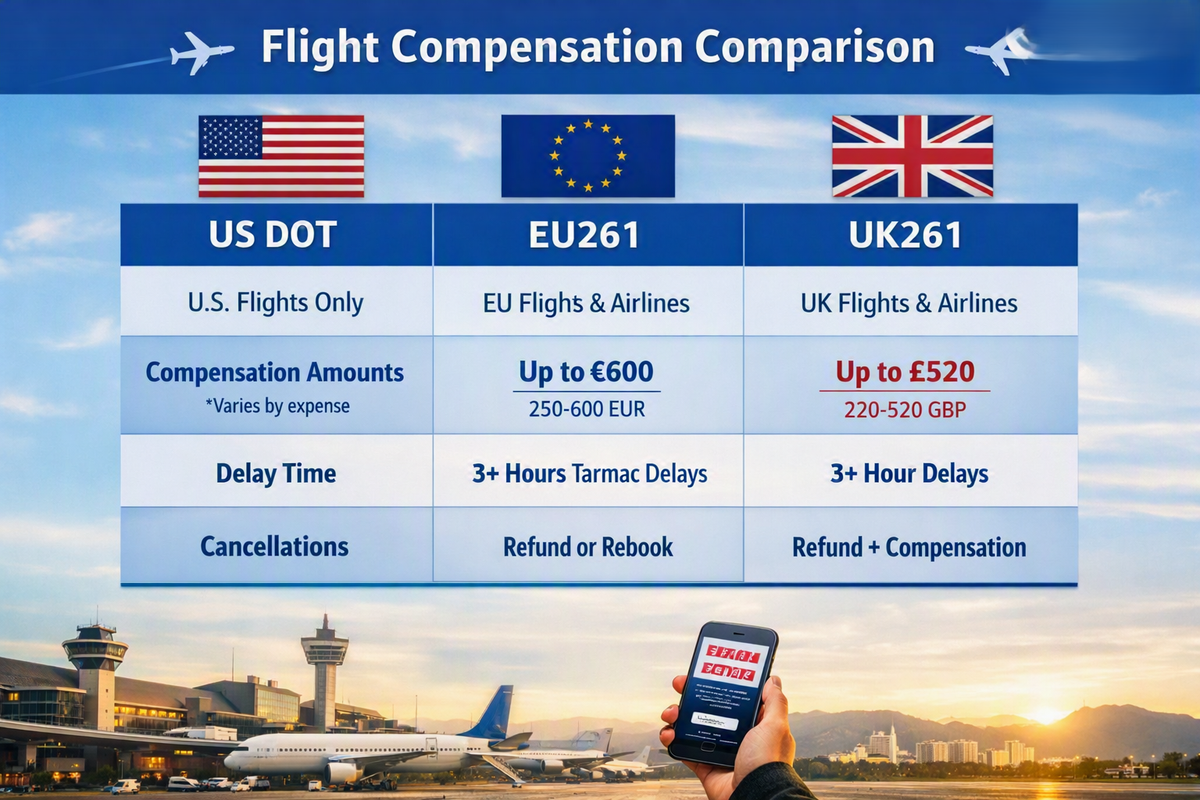
This is where the US and EU/UK systems diverge the most, and it’s worth seeing side by side.
| United States | EU261 | UK261 | |
|---|---|---|---|
| What triggers it | Cancellation, or a schedule change of roughly 3+ hours domestic / 6+ hours international, if you decline to fly | Arrival 3+ hours late, cancellation, or denied boarding, within the airline’s control | Same triggers as EU261, under UK law |
| What you get | A refund of the fare paid | €250 to €600 cash compensation by distance | £220 to £520 cash compensation by distance |
| Does a short delay alone qualify | No, only cancellation or a significant change | Yes, once the 3 hour arrival threshold is met | Yes, once the 3 hour arrival threshold is met |
| Extraordinary circumstances | Doesn’t apply the same way; the refund is owed regardless of cause | Removes compensation, not rerouting or refund rights | Removes compensation, not rerouting or refund rights |
Why This Matters for Flight Delay and Cancellation Compensation Eligibility
The US measures a schedule change against your original booking. The EU and UK measure your actual arrival delay against your original schedule. That’s a subtle difference, but it’s exactly why a 3 hour delay departing from the US and a 3 hour delay departing from Paris can lead to completely different outcomes for the same length of disruption.

How to File a Flight Delay and Cancellation Compensation Claim, Step by Step
- Confirm which system applies to your flight, based on where it departed and which airline operated it.
- Gather documentation: your boarding pass, booking confirmation, and any written record of the delay reason or schedule change from the airline.
- Check your eligibility against the thresholds above, or run your flight through a calculator built for this specifically rather than doing the math by hand.
- File directly with the airline first, through its official claims or customer relations channel. This keeps 100 percent of any payout, rather than handing a percentage to a third party.
- Note that response deadlines vary by airline and by jurisdiction, so check the specific policy that applies to your claim rather than assuming a fixed number. If the airline denies a valid claim or goes silent, escalate to the relevant regulator: the DOT for US refund complaints, or the applicable national enforcement body for EU261 and UK261 claims.
- If you’d rather not handle the correspondence yourself, or the airline is pushing back on a claim you believe is valid, a service that files on your behalf for a percentage of the payout is a reasonable trade-off for the time saved.
Our own flight compensation calculator walks through steps 1 and 3 automatically if you’d rather not cross-reference tables by hand.
Extraordinary Circumstances: When Airlines Don’t Have to Pay
Both the EU/UK compensation systems and, informally, the goodwill practices of US airlines carve out situations genuinely outside an airline’s control. These typically include:
- Severe weather that actually prevents safe operation, not just weather that makes flying inconvenient
- Air traffic control restrictions or strikes that are outside the airline’s own operations
- Security threats, airport closures, or acts of terrorism
- Political instability affecting the route or destination
- A safety defect discovered during a mandatory inspection that the airline couldn’t have caught during routine maintenance
What doesn’t usually count, despite airlines sometimes claiming otherwise: most routine technical or mechanical problems, crew scheduling issues, and strikes by the airline’s own staff. Those are generally treated as within the airline’s control, meaning compensation still applies under EU261 and UK261.
Looking Ahead: The EU261 Reform Coming in 2027
A reform to EU261 passed a European Parliament vote in July 2026. It is not in force yet, and it isn’t expected to apply until the second half of 2027. Nothing about the numbers in this guide changes because of it.
The reform keeps the existing compensation amounts and the 3-hour delay threshold exactly as they are today. What it adds are secondary protections: a guaranteed free cabin bag included in the base fare, faster requirements for how quickly airlines must respond to a claim, and a ban on no-show clauses that currently let some airlines cancel your return flight if you don’t use an earlier leg of the same booking. These are meaningful improvements, but they sit alongside the current rules rather than replacing them.
If you’re reading this well into 2027 or later, it’s worth a quick check of whether that implementation has taken effect yet, since the transition depends on final rollout timing that wasn’t locked in as of the July 2026 vote. Until you see confirmation it’s live, assume the compensation amounts and threshold described earlier in this guide are what apply to your flight.
If a disruption is reshaping your Europe itinerary in the meantime, our guide to cheap travel in Europe can help you rebuild a budget around it.
Common Mistakes
- Accepting a travel voucher on the spot without reading what you’re agreeing to. In some cases this can affect your right to a cash refund, so it’s worth asking directly whether accepting it waives anything before you say yes
- Not knowing about the extraordinary circumstances exceptions, and assuming any long delay automatically means a payout
- Missing the filing window because you assumed a deadline instead of checking the one that actually applies to your airline and jurisdiction
- Assuming a long delay on a US domestic flight comes with the same kind of cash compensation that EU261 or UK261 would provide. It doesn’t, outside the separate denied boarding rule
Pro Tips
- Run your flight through an official or purpose-built calculator to check eligibility before assuming you do or don’t qualify. It accounts for distance bands and thresholds more reliably than doing it manually
- Get the delay or cancellation reason in writing from the airline. This becomes the central piece of evidence if a claim is disputed later
- Keep your boarding passes and any receipts for meals or a hotel during the disruption. EU261 and UK261 care entitlements can cover these separately from the compensation itself
File directly with the airline before turning to a third-party claims company. If the airline is dragging its feet or denying a claim you’re confident is valid, a service like AirHelp can take it over for a percentage of the payout, which is a fair trade if it saves you from a drawn-out dispute.
If a cancellation leaves you rebooking from scratch, comparing flights for the new dates quickly can beat whatever limited options the airline’s own rebooking tool shows you first.
For the costs neither system fully covers, like a short US delay that doesn’t trigger a refund at all, travel insurance is worth having in place before you fly, not after something goes wrong.
Frequently Asked Questions
How much compensation can I get for a delayed flight?
It depends entirely on where you flew from. Departing the EU or UK, a delay of 3 or more hours can mean €250 to €600 (£220 to £520) depending on distance. Departing the US, there’s no equivalent cash payout for a delay alone, though you’re entitled to a refund if the flight is cancelled or significantly changed and you choose not to fly.
Does the US have flight delay compensation like Europe?
No. The US relies on a refund model rather than a compensation model. Airlines must return your money for a cancelled or significantly changed flight you don’t take, but there’s no fixed cash payment for inconvenience the way EU261 and UK261 provide, outside the separate case of involuntary denied boarding.
What counts as a significant flight delay?
In the US, it generally means a schedule change of roughly 3 or more hours for domestic flights or 6 or more hours for international flights, among other qualifying changes. In the EU and UK, compensation eligibility is based on arriving at your final destination 3 or more hours late.
Do I get compensation if my flight is cancelled due to weather?
Usually not, in either system, since severe weather that genuinely prevents safe operation typically counts as an extraordinary circumstance. You’re still entitled to a refund or rerouting, and to care like meals or a hotel under EU261 and UK261, just not the cash compensation itself.
How long do I have to file a flight compensation claim?
It varies by airline and jurisdiction, so there’s no single universal deadline to rely on. Check the specific airline’s policy or the relevant regulator’s guidance for your claim rather than assuming a fixed window.
What’s the difference between a refund and compensation?
A refund gives back money you already paid for a flight you didn’t take. Compensation is an extra payment for the inconvenience of a disruption, separate from anything you’re refunded. You can be entitled to one, the other, or both depending on the situation.
Can I claim compensation and still take the rebooked flight?
Yes, under EU261 and UK261. Compensation for the disruption and getting rerouted to your destination are separate entitlements, so accepting a replacement flight doesn’t waive your right to compensation if you otherwise qualify.
What is EU261 and does it apply to me?
EU261 is the European Union regulation governing flight delay, cancellation, and denied boarding compensation. It applies to flights departing an EU airport on any airline, and to flights arriving in the EU on an EU-based carrier, regardless of your nationality or where you live.
Key Takeaways
- A refund and compensation are legally different things in both the US and the EU/UK, and knowing which one applies changes what you should actually ask for.
- The US guarantees automatic refunds for cancelled or significantly changed flights you don’t take, but no EU-style cash payout for delays alone.
- The EU and UK guarantee €250 to €600 (£220 to £520) in compensation for qualifying delays, cancellations, and denied boarding, unless extraordinary circumstances apply.
- Denied boarding is its own mechanism in both systems, separate from general delay or cancellation rules.
- An EU261 reform in progress changes secondary protections, not the compensation amounts or the 3-hour threshold described in this guide. See Looking Ahead below for timing.
For more practical, fact-checked planning guides like this one, browse our full Travel Tips hub, or start your next search with our guide to finding cheap flights.