
© Hidden Travels. By Shagufta Bashir — Inspiring journeys worldwide. All rights reserved.
Know Before You Book
Entry & Visa Requirements Checker
A free, worldwide visa checker covering 60+ passports and 65+ destinations. Select your passport and your destination to find out - in plain language - whether you need a visa, an e-Visa, a visa on arrival, or nothing at all.
—
—
—
Typical Length of Stay
—
Documents Usually Needed
Please read before you book: This checker is not connected to a live government database - no free public tool is. It gives a fast, general first read based on publicly known visa policy patterns for each passport-destination pair, grouped by category rather than pulled from an official real-time feed. Immigration rules change, sometimes with little notice, and individual circumstances (previous travel history, criminal record, dual nationality, and more) can change your outcome. Always confirm final requirements directly with the destination's official immigration website or nearest embassy before booking non-refundable travel.
You have found the flight. The dates line up, the price is right, and your finger is hovering over "Book Now." Then a thought stops you: do I actually need a visa for this? It's one of the most common - and most costly - gaps in trip planning. Every year, travelers arrive at check-in counters only to be told they can't board, because nobody checked entry requirements before the tickets were purchased.
This free entry and visa requirements checker takes the guesswork out of that moment. Select your passport and your destination above, and get a clear, plain-language answer: visa-free, e-Visa, visa on arrival, an electronic travel authorization, or a full visa application. No jargon, no forty-tab government website marathon - just the answer you need, in seconds.
Quick Answer
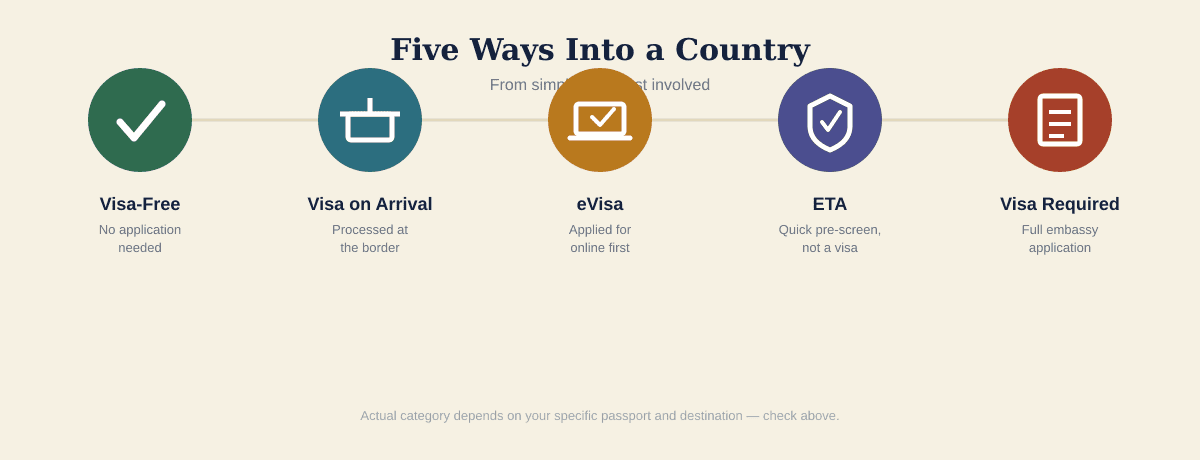
Whether you need a visa depends entirely on your specific passport and your specific destination - there's no single rule that applies to every traveler. Entry requirements generally fall into five categories: visa-free (no application needed), visa on arrival (a short process at the border), an eVisa (applied for online in advance), an Electronic Travel Authorization like ESTA, eTA, or ETIAS (a lightweight pre-screening for already visa-exempt nationalities), or a full visa (an embassy application). Use the checker above for your exact passport-destination pair, then confirm with the destination's official immigration source before booking.
How This Visa Requirements Checker Works
Using the tool is simple, and it's built for the moment you're actually planning a trip - not for immigration lawyers.
- Choose your passport. Select the country that issued your passport, not necessarily where you currently live.
- Choose your destination. Pick the country you're planning to visit.
- Get your result. The tool instantly shows your entry category, a typical length of stay, and the documents travelers in your situation usually need to bring.
Behind the scenes, the checker draws on publicly known visa policy patterns for each passport-destination pair. Because these rules are set by individual governments and can change without much warning, we've built the tool to be a fast first check, not a final legal answer. Below every result, we point you toward verifying with the destination's official immigration authority before you book anything non-refundable.
Why Checking Visa Requirements Before You Book Actually Matters
It's tempting to treat visas as a formality you'll sort out later. In practice, entry requirements affect three things that are much harder to fix after the fact: your budget, your timeline, and whether you board the plane at all.
Some e-Visas and full visa applications take days or weeks to process, and a handful of embassies require in-person appointments that book out months in advance. If you check requirements after buying a non-refundable ticket, you may be racing a clock you can't win. Airlines are also legally required to confirm passengers have permission to enter their destination - if you show up without the right documentation, you can be denied boarding at the gate, not just at immigration on the other end.
The disruption risk runs both ways, too. If your own flight ends up delayed, cancelled, or overbooked, it's worth checking whether you're owed anything - our free flight compensation calculator estimates what you may be entitled to, and services like AirHelp can handle the claims paperwork on your behalf.
There's a cost side too. Some entry categories are free; others carry government fees, service charges, or requirements like proof of funds or travel insurance that are far easier to budget for when you learn about them in week one of planning, not the night before your flight. Checking early doesn't just prevent disaster — it lets you plan realistically and travel with one less thing to worry about.
Types of Entry Requirements Explained: Visa-Free, e-Visa, Visa on Arrival & More
Not every "you can go" answer means the same thing. Here's what each entry category actually means for how you plan and pack.
Visa-Free Entry
This is the simplest category: your passport lets you enter for tourism without applying for anything in advance. You'll usually still need a passport valid for several months beyond your stay, and immigration officers can still ask for a return ticket or proof you can support yourself. Visa-free doesn't mean requirement-free - it means no separate application.
Visa on Arrival
You don't apply before you travel, but you do complete a short process at the airport or border - usually a form, a fee (often payable in cash), and sometimes a passport photo. It's more convenient than a full visa application, but it adds time at arrival, so it's worth knowing about before you land with a tight connection.
Electronic Visas (e-Visas)
An e-Visa is applied for entirely online, usually a few days to a few weeks before departure. You fill out a form, upload a scanned passport and photo, pay a fee, and receive an approval by email that you print or show on your phone. It has become the most common entry category for countries that want more control over who's arriving than visa-free entry allows, without the overhead of a full embassy visa.
Electronic Travel Authorizations (ETA, ESTA, ETIAS)
An ETA looks similar to an e-Visa but works differently - it's a lightweight security pre-screening, not a visa. Programs like the United States' ESTA, Canada's eTA, the UK's ETA, and Europe's upcoming ETIAS exist specifically for nationalities that were previously visa-free, adding a quick background check without adding a full application process. They're usually inexpensive, fast to approve, and valid for multiple trips over one to a few years. If your nationality already required a visa before these programs existed, an ETA typically doesn't apply to you - you'll still need the full visa.
Full Visa Required
This is the most involved category: an application submitted to an embassy or consulate, often with an in-person appointment, biometric data, supporting documents, and a longer processing window. It's also the category where planning ahead matters most - some tourist visas take weeks to process, and appointment slots at busy embassies can be booked out well in advance. If the paperwork feels overwhelming, our travel planning services can help you work through a full application without missing a step.
Common Visa Mistakes That Get Travelers Stopped at the Airport
Most visa problems aren't about being denied a visa - they're about a small, avoidable mistake. These are the ones we see most often:
- Booking before checking. Non-refundable flights get purchased before anyone confirms entry requirements, turning a five-minute check into an expensive lesson.
- Passport validity rules. Many countries require six months of validity beyond your return date - not just that your passport hasn't technically expired.
- Confusing transit with entry. "I'm just changing planes" doesn't always mean no paperwork - some countries require a transit visa even if you never leave the airport, depending on your nationality and layover length.
- Assuming an ETA is instant. Electronic doesn't mean automatic. Some systems run manual checks, and approval isn't guaranteed within minutes.
- Applying for the wrong visa type. A tourist visa and a business visa are not interchangeable, even if your trip involves both a conference and a beach afterward.
- Missing blank passport pages. Some border officials require two to four fully blank visa pages — not just empty space anywhere in the passport.
- Not checking sponsorship or invitation requirements. Certain e-Visas and visa-on-arrival categories require proof of a hotel booking or a local contact that travelers only discover at the counter.
- Ignoring intermediate stops. A layover country can have its own entry rules, entirely separate from your final destination.
Each of these is fixable with a few extra minutes of research — which is exactly what this checker is designed to save you.
How Entry and Visa Rules Keep Changing Year After Year
Entry requirements shift more often than most travelers expect, and the direction of travel - no pun intended - has been consistent for several years running.
Governments are moving toward pre-screening over paperwork. More countries are replacing traditional visa categories with lightweight electronic authorizations that check who's coming before they arrive, rather than processing everyone at the border. Kenya, for example, moved its entire nationality-based visa system to a single universal electronic travel authorization that applies to every visitor, regardless of passport.
Digital nomad and remote-work visas continue to expand, as countries compete for long-stay travelers who spend locally without taking local jobs - a category that barely existed a decade ago and now covers dozens of destinations.
Verification is also getting deeper, not shallower. A growing number of application systems now request financial documentation or cross-reference other information to confirm genuine travel intent, rather than accepting a form and a fee at face value. And "electronic" increasingly doesn't mean "instant" - several pre-approval systems perform manual review on a portion of applications, which means the safe assumption for any ETA-style authorization is to apply with real buffer time, not the week before departure.
None of this makes travel harder overall - it mostly means the research happens earlier, and online, rather than in a queue at the border. The trade-off is that skipping that research now carries bigger consequences than it used to. That's exactly why we treat this page as a living resource rather than a one-time post - passport groupings and destination policies get revisited as rules move, not left to go stale. See the review note in the tool above for when this data was last checked.
Documents You Need Beyond Just the Visa
Getting an approved visa or ETA is rarely the entire story. Immigration officers at many borders can - and do — ask for supporting documents even after your entry permission is confirmed. It's worth having these ready regardless of which category your trip falls into:
- Passport validity — many countries require at least six months of validity remaining beyond your planned departure date, plus a set number of blank visa pages.
- Proof of onward or return travel - a ticket showing you're not planning to overstay, sometimes requested even for visa-free entry. Searching cashback fares on WayAway is an easy way to lock in a return ticket for an application.
- Proof of accommodation - a hotel booking or address where you'll be staying, especially common with e-Visa applications. A refundable booking through Hotellook gives you paperwork without locking you into a non-cancellable stay.
- Proof of funds - bank statements or cash showing you can support yourself for the length of your stay, more commonly requested for longer or higher-scrutiny applications.
- Travel insurance - increasingly required outright for certain visa categories, particularly across parts of Europe and the Gulf.
- Digital and printed copies - keep both. Some borders still expect a printed visa approval or itinerary, even when the official process is entirely digital.
None of these replace an actual visa where one is required — but showing up without them is one of the most common reasons approved travelers still get delayed at the border.
Does Your Passport's Strength Really Affect Your Trip?
Yes — more than most travelers realize until they're comparing notes with a friend from another country. Passport strength, usually measured by how many destinations a passport can enter visa-free or with a lightweight authorization, shapes how far in advance you need to plan, how much a trip costs before you even leave, and which destinations are realistically available on a short timeline.
Two friends booking the same trip can have completely different experiences: one clicks through an ETA in ten minutes, the other needs an embassy appointment, a set of documents, and a multi-week wait. Neither is a reflection of the traveler - it reflects the passport. This is exactly why a one-size-fits-all "top destinations" article can't tell you what you actually need to know. Checking your specific passport against your specific destination is the only way to get an answer that applies to your trip.
How We Keep This Visa Checker Accurate
Full transparency: this tool is not plugged into a government API, and no free public visa checker genuinely is. Instead, it groups passports by their general visa-free reach and matches that against each destination's publicly documented entry policy - the same kind of categorization used across the travel industry, just presented instantly instead of buried in a PDF.
That approach is fast and useful for planning, but it isn't a substitute for official confirmation, especially for less common passport-destination combinations, dual nationality, or anyone with a complicated travel history. We review and refresh the dataset periodically rather than on a fixed schedule tied to a single year, precisely because visa rules don't wait for a calendar. The current review date is shown directly beneath the checker above.
If you ever spot a route that looks out of date, we'd genuinely like to know - accuracy here is the entire point of the tool.
Frequently Asked Questions About Entry and Visa Requirements
Do I need a visa to travel abroad?
It depends entirely on your passport and your destination - there's no universal answer. Some passport-destination combinations allow visa-free entry, others require an e-Visa, visa on arrival, an electronic travel authorization, or a full visa application. Use the checker above with your specific passport and destination for an accurate starting point.
What's the difference between an e-Visa and an Electronic Travel Authorization (ETA)?
An e-Visa is a genuine visa applied for and issued online. An ETA is a lighter security pre-screening for nationalities that were already visa-free - it confirms you're not a risk, rather than granting permission you didn't already have by nationality.
How far in advance should I apply for a visa?
As early as your travel plans are confirmed. Full visa applications can take anywhere from a few days to several weeks, and embassy appointment slots in busy periods can book out well in advance. e-Visas and ETAs are usually faster, but applying at least a few weeks before departure gives you a buffer if anything is delayed or rejected the first time.
Can visa requirements change after I've already booked my flight?
Yes. Governments update entry policies with limited notice, sometimes in response to security concerns, diplomatic relations, or reciprocity with other countries. It's worth re-checking requirements a few weeks before departure, even if you confirmed them when you first booked.
Is a visa-free country really requirement-free?
No. Visa-free means you don't need to apply for permission in advance - it doesn't remove other conditions like passport validity, proof of onward travel, or proof of funds, which immigration officers can still ask for on arrival.
My layover country is different from my destination - do I still need a visa for it?
Sometimes, yes. Some countries require a transit visa depending on your nationality, how long your layover is, and whether you leave the airport. Always check the transit country's rules separately from your final destination's.
How accurate is this visa checker tool?
It's designed to give you a fast, reliable first read based on publicly known visa policy patterns for each passport and destination. Visa rules can change, and some situations involve exceptions specific to bilateral agreements or individual circumstances. Always confirm final details with the destination country's official immigration website or nearest embassy before booking non-refundable travel.
Continue Planning Your Trip
Once your entry requirements are settled, the rest of the planning gets a lot easier. These are the tools we'd reach for next:
A visa check takes less time than choosing a seat number - and it's the one step in trip planning that can quietly derail everything else if it's skipped. Run your passport and destination through the checker above before you book, then check again a few weeks before departure if your plans or the destination's rules have shifted. Once your entry requirements are confirmed, you can search flights with confidence on Aviasales and get on with the fun part of trip planning.
Some links on this page are affiliate links. If you book through them, Hidden Travels may earn a small commission at no extra cost to you - it never affects the information in the checker above.