
⚠️ Affiliate Disclosure: Some links in this post are affiliate links – we earn a small commission if you book through them, at no extra cost to you. We only recommend services we genuinely trust.
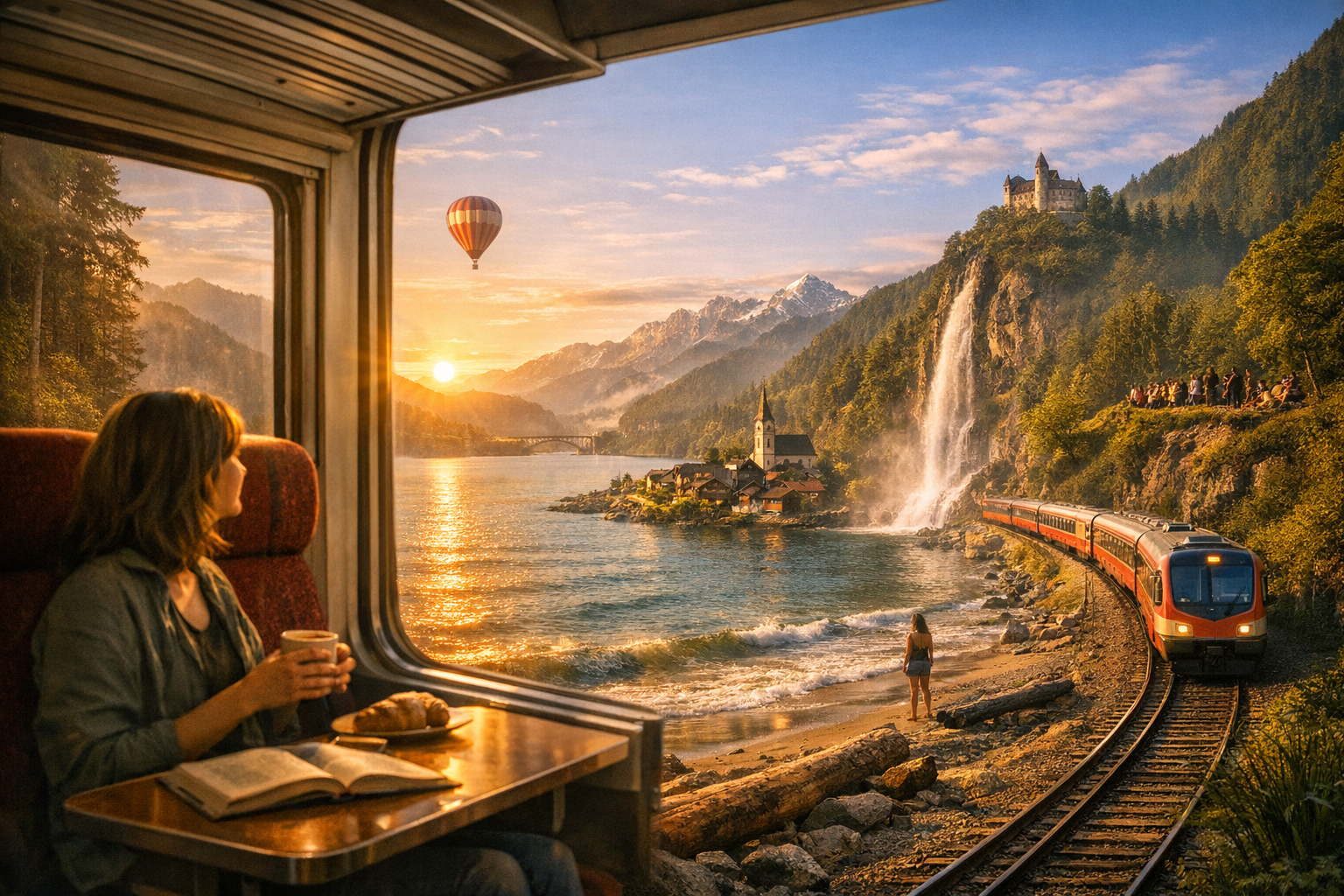
There is a specific kind of happiness that belongs exclusively to train travel. It doesn’t happen on planes, where the sky looks the same from 35,000 feet regardless of the continent below. It doesn’t happen in cars, where you’re navigating and the world outside is something you pass through rather than watch. It happens in a train window seat on a slow mountain railway in the Alps when the tunnel ends and a valley opens below you – ice-blue river, pine forest, a cluster of wooden chalets with smoke coming from a chimney – and you have absolutely nothing to do but watch it happen.
Europe has more scenic rail routes per kilometre than any continent on earth. The geography – the Alps, the Norwegian fjords, the Iberian mountains, the Scottish Highlands, the Adriatic coast – is designed, almost deliberately, for train travel. The lines were cut through impossible terrain by 19th-century engineers who were either mad or visionary, and what they built is the best way to see a continent that has been layered with human and natural history for thousands of years.
I have been making a point of taking the train across Europe whenever the schedule allows for many years. Some of these journeys I’ve done three or four times. Some I seek out specifically when the alternative would be faster. This guide covers the 12 most breathtaking train journeys in Europe – ranked not just by the scenery but by the complete experience of being on board, the ease of booking, and the specific moments that make each one worth planning a trip around.
A note on international visitors from the USA, Canada, and beyond: European train travel is one of the genuinely great pleasures available to you, and it is far more approachable and affordable than most people think before they try it. The Interrail (for European residents) and Eurail (for non-European residents) pass systems make multi-country train travel highly cost-effective. Even without a pass, individual journey prices booked in advance are often competitive with flying – with none of the airport time, the luggage restrictions, or the view.
Pro Tip: Before planning your European rail trip, use our AI Travel Budget Estimator to calculate real costs across multiple countries, and check the Live Currency Converter to compare ticket prices against your home currency in real time.
Why the Train Is the Best Way to See Europe
The case for European train travel is not primarily about sustainability, though train travel produces roughly 14 times fewer carbon emissions per passenger kilometre than flying. The case is about the experience itself – what you see, what you feel, and what you understand about a place that you can only get at ground level, at the pace of a train rather than the pace of an aircraft.
From a train window you see the edge where the city becomes its hinterland. You see the farms that feed the city, the forest that surrounds it, the mountains that shaped its character and defined its borders for centuries. You arrive at the heart of the city rather than at an airport 40 minutes from the centre. You carry as much luggage as you can lift rather than as little as the airline allows. You can eat a full meal, drink a glass of local wine, read a book, sleep, work, and watch the landscape change through all of it.
And on the routes in this guide, the landscape changing through your window is some of the most spectacular scenery on Earth.
Local Insight: The golden rule of scenic train travel: always book a window seat on the correct side of the train. For every route in this guide, I’ve specified which side gives the best views (left or right when facing the direction of travel). Getting this wrong can mean looking at a tunnel wall while the valley you came for is on the other side of the carriage. Book early so you can choose.
12 Most Breathtaking Train Journeys in Europe
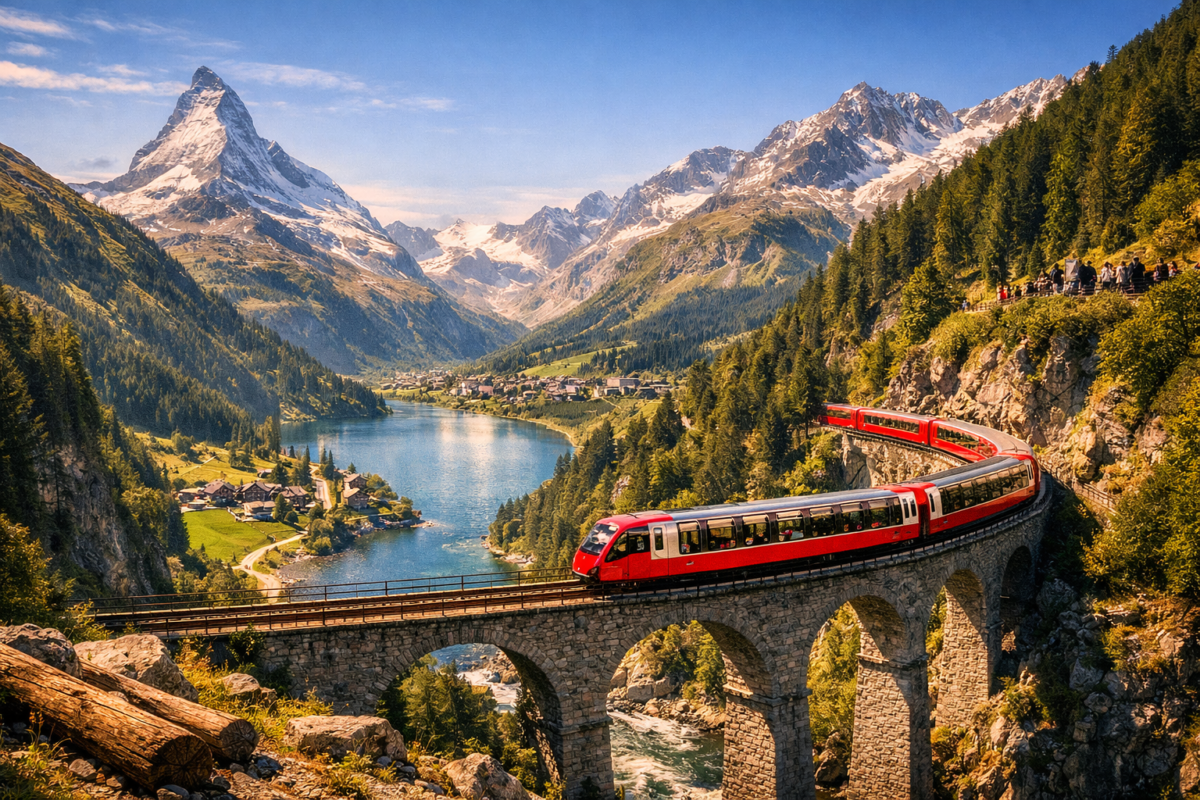
1. The Glacier Express – Zermatt to St. Moritz, Switzerland
Duration: 7.5–8 hours (full route)
Distance: 291 kilometres across the Swiss Alps
Best seat: Right side facing forward for Landwasser Viaduct; left side for Oberalp Pass views
Best season: January–March (winter Alps) or July-August (alpine meadows in flower)
Booking: Advanced reservation essential – fills weeks ahead in peak season
The Glacier Express is the most famous scenic railway in the world, and it earns that reputation with a route that is simultaneously a feat of 19th-century engineering audacity and one of the great landscape experiences of European travel. In 7.5 hours it climbs from the car-free village of Zermatt (where the Matterhorn stands above the valley like a thesis statement about mountains), crosses the 2,033-metre Oberalp Pass, traverses 291 bridges and 91 tunnels, and descends through the Engadine valley to the winter resort of St. Moritz.
The Landwasser Viaduct – a 65-metre-high curved stone viaduct that emerges directly from a cliff face – is the most photographed railway structure in Europe, and the moment the train rounds the curve and the full curve of the viaduct appears below the carriage is genuinely gasping. The panoramic viewing car at the rear of the train (bookable separately) offers unobstructed 360-degree views from a glass-enclosed observation deck that makes the tunnels a surprising relief from the sensory intensity of the open sections.
The Glacier Express is not fast – the name is ironic, a joke that Swiss railway culture tells about itself. It is the world’s slowest express, and the unhurriedness is the point. There is no rush. You are in the Alps. You have nowhere better to be.
Pro Tip: Book the panoramic car supplement (CHF 20-30 extra) and bring your own food and wine rather than using the restaurant car, which is expensive even by Swiss standards. The Glacier Express is a full-day commitment – treat it as the activity itself, not transport to somewhere else.
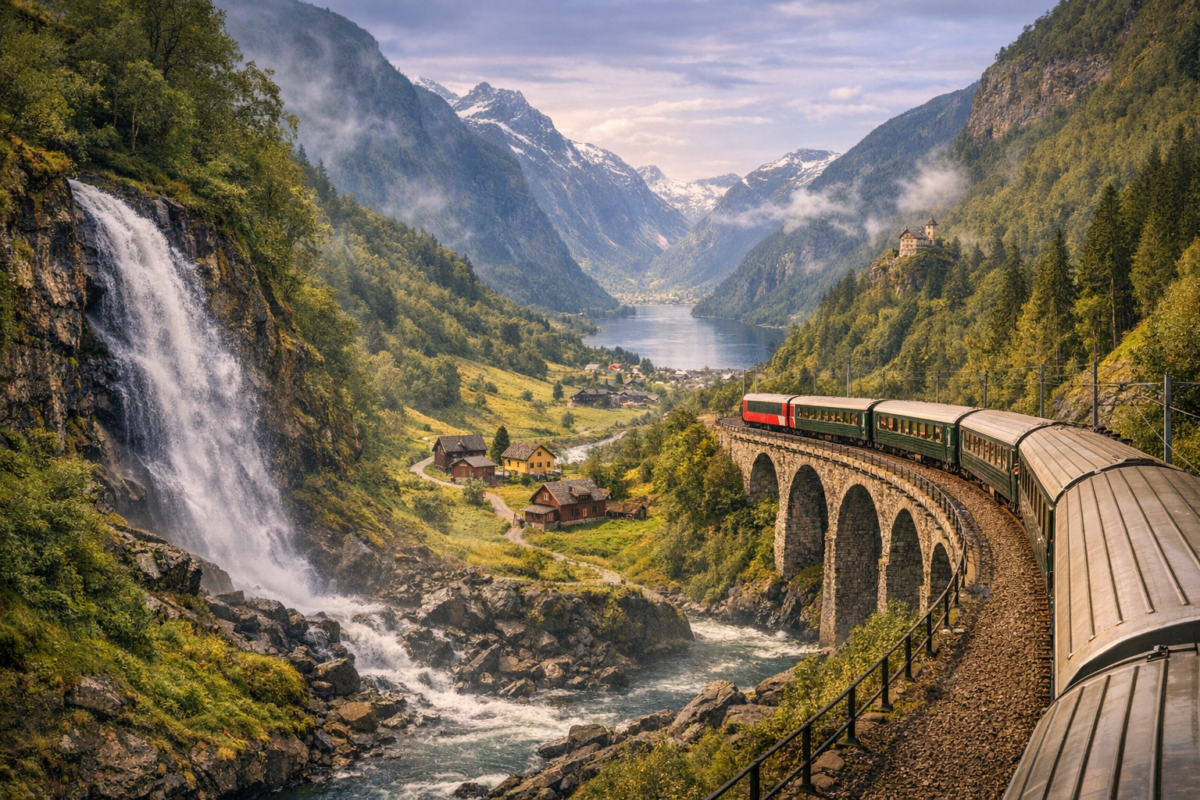
2. The Flam Railway (Flamsbana) – Myrdal to Flam, Norway
Duration: 55 minutes – one of Europe’s steepest railway lines
Distance: 20 kilometres, descending 866 metres
Best seat: Right side facing downhill (toward Flåm) for waterfall and fjord views
Best season: May-September (all seasons are extraordinary; spring snowmelt creates most dramatic waterfalls)
Booking: Advance booking strongly recommended June–August – it fills completely
Fifty-five minutes on the Flamsbana is, per minute of travel, the most spectacular train journey in Europe. In less than an hour it descends 866 metres through 20 tunnels, past waterfalls that appear at every curve, through birch forest and mountain farms, and into the village of Flåm at the inner end of the Aurlandsfjord – one of the arms of the Sognefjord, the longest and deepest fjord in Norway.
The train slows at the Kjosfossen waterfall – one of the largest in Norway – for a five-minute photographic stop where a performer in traditional Huldra (Norwegian folk myth forest spirit) costume dances on the rocks above the falls. It is slightly theatrical and completely magical. The waterfall generates enough hydroelectric power to supply the entire railway’s electricity needs. The spray reaches the open windows of the train.
The Flåmsbana is combined by most visitors with the Norway in a Nutshell self-guided tour – Oslo to Bergen by train, the Flåm Railway, a fjord ferry, and the Bergen Railway back – which is one of the great rail itineraries in Europe and bookable as a package through the national rail operator. The journey covers all three modes of the Norwegian scenery: mountain plateau, dramatic descent, and fjord-level water. In a single day.
Heads Up: The Norway in a Nutshell route is the most popular tourist experience in Norway and the Flam Railway cars fill completely in July and August. Book individual journey segments at least 3-4 weeks ahead, especially for the Flåm Railway itself. The ferry across the Aurlandsfjord and Nærøyfjord (the narrowest fjord in Europe, a UNESCO World Heritage Site) books out similarly – do not leave it to the last minute.
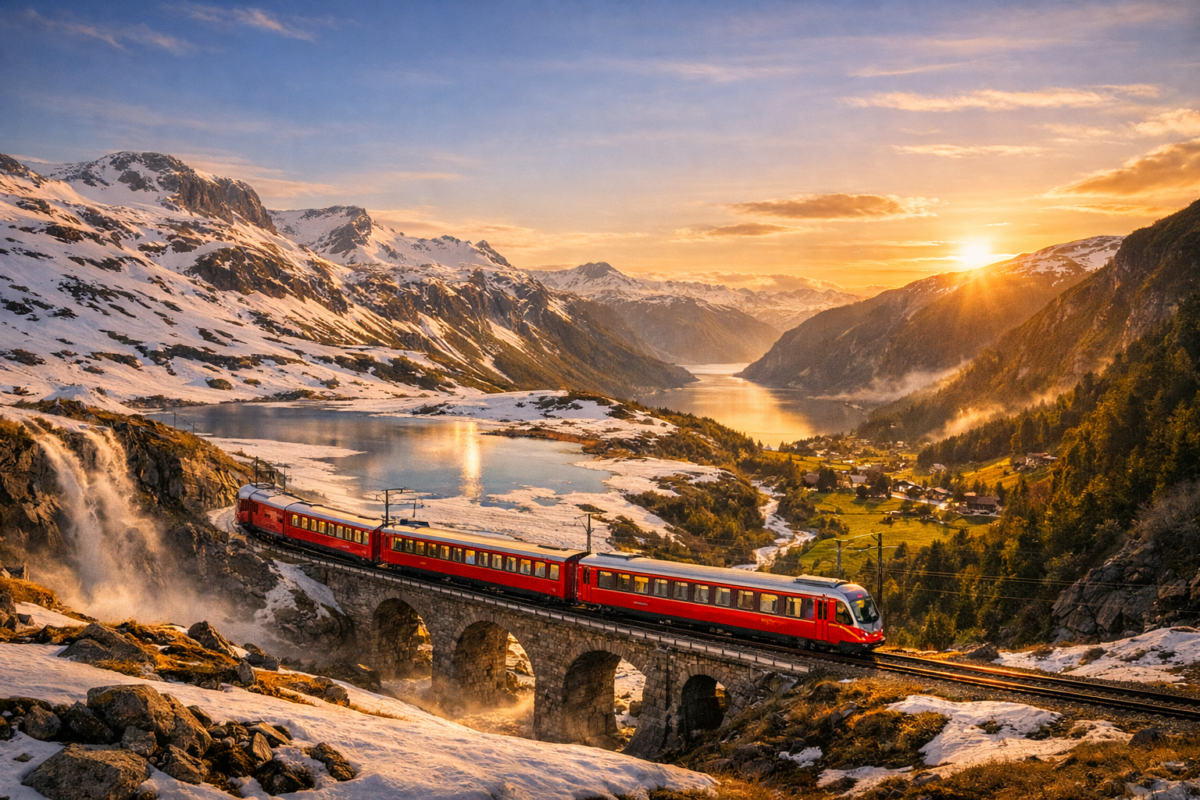
3. The Bergen Railway (Bergensbanen) – Oslo to Bergen, Norway
Duration: 6.5-7 hours
Distance: 496 kilometres, crossing the Hardangervidda mountain plateau
Best seat: Either side – the landscape is panoramic and there is no single ‘correct’ window
Best season: October-November (autumn colours) or February-March (Hardangervidda under snow)
Booking: NSB (Vy) Norwegian Railways – advance purchase saves significantly
The Bergen Railway climbs from Oslo through evergreen forest, across the Hardangervidda – the largest mountain plateau in Europe at 1,200+ metres, crossed entirely by this one railway – and descends through dramatic fjord country to Bergen on the Atlantic coast. It is Norway’s most ambitious infrastructure achievement and one of the great rail journeys of the world.
The crossing of Hardangervidda is the highlight – a landscape of treeless high tundra, frozen lakes, and snowfields that stretches to every horizon and feels genuinely Arctic even in September. The section around Finse (the highest point at 1,222 metres, accessible only by train and snowmobile in winter) passes through terrain so exposed and remote that Scott of the Antarctic used it for training expeditions before his South Pole attempt. In winter the snow drifts above the carriage windows. In late September the whole plateau is deep rust and amber.
Bergen itself – where the railway arrives – is one of the great small cities of Northern Europe: colourful wooden Hanseatic merchant buildings along the wharf (Bryggen, a UNESCO World Heritage Site), a fish market that has been running since the 12th century, and mountains rising directly behind the rooftops. Arriving by train rather than flying means you get to watch the approach through the fjord country rather than drop out of cloud directly into the airport.
Local Insight: The Bergen Railway section between Voss and Bergen passes through the Mjølfjell and Urdland tunnels – emerging from the latter onto a viaduct above the Voss valley with a sudden panoramic view that consistently draws involuntary reactions from passengers. Look right (when travelling toward Bergen) as you exit the tunnel.
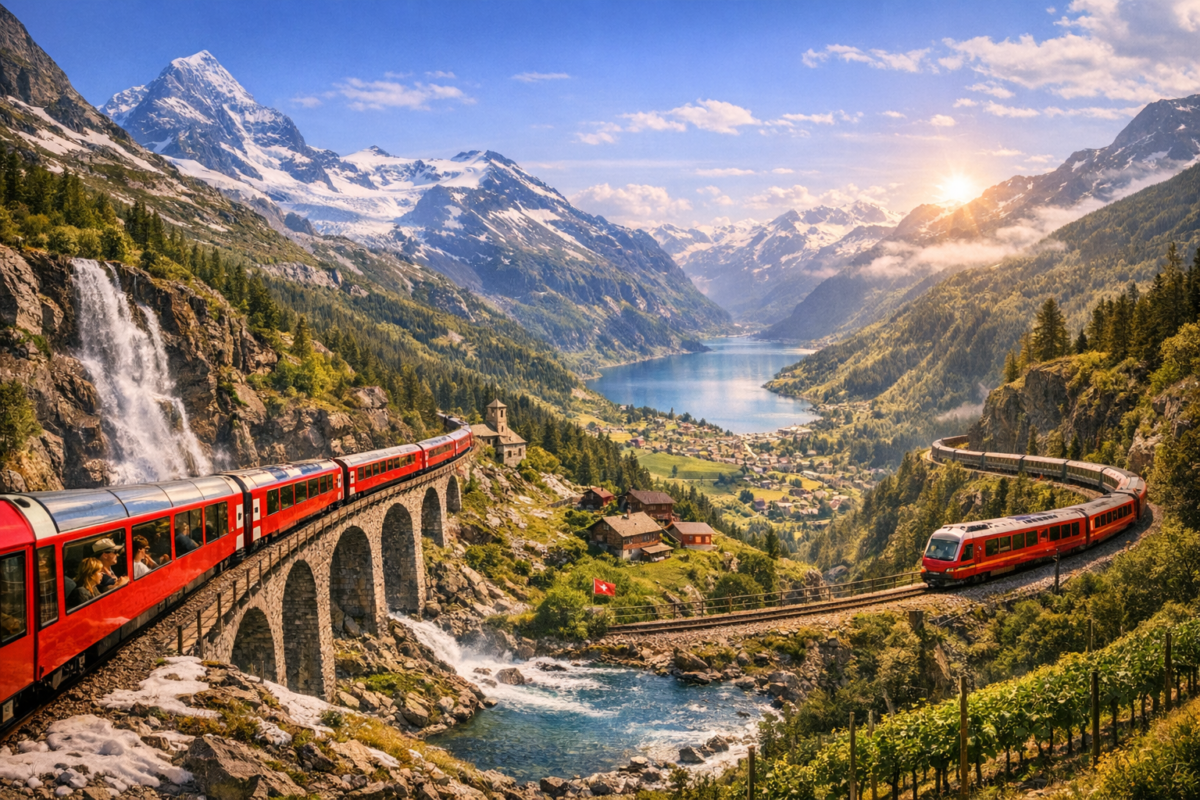
4. The Bernina Express – Chur to Tirano, Switzerland/Italy
Duration: 4 hours (full route Chur to Tirano)
Distance: 144 kilometres crossing the Alps into Italy
Best seat: Left side facing forward from Chur for the Brusio Circular Viaduct
Best season: July-August for Alpine flowers; December-February for snow
Booking: Panoramic car supplement bookable through Rhätische Bahn – essential for summer
The Bernina Express crosses the Alps from Switzerland into Italy on a UNESCO World Heritage railway line that includes the Brusio Circular Viaduct – a 360-degree helical viaduct that spirals around itself to manage the steep gradient descent into the Italian valley below. There is a moment on this viaduct when you can look out of the window and see the tail of your own train completing the loop below the front. It is one of the most extraordinary engineering experiences available on any railway in the world.
The route passes the Bernina Pass at 2,253 metres – the highest railway crossing in the Alps – where the train runs alongside the Lago Bianco glacier lake at altitude, with views of 4,000-metre peaks on three sides. Then it descends through vineyards and chestnut forests into the Valtellina valley in northern Italy, arriving at Tirano in what feels like a different climate, a different landscape, and a different century from the Alpine setting of an hour before.
The complete journey from St. Moritz (connecting from the Glacier Express) to Tirano takes about 2.5 hours and covers one of the most diverse landscapes available on a single rail journey in Europe – from glacier lake to Italian village, with the full spectrum of Alpine to Mediterranean landscape in between.
5. The West Highland Line – Glasgow to Mallaig, Scotland
Duration: 5.5 hours (full route)
Distance: 264 kilometres through the Scottish Highlands
Best seat: Left side facing forward for best loch and moorland views; right for Glenfinnan Viaduct approach
Best season: September-October (autumn colours and heather) or May-June (long days, green landscape)
Booking: ScotRail – the Jacobite steam train (May–Oct, separate booking) covers the most scenic section
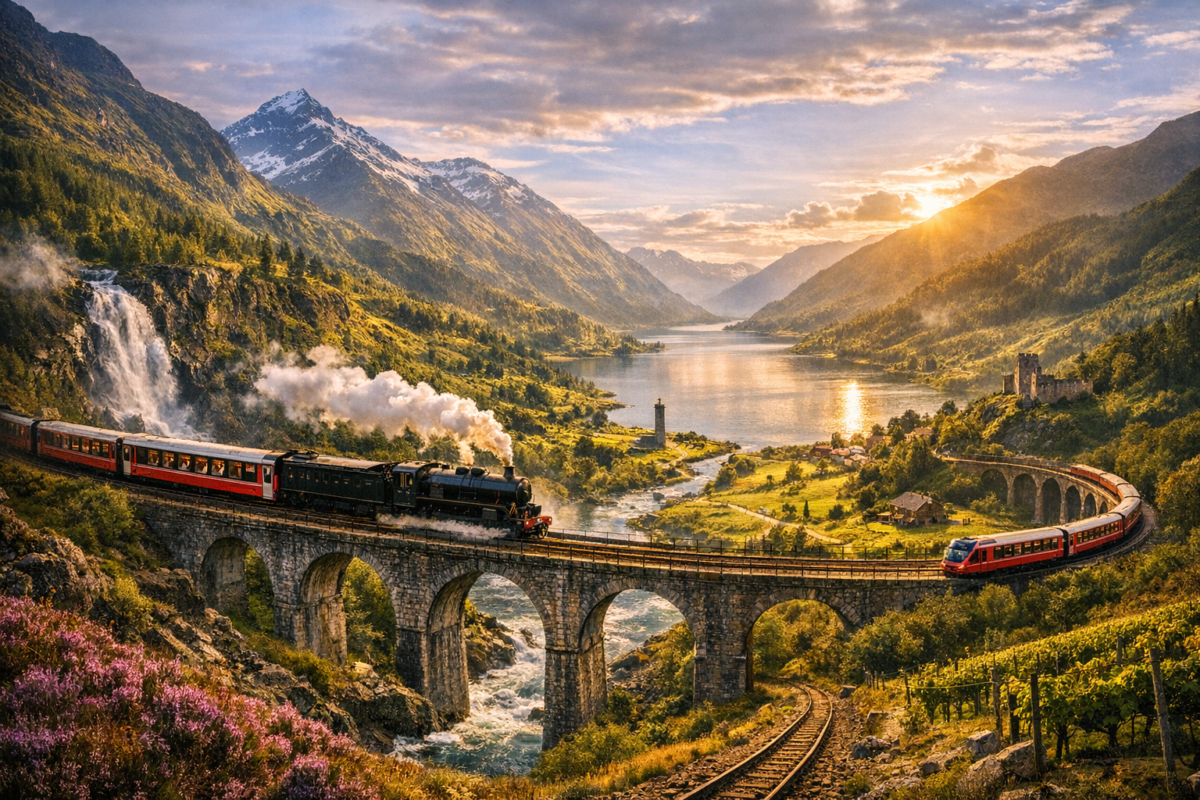
The West Highland Line from Glasgow to Mallaig is the most romantic railway journey in Britain and arguably in Europe – a 5.5-hour passage through the Scottish Highlands that covers Rannoch Moor (one of the great desolate landscapes of Northern Europe), the shores of Loch Lomond, the approach to Fort William beneath Ben Nevis, and finally the coastal run to Mallaig through scenery that was designed by someone who loved both film and reality in equal measure.
The journey’s most famous moment is the crossing of the Glenfinnan Viaduct – the 21-arch Victorian stone viaduct above the head of Loch Shiel, used as the Hogwarts Express viaduct in the Harry Potter films. The regular ScotRail service crosses it with the same views as the famous steam train, at a fraction of the cost. The Jacobite steam train (CA$60-75 return, runs May to October) is the one you see in photographs – the steam billowing as it crosses the viaduct with Loch Shiel below – but both are extraordinary.
Rannoch Moor, mid-route, deserves particular mention. The railway crosses 30 kilometres of open peat bog in a section so remote that the tracks were originally laid on a floating bed of brushwood and peat – the ground couldn’t support conventional ballast. The moor stretches to the horizon in every direction, brown and treeless and ancient, and on a grey Scottish morning with low cloud sitting on the hills, it has a quality that is hard to describe without sounding slightly dramatic.
Pro Tip: Take the morning train from Glasgow Queen Street (departs around 5:22am and 8:21am) and sit in a window seat with a coffee and a packed breakfast. The early light on Rannoch Moor is extraordinary. Book ScotRail tickets at least 2–3 weeks ahead for weekends – the full journey to Mallaig fills quickly on Saturdays in summer and autumn.
6. The Douro Line – Porto to Pocinho, Portugal
Duration: 3.5–4 hours to Pinhão; full journey to Pocinho is 5+ hours
Distance: 175 kilometres along the Douro Valley
Best seat: Right side facing forward from Porto – the Douro River is on this side for most of the journey
Best season: September–October (grape harvest, autumn gold on the terraced vineyards)
Booking: CP (Comboios de Portugal) – regional train, no reservation required, very affordable
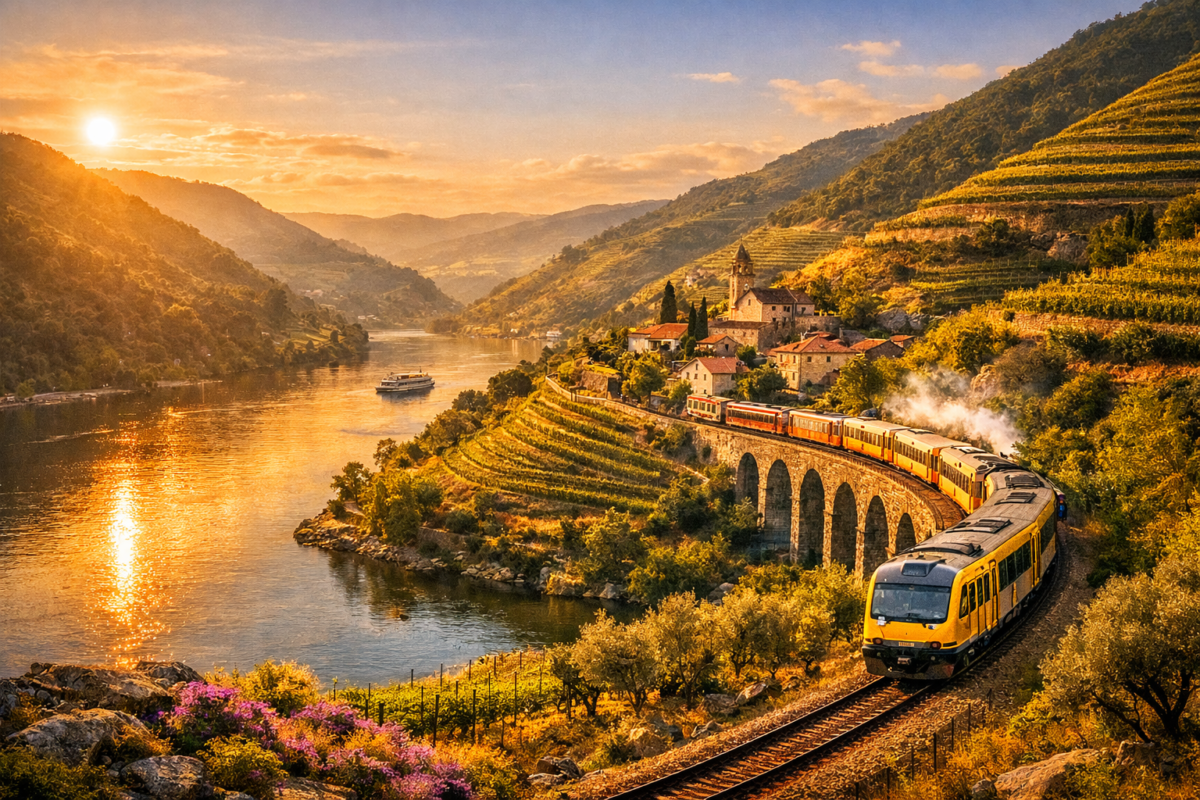
The Douro Line from Porto follows the Douro River east through the port wine valley – one of the oldest demarcated wine regions in the world (1756) and one of the most visually extraordinary agricultural landscapes in Europe. The terraced vineyards climb from the river’s edge to the ridgetops in a series of hand-built stone walls that have been reshaping this hillside since Roman times. In September and October, when the grapes are being harvested, the valley is all dust and activity and the air smells of fermentation from every quinta (wine estate) along the water.
The train follows the river so closely that on some sections you could lean out the window and touch the water – or would, if the cliffs weren’t in the way. The old-growth olive trees on the hillside, the white-painted wine lodges, the occasional Roman bridge still carrying road traffic above the gorge – the whole journey is a moving gallery of Portuguese agricultural and architectural history.
The best practical strategy: take the train from Porto to Pinhão (3.5 hours, about €15-20 one-way), spend a night or two exploring the wine estates and the village, and return by train. Pinhao station is famously decorated with blue-and-white azulejo tile panels depicting the harvest and river scenes of the valley – the station itself is a reason to make the journey.
Local Insight: The Douro Line regional train is one of the best-value scenic rail journeys in Europe – the full Porto to Pinhão journey costs around €15-20 and covers scenery that most people associate with much more expensive wine region tours. It is slow (the line was built in the 1870s and the trains behave accordingly), and the slowness is exactly right. Bring lunch.
7. The Cinque Terre Coast by Train – La Spezia to Levanto, Italy
Duration: 30 minutes – one of Europe’s shortest scenic railway sections
Distance: 18 kilometres along the Ligurian coast
Best seat: Left side facing forward from La Spezia – sea side for most of the journey
Best season: April-May or September-October (summer is very crowded)
Booking: Trenitalia regional trains – Cinque Terre Card includes unlimited train journeys
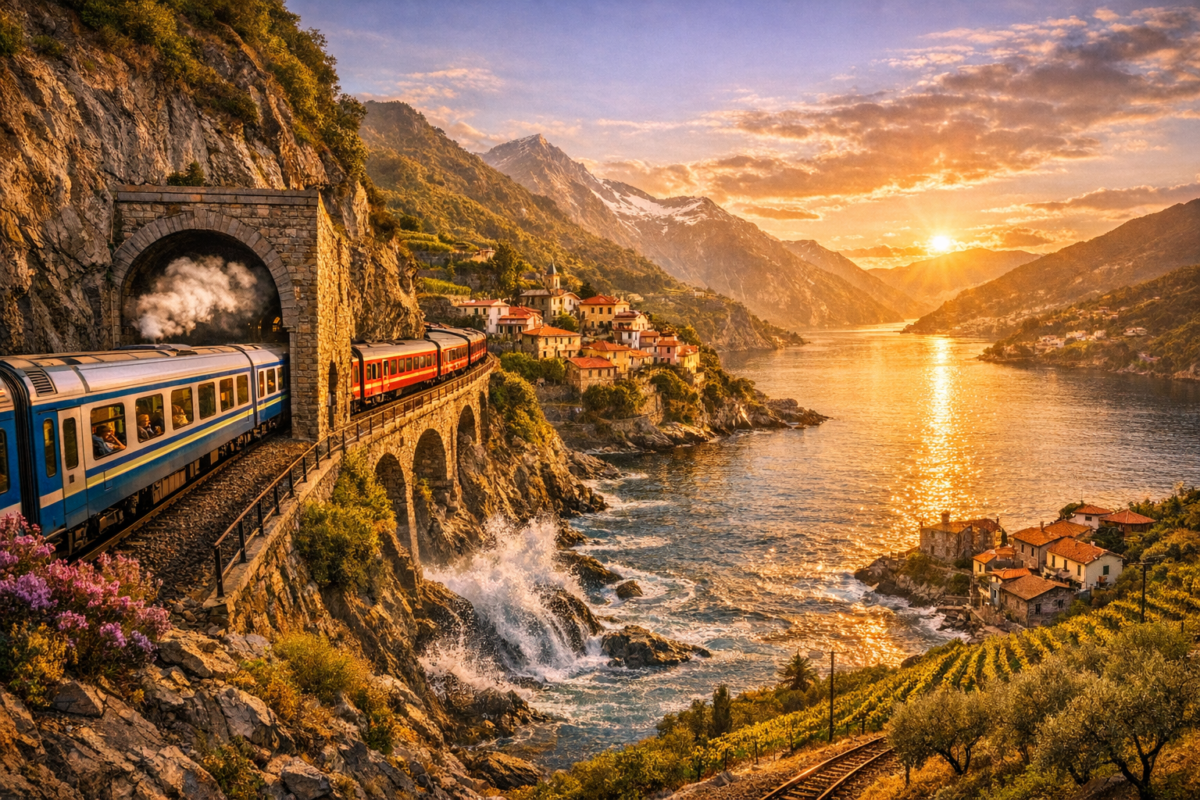
The Cinque Terre railway is the only practical way to travel between the five villages of the Italian Riviera – the cliff-hanging settlements of Riomaggiore, Manarola, Corniglia, Vernazza, and Monterosso – because the terrain makes any other land connection impossible. The railway that connects them was blasted through solid rock in the 1870s and emerges from tunnels at each village onto viaducts above the Ligurian Sea, giving passengers approximately 30 seconds of extraordinary view per village before plunging back into the cliff.
Those thirty seconds, multiplied by the five villages and the multiple journeys a day between them, add up to one of the most viscerally beautiful short rail routes in Europe. The sea below is the particular blue that the Mediterranean reserves for when the sky is clear and the light is slightly past noon. The painted villages cling to their respective cliffs. The olive terraces above and the fishing boats below complete a picture that – let’s be honest – looks exactly like a travel poster because that’s what travel posters were copying in the first place.
The Cinque Terre Card (€18-29 per day) covers unlimited train travel between the villages plus the national park hiking path access. For a day exploring all five villages by a combination of train and walking, it is excellent value. Buy it at La Spezia Centrale station before boarding your first train.
8. The Transylvania Express – Budapest to Brasov, Romania
Duration: 7-8 hours (Budapest to Brasov with connection in Cluj-Napoca)
Distance: ~600 kilometres crossing the Carpathian Mountains
Best seat: Either side – the Carpathian crossing is panoramic
Best season: October (autumn colours in Transylvania) or December-January (snow in the Carpathians)
Booking: CFR Calatori (Romanian Railways) plus MÁV for Hungarian section – book at least a week ahead
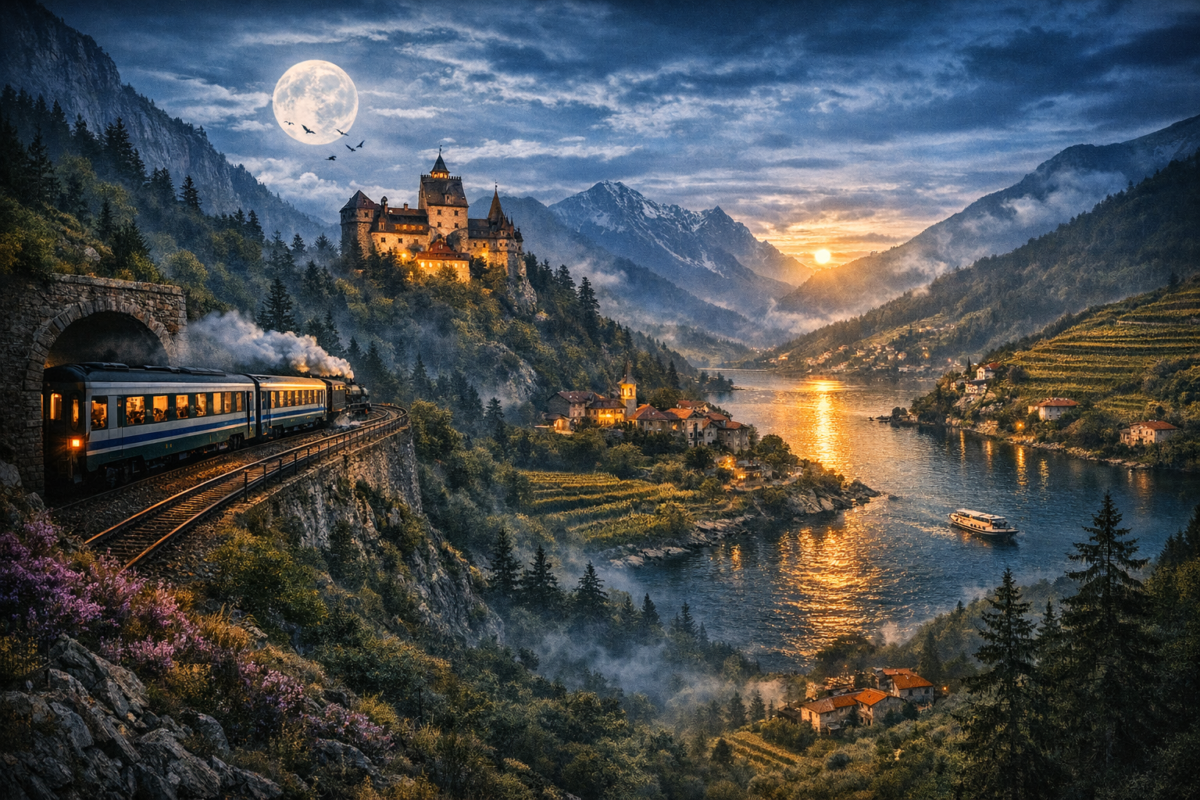
Romania does not appear on most European rail itineraries, which means the Budapest to Brasov journey through Transylvania remains one of the most genuinely surprising long-distance train experiences on the continent. The Hungarian section – flat agricultural plain, the Alföld stretching to the horizon – sets the scene for the transformation that comes as the train crosses into Romania and begins the long climb into the Carpathian Mountains.
Transylvania – the region that inspired Bram Stoker’s Dracula and gave the world both Vlad the Impaler and some of the finest medieval walled cities in Europe – is crossed through its forested centre. The railway passes through river gorges, past fortified Saxon churches visible from the window, and across mountain meadows where horse-drawn carts share the agricultural landscape with the 21st century in a way that feels not backward but genuinely continuous with history.
Brasov itself, a medieval city at the foot of the Carpathians, is one of the most beautiful towns in Eastern Europe and almost entirely unknown to Western European tourism. The Black Church, the old city walls, and the surrounding mountains – accessible by cable car and hiking trail – make it a destination that completely rewards the journey to get there.
Heads Up: Romanian train punctuality is variable and journey times can extend significantly – factor in delays, especially on overnight and international services. Bring food and water for the full journey, as dining car provision is inconsistent. Compartment sleeper trains are available on the Budapest-Bucharest route and worth booking for comfort on overnight journeys.
9. The Jungfraubahn – Interlaken to Jungfraujoch, Switzerland
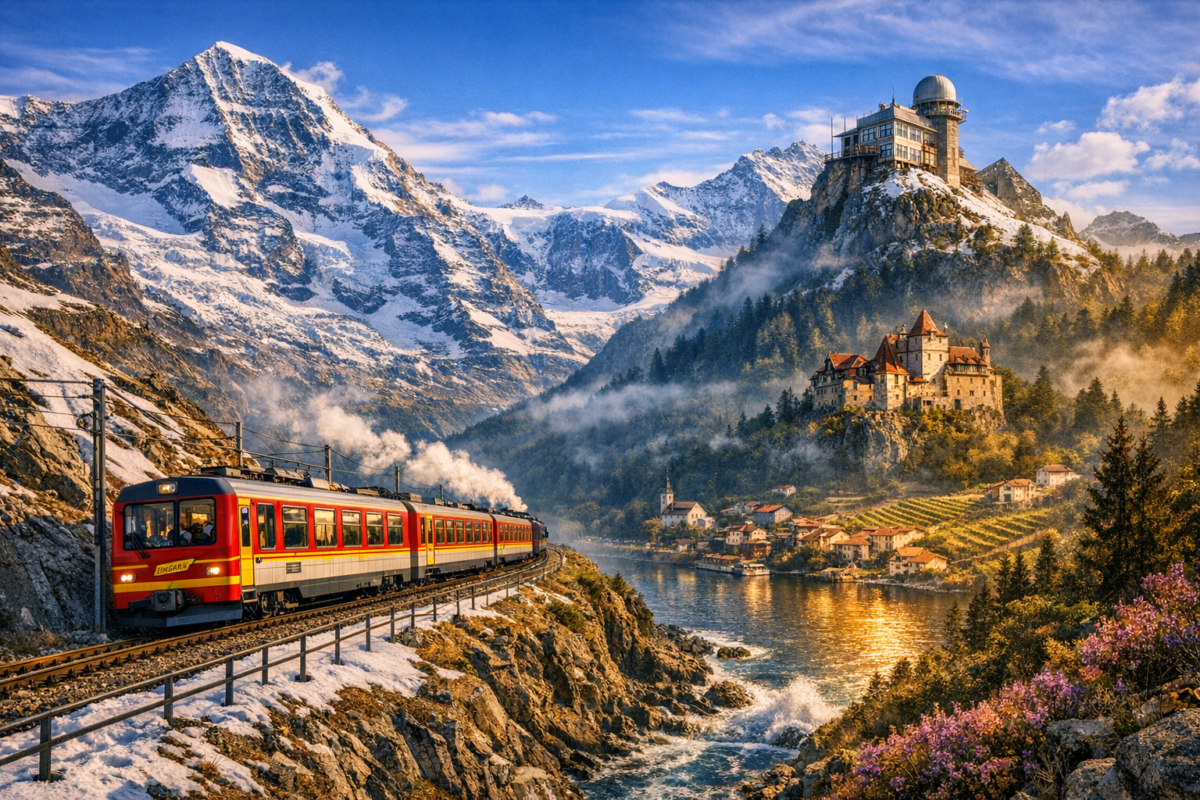
Duration: 2 hours from Interlaken Ost to the summit
Distance: 73 kilometres to Europe’s highest railway station (3,454 metres)
Best seat: Left side facing uphill – Eiger face views
Best season: July-September for best summit visibility; December-February for winter atmosphere
Booking: Jungfrau Railways – book in advance, significant price premium for summer weekends
The Jungfraubahn climbs from the Bernese Oberland valley to the Jungfraujoch – the ‘Top of Europe’ railway station at 3,454 metres altitude – through 14 kilometres of tunnel bored directly through the Eiger and Mönch mountains. The journey from Interlaken takes two hours by a combination of rack railways; the final section inside the Eiger is punctuated by two stops where windows cut into the cliff face allow you to look out across the glacier far below through glass apertures in the living rock.
At the summit, the views on a clear day extend south to the Swiss Alps, Italy, and France – a 360-degree panorama of glaciers, peaks, and the white expanse of the Aletsch Glacier below, the longest glacier in the Alps at 23 kilometres. The cold at altitude is significant even in summer – bring a warm layer regardless of the temperature in the valley below.
The Jungfraubahn is expensive (CHF 200+ round trip from Interlaken without any rail pass discount), but the Good Morning Ticket – available for the first departure only, around 6:30am – costs significantly less and gives you the summit largely to yourself for the first two hours. The early morning light on the Aletsch Glacier is extraordinary, and being there before the tourist buses arrive is worth the early alarm.
Pro Tip: The Jungfrau rail pass discount is significant – Eurail/Interrail holders get 25–35% off the summit fare. Swiss Travel Pass holders get 50% off. If you’re doing a multi-day Swiss rail trip, calculate whether the Swiss Travel Pass (which covers most Swiss trains completely) makes financial sense before buying individual tickets.
10. The Coastal Route – Split to Dubrovnik, Croatia
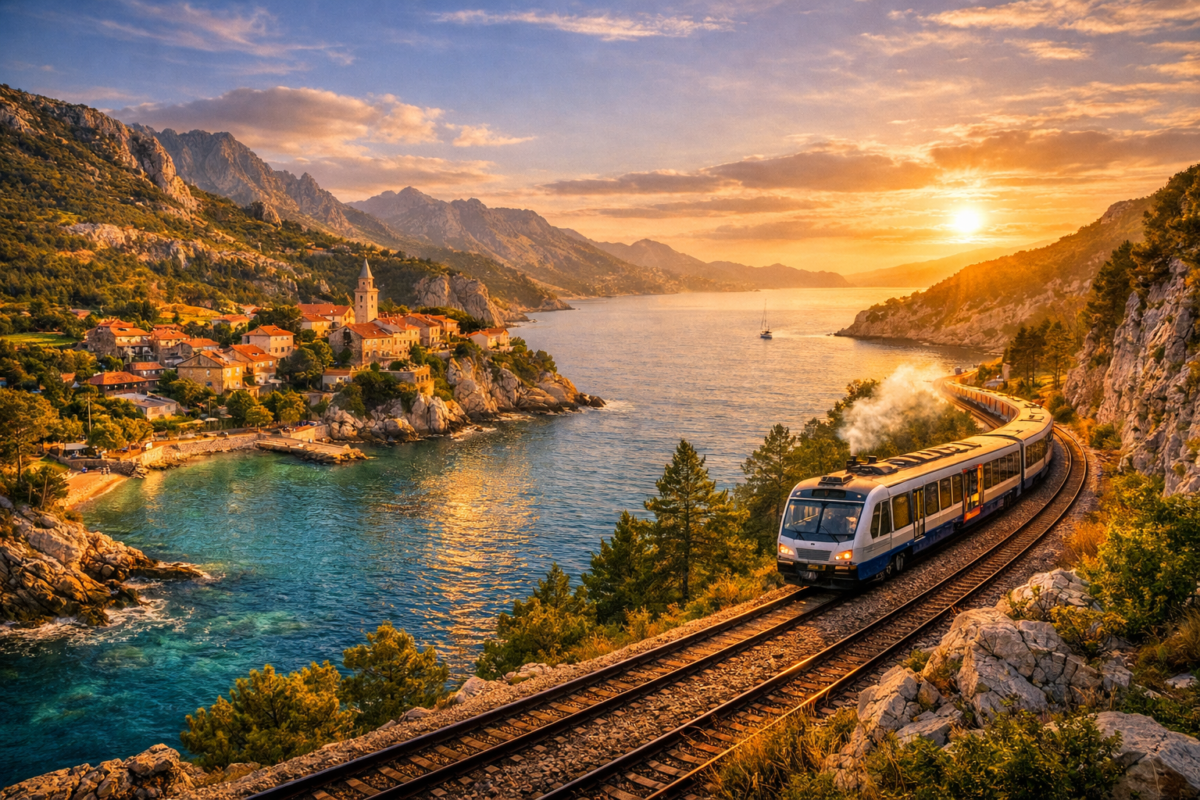
Duration: 4.5-5 hours by bus along the Dalmatian coast (no direct train – bus is the mode here)
Distance: 230 kilometres along the Adriatic
Best seat: Left side of the bus facing south from Split – sea views for most of the journey
Best season: May or September – coast road in July is a slow-moving tourist convoy
Booking: FlixBus, GetByBus, or Arriva Croatia – advance booking 3-5 days ahead sufficient outside peak season
The Split to Dubrovnik coastal road is not technically a train journey – it is a bus route — and I am including it in this guide because it is one of the great scenic rides in Europe regardless of the vehicle, and because flying between these two cities (as most tourists do) means missing one of the most extraordinary 230 kilometres of Adriatic coastline in the world.
The bus follows the Adriatic Highway along a corniche above the sea – cliffs dropping to turquoise water on the left, the Dinaric Alps rising on the right, the islands of Brač, Hvar, and Korčula visible across the channel as the route progresses south. The Makarska Riviera section is the most dramatic – the Biokovo mountain range rises nearly 2,000 metres directly from the coast, and the road is cut into the cliff face above beaches that are invisible from above and accessible only by staircase from the highway.
The route also crosses into Bosnia and Herzegovina briefly at the Neum Corridor – a 24-kilometre stretch of Bosnian coast that divides Croatian territory, giving Bosnia its only access to the Adriatic. The border crossing takes 10-15 minutes. The resulting passport stamp in your document is, for many travellers, a pleasant surprise.
Local Insight: The new Pelješac Bridge (opened 2022) now allows the bus to bypass the Neum border crossing entirely – the route goes over the bridge directly. Some operators still use the old coastal route through Neum (which is slower but more scenic). Check which route your specific bus service takes when booking.
11. The Rauma Line – Dombås to Åndalsnes, Norway
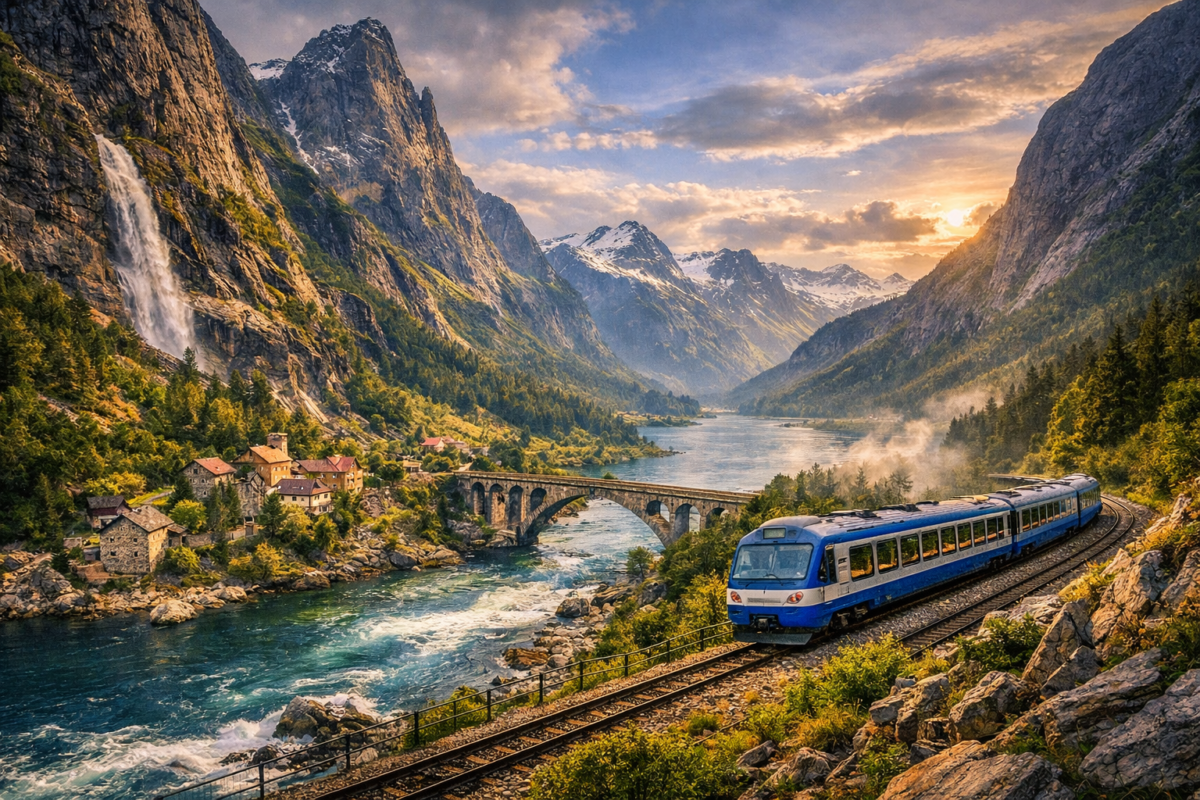
Duration: 1.5 hours
Distance: 115 kilometres through the Romsdalen valley
Best seat: Either side – the valley is enclosed on both sides by extraordinary walls
Best season: June–August for maximum daylight; September-October for autumn colours
Booking: By Norwegian Railways – advance booking recommended in summer
The Rauma Line is Norway’s most dramatic single railway section that most international visitors have never heard of. It runs from Dombås (a junction on the main Oslo-Trondheim Dovre Line) down through the Romsdalen valley to the coastal town of Åndalsnes on the Romsdalsfjord – descending through some of the steepest and most spectacular valley scenery in Norway with walls rising 1,600 metres on both sides of the train.
The Trollveggen (Troll Wall) – the highest vertical rock face in Europe at 1,100 metres of unbroken cliff – appears on the right side of the train as it enters the lower valley. It is an extreme climbing destination that has been attracting alpinists since the 1960s and is visible in its full scale only from below, from the valley floor or the train. The scale is genuinely difficult to process – it takes the eye several seconds to reconcile the height of what it is seeing with any reference point it has.
Åndalsnes itself, at the end of the line, is a small town at the junction of two fjords with a mountaineering culture and several excellent cafés. The Trollstigen mountain road – one of the great mountain drives in Norway – begins here, and combining the train in from Dombås with a day exploring Trollstigen by car (or bus in summer) makes for one of the finest all-round transport days in Norway.
12. The Harz Narrow Gauge Railway – Wernigerode to Brocken, Germany
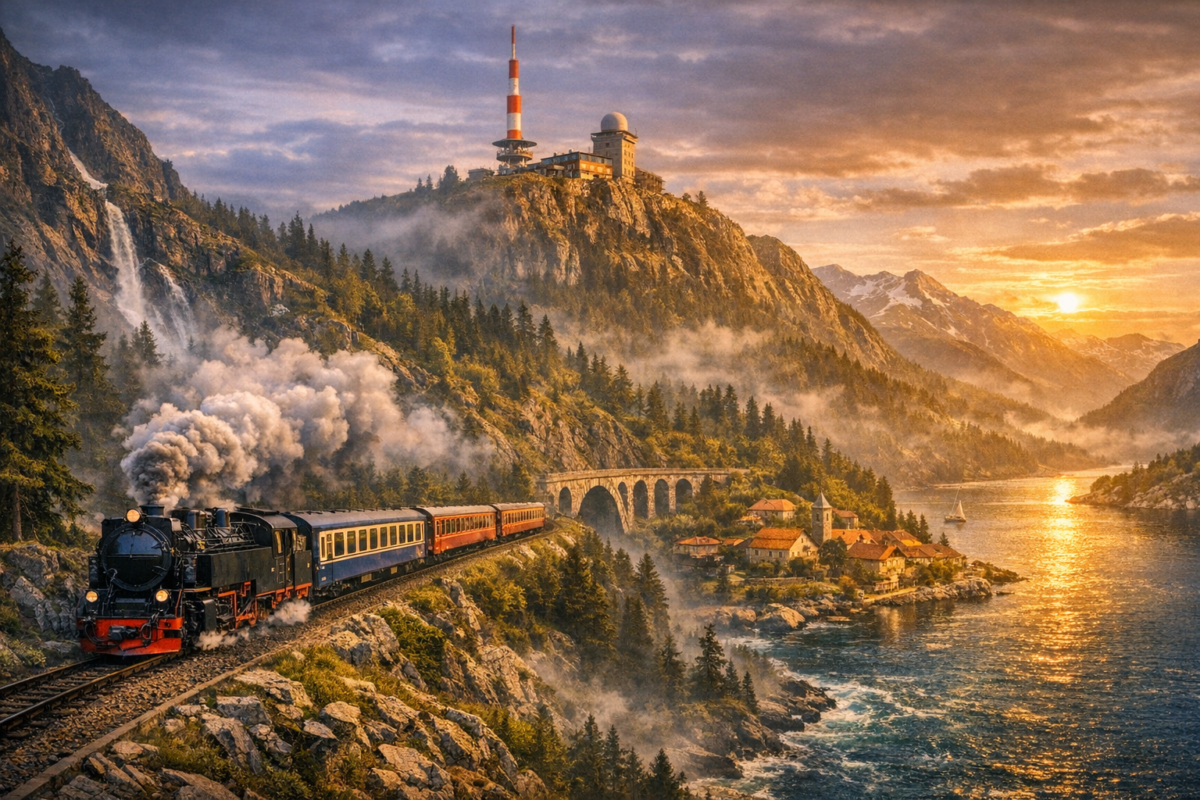
Duration: 1.5-2 hours to the Brocken summit
Distance: ~60 kilometres from Wernigerode, with several route options
Best seat: Any window – the narrow gauge carriage gives close-up forest views on both sides
Best season: October-November for fog and folklore atmosphere; May-June for blossom and spring green
Booking: Harzer Schmalspurbahnen (HSB) – steam and diesel services, no advance booking required
The Harz Narrow Gauge Railway is Germany’s most atmospheric heritage railway – a network of narrow gauge steam and diesel trains that has been running through the Harz Mountains since 1897 and continues to operate today as a working, scheduled public transport system rather than a heritage attraction. It is the only way to reach the Brocken – the highest peak in northern Germany at 1,141 metres – by public transport, and the journey through the dense spruce and beech forest of the Harz National Park is genuinely, quietly magical.
The Brocken has been the site of Walpurgisnacht (Witches’ Night) celebrations since the Middle Ages – Goethe set a scene of Faust on the summit – and the mountain has a particular atmosphere of dark romanticism that the steam train, climbing through cloud into the open summit moorland, does nothing to dispel. On misty mornings in October, the train emerges from the forest into visibility of about 50 metres on the summit plateau and the whole thing feels like a scene from a German folktale.
The steam locomotives are the original 1950s engines, maintained by the railway’s engineering team in Wernigerode. The carriages are old wooden compartment stock. The ticket costs around €35-50 return from Wernigerode to the Brocken and back. It is the kind of railway experience that is disappearing from Europe – not because it stopped being extraordinary, but because most railways modernised – and experiencing it before it does is the reason to go soon.
Pro Tip: Combine the Harz Railway with Quedlinburg – a medieval town 20 minutes from Wernigerode with an extraordinary UNESCO World Heritage hilltop collegiate church and one of the best-preserved historic town centres in Germany. Stay overnight in Wernigerode (a beautifully preserved half-timbered German town) and do the summit railway as a morning excursion before exploring Quedlinburg in the afternoon.
How to Book European Train Journeys: A Practical Guide
Interrail and Eurail Passes – Are They Worth It?
The Interrail Global Pass (for European residents) and Eurail Global Pass (for non-European residents) provide unlimited travel on most European national rail networks for a set number of days within a validity period. They make financial sense if you’re doing multiple long journeys across multiple countries.
For the journeys in this guide specifically: a 7-day Eurail Pass (continuous use, approximately US$330-400 for adults) covers the Glacier Express supplement, Bergen Railway, and West Highland Line with significant savings over individual tickets. For the Swiss journeys specifically, the Swiss Travel Pass (4 days from CHF 245) covers all Swiss trains, trams, and buses plus museum entry – exceptional value if you’re planning multiple days of Swiss rail travel.
Booking Individual Tickets
For individual journeys booked in advance, the national rail operators consistently offer the best prices: SBB (Swiss Federal Railways) for Switzerland, Vy for Norway, ScotRail for Scotland, CP for Portugal, Trenitalia for Italy, DB for Germany, CFR for Romania. Booking 4-8 weeks ahead typically yields prices 30–50% lower than walk-up fares on most European networks.
For flights to get to the starting points of these rail journeys, search Aviasales for the best transatlantic and intra-European fares – particularly useful for flights into Geneva, Bergen, Glasgow, and Porto, which have multiple carriers competing. Earn cashback on every flight booking with WayAway. If your connecting flight is disrupted, AirHelp handles compensation claims on a no-win-no-fee basis.
Accommodation Along Rail Routes
For accommodation at journey endpoints and stopovers – Zermatt, Bergen, Porto, Brasov, Interlaken, Wernigerode – Hotellook searches all booking platforms simultaneously and is particularly strong for the smaller European towns that global platforms underserve. For longer stays in one place or self-catering apartments for rail base-camps, Intui offers competitive rates on apartment rentals across most of these destinations.
Luggage on European Rail Journeys
Most European trains have generous luggage allowances – you carry what you can manage, there are no fees. The practical considerations are space (overhead racks and end-of-car storage on scenic trains fill quickly) and porterage (no trolleys at mountain railway stations – you carry everything on your back). Pack light, particularly for the Swiss mountain routes where luggage handling is genuinely limited.
If you need to store luggage at departure cities while doing day or overnight rail excursions, Radical Storage has locations at or near the stations in Bergen, Porto, and several other gateway cities on this list.
Staying Connected on Long Train Journeys
WiFi on European trains is inconsistent – excellent on Swiss intercity services, variable on Norwegian and Scottish lines, nonexistent in Romanian mountain tunnels. An eSIM with European data coverage is the most reliable solution. Airalo and Yesim both offer Europe-wide packages covering all 12 countries in this guide. Activate before flying and you’re connected for every journey. For geo-restricted streaming during longer journeys, NordVPN works across all European network types.
Travel Insurance for Rail Holidays
Comprehensive travel insurance covering trip cancellation, baggage delay, and medical emergencies is essential for any multi-country European rail trip. Ekta Travel Insurance offers flexible single-trip and annual policies that cover European multi-country travel including rail-specific trip disruption scenarios.
Guided Rail Tours and Experiences
For those who prefer guided rail journeys with local context – including the Douro Valley wine train experience, guided fjord-and-rail combinations in Norway, and small-group Swiss rail tours – WeGoTrip has a strong European rail experience catalogue. Audio guides for self-guided journeys (particularly useful on the West Highland Line and Cinque Terre route) are available through the same platform.
Plan Your European Rail Adventure with These Free Tools
- AI Travel Budget Estimator – calculate your total multi-country rail trip budget including tickets, accommodation, and activities
- Live Currency Converter – real-time conversion for CHF, NOK, GBP, EUR, USD, and all major currencies
- Packing List Generator – custom packing list for multi-country rail travel, including Alpine cold-weather layers and long-journey essentials
- More Destination Guides – deeper coverage of Switzerland, Norway, Scotland, Portugal, and every other European destination in this guide
- Budget Travel Hub – money-saving strategies that work across European rail travel and every other destination we cover
Frequently Asked Questions
Q1: Which European train journey is the most scenic overall?
The Glacier Express is the answer most railway enthusiasts give, and it earns its reputation – 8 hours of Swiss Alpine scenery at its most varied and dramatic, crossing 291 bridges and 91 tunnels between two of Switzerland’s most extraordinary mountain destinations. If you can only do one train journey in Europe, make it this one. If you have time for two, add the Flam Railway for the best return on 55 minutes of travel of any route in this guide.
Q2: How do I get the best prices on European scenic rail journeys?
Book as far in advance as possible through the national rail operator of the country you’re travelling in – SBB for Switzerland, Vy for Norway, ScotRail for Scotland, CP for Portugal. Advance purchase discounts are typically 30-50% below walk-up prices. If you’re doing three or more long journeys, calculate whether an Interrail or Eurail pass (for non-European residents) saves money. Swiss journeys specifically are better value with a Swiss Travel Pass if you’re spending 4+ days in Switzerland.
Q3: Is it possible to combine several of these journeys in a single trip?
Yes – and the combinations are part of the pleasure. A classic 10-12 day Swiss rail circuit covers the Glacier Express, Bernina Express, and Jungfraubahn with the Swiss Travel Pass. A Norway rail week covers Bergen Railway, Flåm Railway, and Rauma Line with Interrail. A Southern Europe rail trip combines Porto (Douro Line), Cinque Terre, and Transylvania in 2-3 weeks. Use our Travel Planning Services for a custom multi-journey itinerary.
Q4: What should I bring on a long European scenic train journey?
The essentials: a window seat booking confirmation (always book a specific seat on scenic trains), more food and drink than you think you need (restaurant cars are expensive), headphones for the tunnel sections, a good book for the flat sections, and the right clothing for the endpoint’s altitude – the Jungfraujoch and Glacier Express both reach elevations where a warm layer is necessary even in July. Full packing list at packing list generator
Q5: Are European scenic train journeys suitable for families with children?
Absolutely – and often better for families than for adults travelling alone, because children respond to the drama of the scenery with an enthusiasm that adults have to work to maintain. The Flåm Railway (55 minutes, genuine spectacle, manageable for any age), the Jungfraubahn (cable-car-like appeal, snow at the top, tunnel stops), and the West Highland Line (long but comfortable, with enough variety to maintain interest) are particularly family-friendly. Swiss trains have family carriages on most services with space for pushchairs and fold-down tables.
Q6: Do I need to speak the local language to navigate European trains?
No – and increasingly not even helpful. All Swiss, Norwegian, and major European rail apps have English-language interfaces. Station announcements in most countries include English. Timetable boards use standard European notation (24-hour time, platform numbers, train numbers) that requires no translation. The only exception is Romania, where English signage outside the main cities is limited – bring a screenshot of your ticket details and destination in local script as a backup.
Final Thoughts: Slow Down. The View Is Outside the Window.
There is a particular kind of travel impatience – very modern, very understandable – that treats the journey as an obstacle between the destination and the experience. Get there faster. Get there cheaper. Get there with less hassle. And for a lot of travel, that’s the right call.
But somewhere on a slow mountain railway in the Alps, or on a Norwegian line with a fjord materialising around a granite cliff above you, or on a heritage steam train climbing through German beech forest into cloud – that calculation reverses. The journey is the experience. The window is the destination. The whole point of being on this train, on this day, is to be watching what is happening outside it right now.
These 12 routes are the ones that make that case most powerfully. Put them on the list. Take the slow train. The view is worth every extra hour it takes to get there.
Start planning your European rail adventure today. Find the best connecting flights on Aviasales, earn cashback with WayAway, compare accommodation at Hotellook, activate your eSIM with Airalo or Yesim, and protect every journey with Ekta Travel Insurance. Browse our full Europe destination guide library for destination detail on every country in this guide.
Book the window seat. Take the slow train.
Hidden Travels Team | hiddentravels.site