
⚠️ Affiliate Disclosure: Some links in this post are affiliate links – we earn a small commission if you book through them, at no extra cost to you. We only recommend services we genuinely use and trust.
The moment that rewired the way I think about the Scottish Highlands happened on a Wednesday morning in October, forty minutes north of Inverness, at a layby on the A9.
I had pulled over because a red deer stag had walked out of the birch forest to the left of the road and was standing in the middle of the tarmac, apparently unconcerned. He had the kind of antlers that belong in a painting. The morning mist was still sitting in the valley below the road. The mountains on the far side were dark with rain shadow, and the lower slopes were blazing with late bracken in every shade of copper and rust. The deer looked at me for perhaps thirty seconds, then walked – slowly, with the dignified unhurriedness of an animal that hasn’t needed to develop anxiety – back into the trees.
I sat in that layby for another twenty minutes not doing anything in particular, and I think about it more often than I think about most of the places I have been.
The Scottish Highlands is not a destination in the way that a city is a destination. It’s not something you tick off a list. It’s a landscape that changes the pace of your thinking – that slows you down to its own rhythm, which is the rhythm of weather and light and the long geological patience of very old mountains. And it does this to most people who spend real time in it, regardless of where they started from.
This guide is for the people who want to do the Highlands properly – not the single-day bus tour or the Instagram-by-numbers route. It covers the best places to stay, the hikes worth doing, the food and whisky worth seeking out, the drives worth taking, and the specific moments – mostly free, occasionally transcendent – that make the Scottish Highlands one of the most extraordinary places on this particular planet.
Pro Tip: Check Scotland’s weather forecast before planning day hikes and drives using our Weather Checker. Highland weather changes faster than anywhere else in Britain – a forecast from the morning can be irrelevant by noon.
Why the Scottish Highlands Should Be on Every Traveller’s List
Scotland’s mainland Highlands cover roughly 10,000 square miles of mountain, glen, loch, coast, and moorland – an area approximately the size of Wales, with a population of around 230,000 people. That ratio of landscape to population creates something increasingly rare in the developed world: genuine, accessible wilderness within a country with a functioning road network, excellent accommodation, and a food and hospitality culture that has genuinely transformed over the last two decades.
What the Highlands has that almost nowhere else in Europe has in the same combination:
- Scale: Mountains that rise 1,000 metres straight from sea level with nothing between them and the sky. Ben Nevis, at 1,345 metres, is Britain’s highest peak and it rises from a town that has a Lidl and a Wetherspoons. The contrast never stops being remarkable.
- Wild swimming: Rivers, lochs, and coastal inlets of stunning clarity accessible within a few minutes’ walk almost everywhere. A culture of wild swimming that has grown substantially – there are now dedicated wild swimming guides to the region.
- Dark skies: The Cairngorms National Park is a designated International Dark Sky Park. Parts of the far north coast and the western Highlands rank among the darkest skies in the UK. On clear nights away from any settlement, the Milky Way is visible to the naked eye.
- Whisky: The Highlands and Speyside together contain the world’s greatest concentration of single malt whisky distilleries – over 50 active distilleries within easy driving distance of each other on the Malt Whisky Trail.
- History: The Highland Clearances, the Jacobite risings, the clan system, the Vikings, the Picts – the Highlands carry layers of human history going back thousands of years, and it is visible in the landscape, the place names, the ruins, and the faces of the people.
- Food: Highland beef, venison, langoustines from the west coast, smoked salmon, Stornoway black pudding, haggis done properly – the food scene in the Scottish Highlands has developed enormously and the produce is extraordinary.
Local Insight: The Highlands has a right to roam legislation under the Land Reform (Scotland) Act 2003 that is the most progressive in Europe – you can walk, cycle, and camp on virtually any land in Scotland as long as you follow the Scottish Outdoor Access Code. This means the landscape is yours to explore in a way that simply doesn’t exist in most countries. The mountains are not private property. Use this freedom responsibly and leave no trace.
The Scottish Highlands Region by Region
1. Inverness & the Great Glen – Gateway to the Highlands
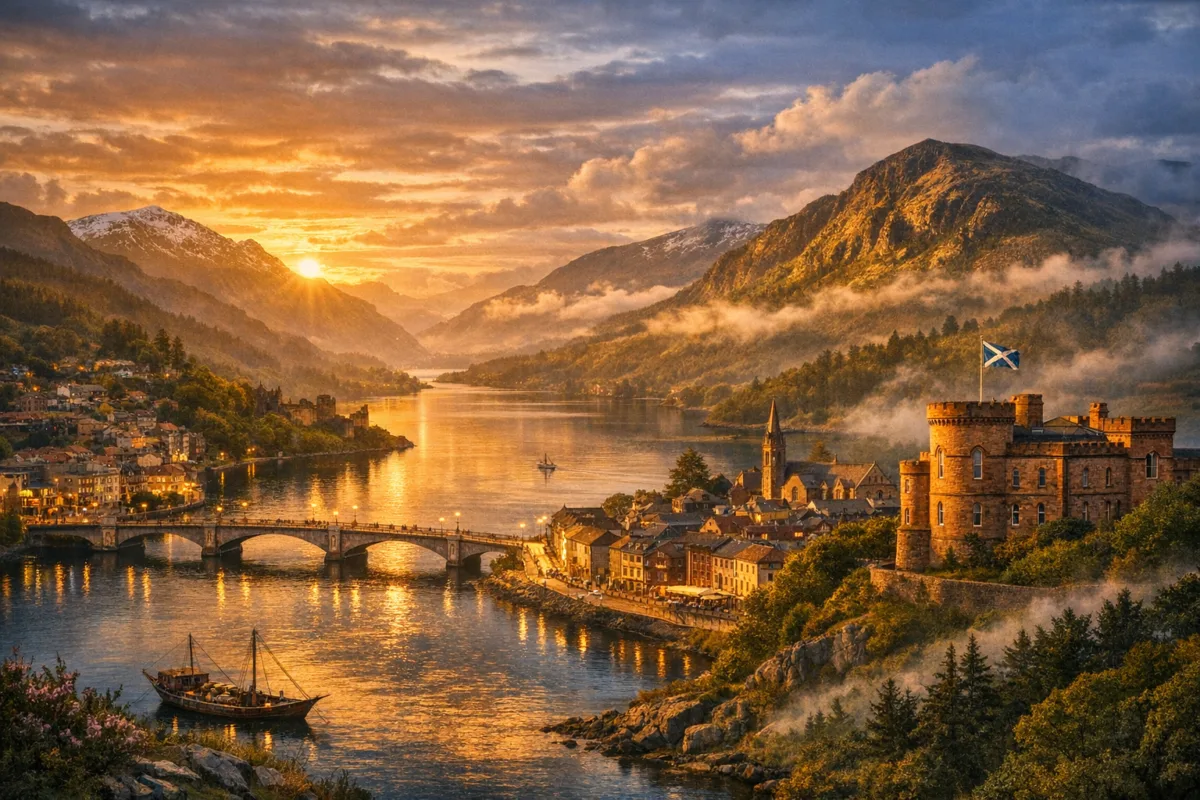
Inverness is the capital of the Highlands – a compact, handsome city on the River Ness that functions as the natural base for exploring the central and northern Highlands. It has an excellent food and pub scene, a Victorian market with good local produce, and is within easy reach of Loch Ness, the Cairngorms, the Black Isle, and the start of the North Coast 500.
Loch Ness stretches 23 miles southwest of Inverness along the Great Glen fault – a geological rift that cuts Scotland diagonally from Inverness to Fort William. The loch holds more fresh water than all the lakes of England and Wales combined. Urquhart Castle, the ruined medieval fortress on its western shore, has been here since the 13th century and the combination of the castle ruins and the loch behind is one of the great views in Highland Scotland. Entry £11, Historic Environment Scotland.
The Falls of Foyers – a 165-foot double waterfall on the south shore of Loch Ness – are reached by a short woodland walk from a car park and are among the finest waterfalls in the Highlands. Robert Burns visited them in 1787 and wrote about them. They remain as he described.
Pro Tip: Inverness Airport has direct flights from London Gatwick, London City, Manchester, Bristol, and several European airports. Search for the best fares on Aviasales – flying directly into Inverness rather than Edinburgh saves 2-3 hours of driving and is often cheaper in shoulder season. Compare car rental prices at GetRentACar for the best available rates from Inverness Airport.
2. Glencoe & Rannoch Moor – The Highlands at Their Most Dramatic
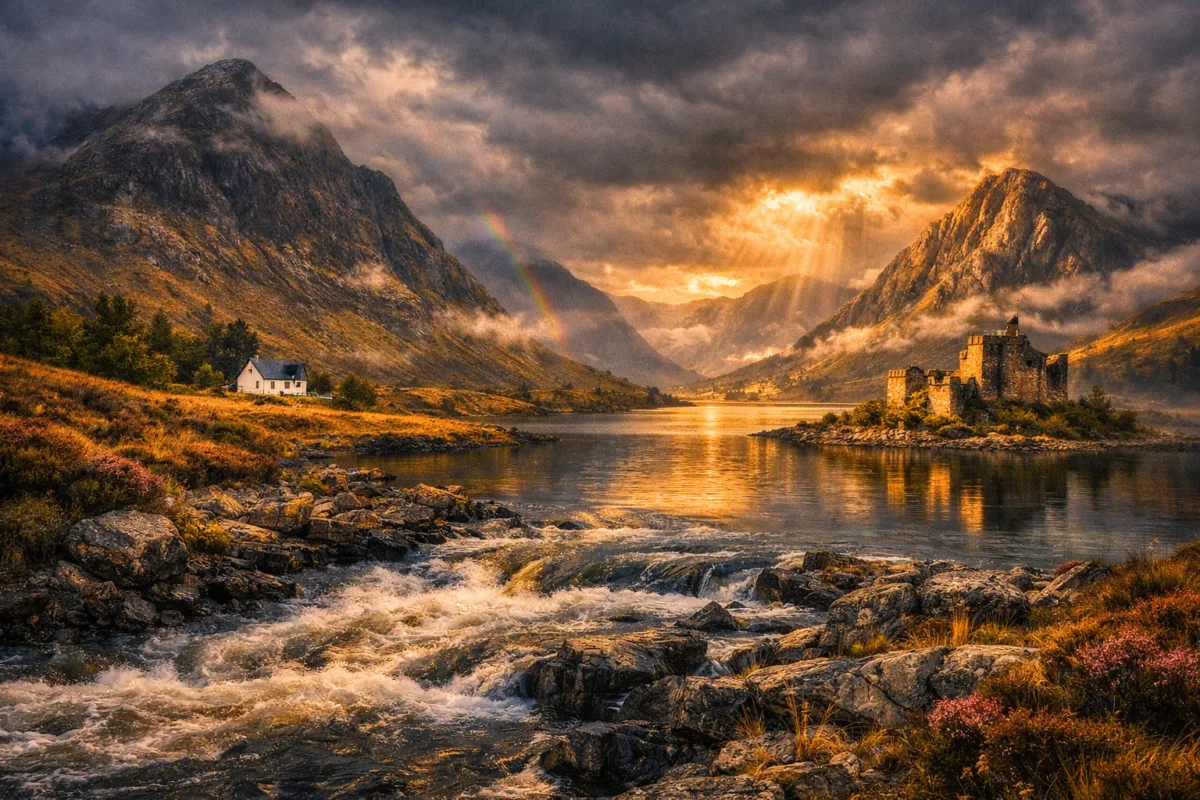
If you visit only one place in the Scottish Highlands, make it Glencoe. The valley – a 6-mile rift between some of the most dramatic mountains in Britain – has a quality that is hard to explain to people who haven’t been there. It isn’t just the scale of the peaks (the Three Sisters ridge is 2,700 feet from valley floor to summit) or the quality of the light, which at the right moment is theatrical in the way that theatrical was invented to describe. It’s also the history: this is where the Campbells massacred 38 members of the MacDonald clan in February 1692, after accepting their hospitality for two weeks. The landscape holds that.
The Glencoe Visitor Centre (National Trust for Scotland, entry by donation) is the best starting point – it has excellent displays on the geology, ecology, and history of the valley and the staff are knowledgeable and generous with local advice. The Lost Valley hike (Coire Gabhail) – a hidden valley behind the Three Sisters where the MacDonalds hid their cattle – is a 3-mile round trip that rewards with extraordinary views and requires the kind of scramble over boulders that makes you feel like you’ve earned what you’re looking at.
Rannoch Moor extends north and east of Glencoe – 50 square miles of blanket bog that is one of the largest areas of undrained peat in Western Europe. The A82 crosses the southern edge; the West Highland Railway crosses the middle on a floating bed of brushwood laid over the peat in 1894. On a grey morning the moor has a beauty that is entirely its own – not the beauty of drama or spectacle but the beauty of scale and desolation and a sky that fills two-thirds of every view.
Heads Up: Glencoe is one of the most visited sites in Highland Scotland and the main car park at the Three Sisters fills by 9am in summer. Arrive early, park at the Glencoe Visitor Centre (larger, further up the valley), or walk the Glencoe Valley Trail (3 miles, flat, free) from the village. The A82 layby for the Three Sisters viewpoint has no parking – do not stop there in peak season.
3. Fort William & Ben Nevis – Britain’s Highest Peak
Fort William calls itself the Outdoor Capital of the UK and the designation is not unearned. The town sits at the head of Loch Linnhe beneath Ben Nevis – and the relationship between the town and the mountain it lives under is immediate and defining. Ben Nevis at 1,345 metres is Britain’s highest peak, and from the summit on a clear day you can see the Irish coast, the Outer Hebrides, and roughly 200 miles of Highland landscape in every direction.
The tourist path (known as the Mountain Track or Pony Track) takes 6-8 hours return from the visitor centre in Glen Nevis, gains 1,345 metres of elevation, and is genuinely non-trivial – the summit is a high-altitude plateau that can be in cloud and winter conditions even in July. Proper boots, waterproofs, layers, food, and water are non-optional. Every year, visitors in trainers and t-shirts are helped off the mountain by Mountain Rescue. Do not be one of them.
For those not doing the full Ben Nevis, the Glen Nevis Gorge Walk (2 miles from the youth hostel car park, free, spectacular) follows the Water of Nevis through a narrow gorge with waterfalls to the open upper glen – one of the finest short walks in the Highlands with none of the elevation commitment of the summit.
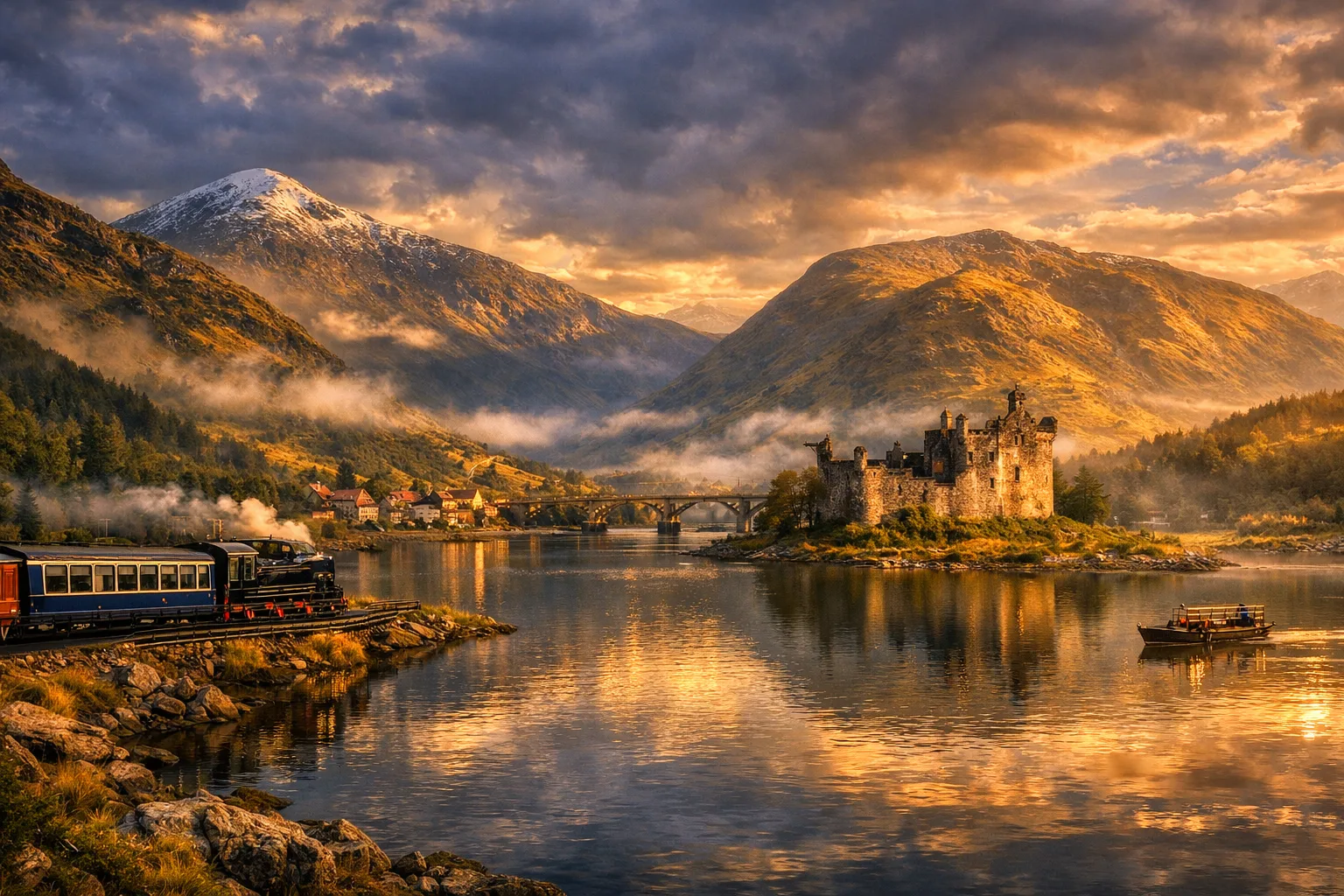
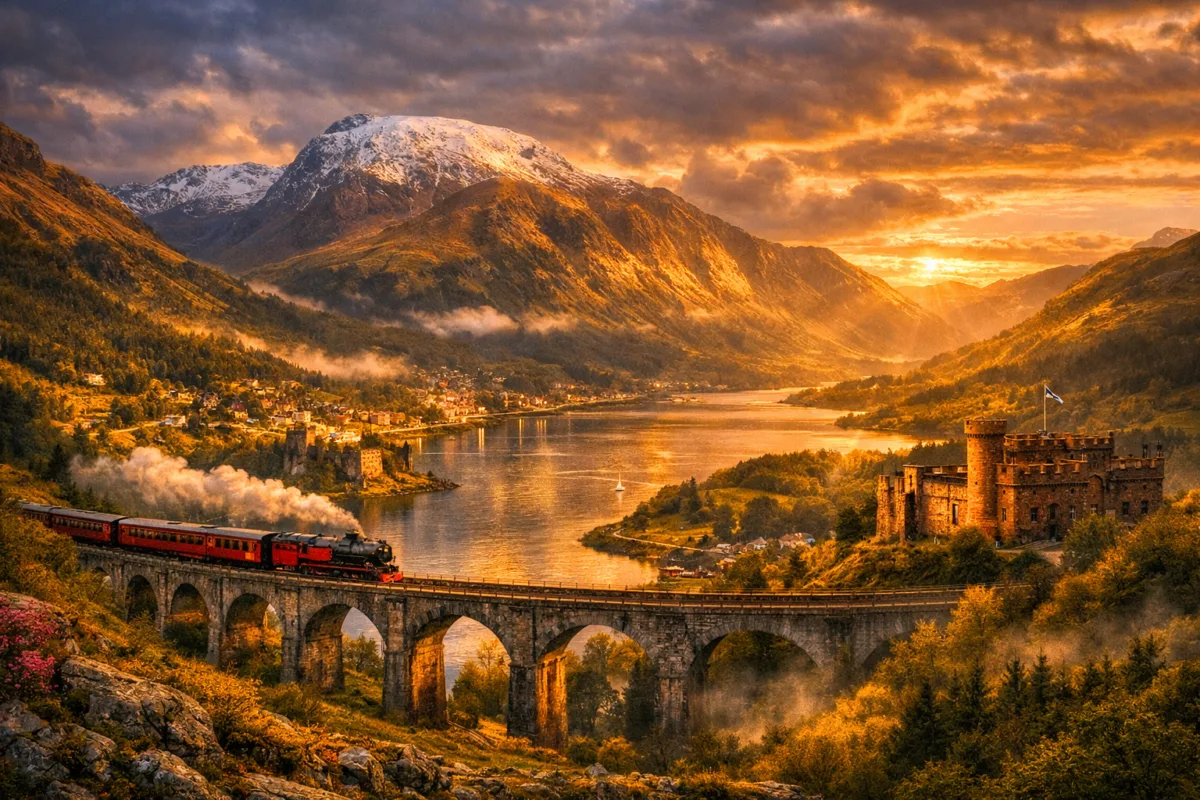
Sixteen miles west of Fort William on the A830, the Glenfinnan Viaduct carries the West Highland Railway over the head of Loch Shiel in a 21-arch curve that is the most photographed railway structure in the UK. The Jacobite Steam Train crosses it between May and October (book months ahead). The Glenfinnan Monument on the loch shore marks the point where Bonnie Prince Charlie raised his standard in 1745 to begin the last Jacobite rising – a moment of history and hubris that ended at Culloden nine months later.
4. The Isle of Skye – Scotland’s Crown Jewel
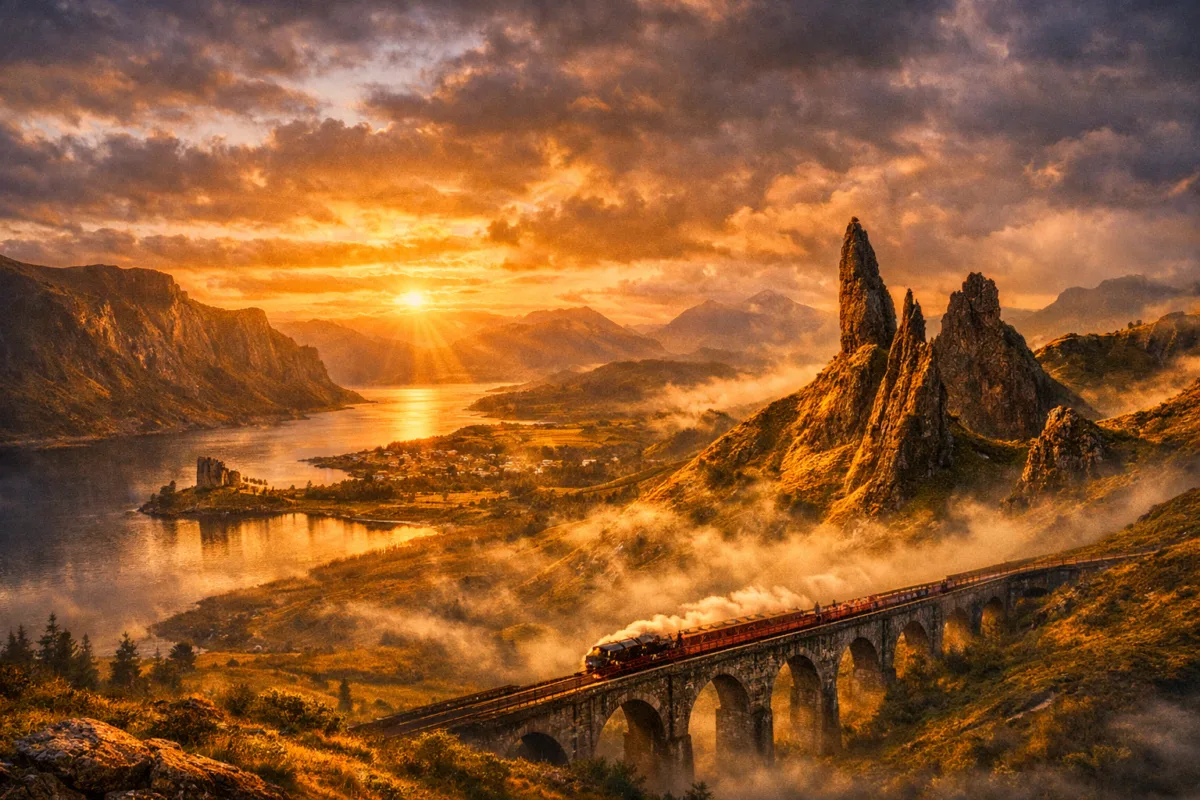
No guide to the Scottish Highlands is complete without the Isle of Skye – a 50-mile peninsula of volcanic rock, ancient limestone, and Cuillin gabbro that juts into the Minch and the North Atlantic and has been the most visited destination in Highland Scotland for the last decade. The crowds are real and manage the island’s narrow roads in summer in a way that requires patience. The landscape is so extraordinary that the patience is warranted.
The Cuillin Ridge – a 7-mile arc of jagged black gabbro peaks that forms the most serious mountain ridge in Britain outside the Alps – dominates the south of the island. The easiest Cuillin summit, Bruach na Frithe, requires a full day and basic scrambling ability. The full ridge traverse is a serious mountaineering undertaking that takes 2–3 days for experienced parties.
For those not doing serious ridge walking, the Fairy Pools at Glen Brittle (a series of glacial waterfalls and turquoise pools in the foothills of the Cuillin) are Skye’s most visited non-road attraction. The car park fills by 8am in summer – arrive before 7:30am or after 6pm. The pools are genuinely extraordinary and the walk (2 miles circular) is accessible for most fitness levels.
The Trotternish Peninsula in the north of the island offers the most diverse and accessible Highland geology in one place: the Old Man of Storr (a 160-foot basalt pinnacle accessible on a 2.5-mile return hike), the Quiraing (a landslip landscape of pinnacles, cliffs, and hidden meadows), and Kilt Rock (a 300-foot basalt sea cliff with a waterfall dropping directly into the sea) are all within 20 miles of each other on the A855 coast road.
Local Insight: Portree, Skye’s main town, is the best base for exploring the island – it has the widest choice of accommodation, good restaurants, and a harbour that is one of the prettiest small town settings in Scotland. Hotellook searches all platforms simultaneously for Portree and Skye accommodation – book at least 6 weeks ahead for July and August stays, when the island’s limited rooms fill completely.
5. The North Coast 500 – Scotland’s Answer to Route 66
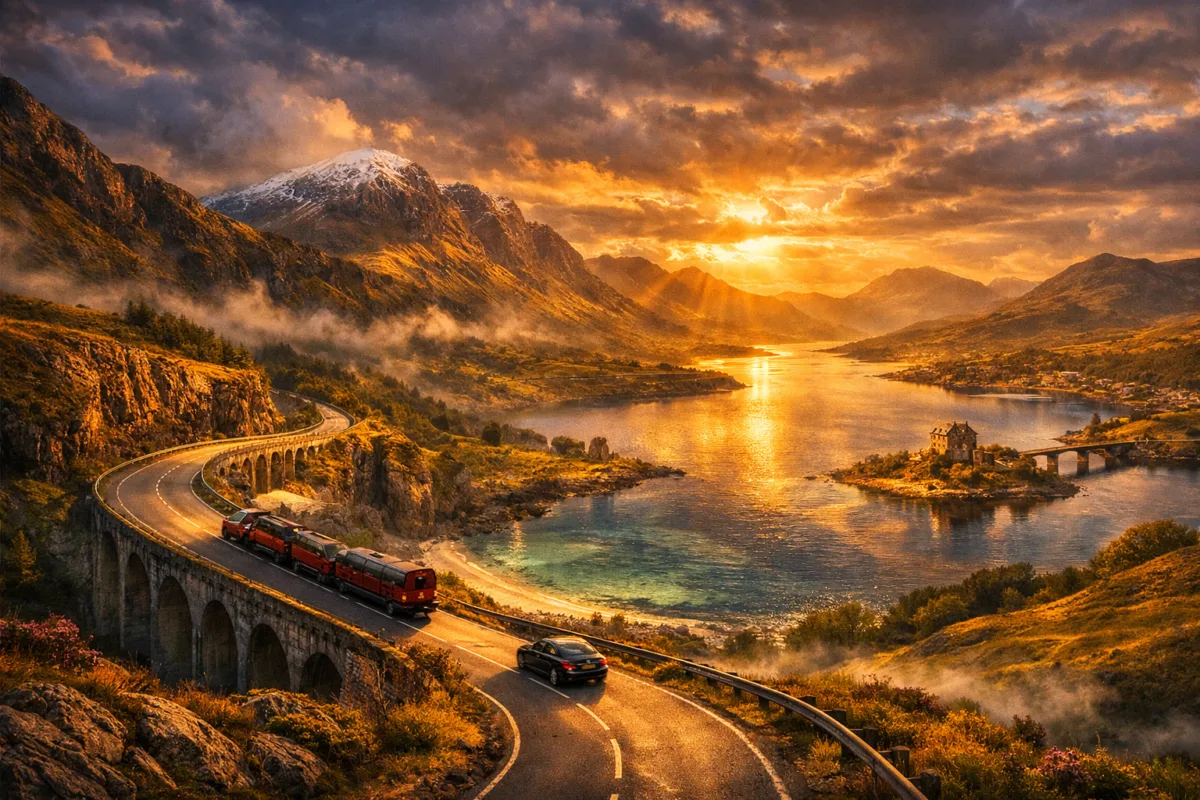
The North Coast 500 is a 516-mile circular driving route that starts and ends in Inverness, looping around the northern tip of mainland Britain through some of the most remote and dramatically beautiful coastal scenery in Europe. It was conceived in 2015 as a marketing initiative for the north of Scotland; it worked, and within two years the route was receiving international attention and the villages along it were developing the accommodation and food infrastructure to support visitors.
The route covers the Black Isle and Easter Ross on the eastern leg; the far north coast through Durness, Tongue, and Bettyhill; and the spectacular west coast – the Torridon mountains, Applecross Peninsula (with the extraordinary Bealach na Bà mountain pass), and the reef-and-loch landscape of Assynt – on the return south. Allow 5–7 days for the full route. The roads in the far north are almost all single-track.
North Coast 500 Unmissable Stops
- Dunrobin Castle (near Golspie): The most fairytale castle in Scotland – French Renaissance spires above formal gardens on the North Sea coast. Falconry displays in summer. Entry £14.
- Smoo Cave (near Durness): A vast sea cave with an inland waterfall accessible by boat tour. One of the most unusual natural structures on the NC500.
- Balnakeil Beach (Durness): A mile of white shell sand on the north coast, with the ruins of a 17th-century chapel at the far end. Empty almost all year. One of the finest beaches in Scotland.
- Suilven (Assynt): A solitary sandstone mountain rising from the Lewisian Gneiss plateau like a thumb – one of the most distinctive silhouettes in the Highlands. The approach hike (12 miles round trip) is long but not technically difficult.
- Bealach na Bà (Applecross): The third-highest road pass in the UK – a series of hairpin bends above 2,000 feet with views on clear days to the Outer Hebrides and the Isle of Skye. The Applecross Inn at the bottom serves the best seafood in the Highlands.
- Torridon: Some of the oldest rocks in the world (750 million years old) form the Torridon mountains – dramatic ridges of red sandstone above a sea loch. The village has a National Trust visitor centre and excellent walking from the road.
Pro Tip: Accommodation on the NC500 – particularly in Durness, Tongue, and Applecross – must be booked well in advance for summer. Some villages have only 2–3 guesthouses and they fill months ahead for June-August. Book through Hotellook to compare all platforms simultaneously, or contact guesthouses directly for availability.
6. The Cairngorms National Park – Britain’s Largest and Highest National Park
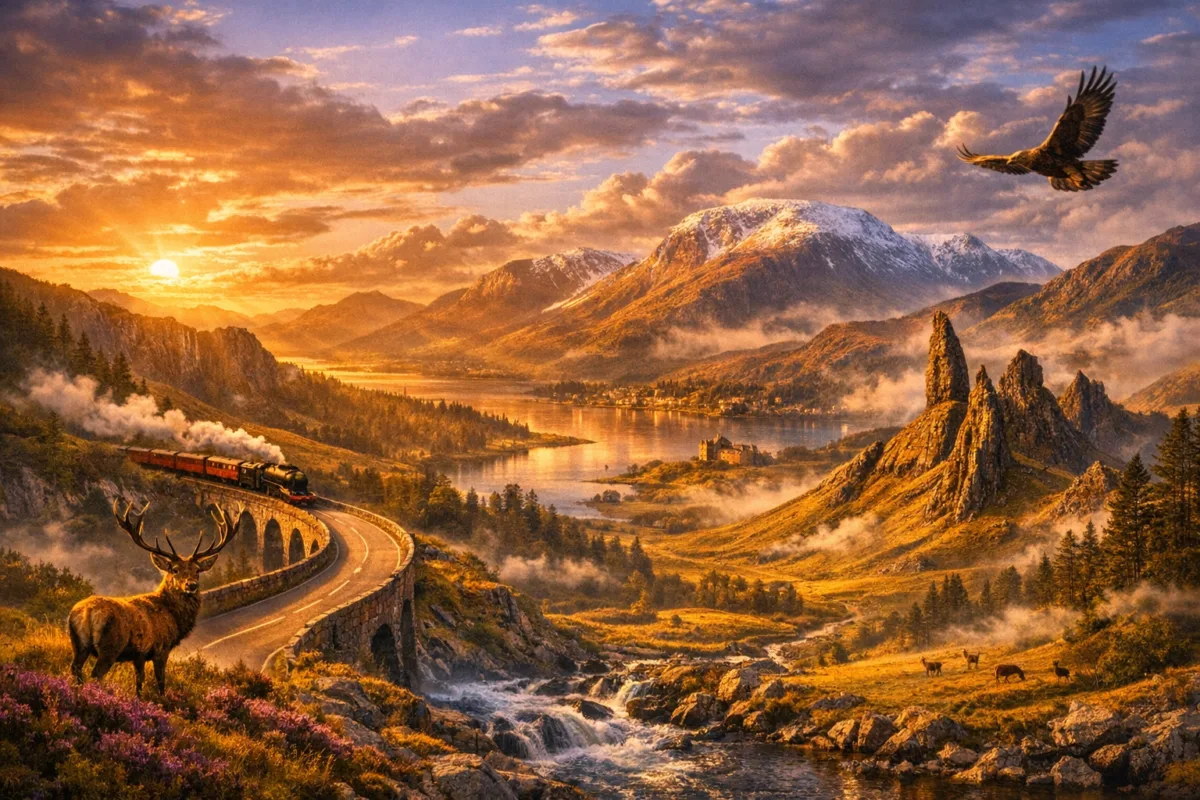
The Cairngorms is the largest national park in Britain and the highest – a high sub-arctic plateau where Britain’s only reindeer herd grazes freely, where the ptarmigan turns white in winter, where ospreys fish the rivers in summer, and where the Cairn Gorm plateau above 1,200 metres has a climate closer to Lapland than to the English countryside forty miles south.
The park encompasses the market town of Aviemore (the main ski resort centre), the Victorian planned village of Grantown-on-Spey, the whisky towns of the Speyside valley, and the dark pine forests of the Caledonian Forest – one of the last remaining fragments of the ancient woodland that covered most of Scotland before 5,000 years of human activity cleared it.
The Cairngorms Mountain Railway (funicular from the Cairn Gorm base station to 1,085 metres altitude) offers the easiest access to the high plateau – the views from the top station on a clear day extend from the North Sea to the Atlantic. The Rothiemurchus Estate near Aviemore has excellent forest walking, red squirrels, and osprey viewing from designated hides. The Highland Wildlife Park at Kincraig is where you’ll most reliably see wolves, lynx, Highland cattle, and reindeer in a Scottish landscape context.
What to Eat and Drink in the Scottish Highlands
Highland Food: The Real Thing
The Scottish Highlands has some of the finest produce in Britain – and increasingly, some of the finest kitchens using it. The transformation of Highland food culture from deep-fried basics to thoughtful cooking using exceptional local ingredients has been one of the great stories of British regional food in the last fifteen years.
Langoustines from the west coast – sweet, firm, barely different from the live state they were in forty-five minutes ago – are the finest shellfish in Europe. The best way to eat them is at a small café on the west coast with a glass of cold white wine and a view of the water they came out of. They cost perhaps £15–20 for a generous portion and they are worth every penny.
Venison from Highland estate stalking is lean, flavourful, and ethical in a way that commercial meat production is not. Venison burger, venison stew, slow-roasted venison haunch – it appears on menus throughout the Highlands and is always worth ordering when it does.
Stornoway black pudding – made on the Isle of Lewis to a centuries-old recipe, with a completely different texture and depth of flavour from the English version – appears on breakfast plates throughout the Highlands. Order it wherever you see it.
Cullen skink – a thick, creamy soup of smoked haddock, potato, and onion – is the definitive Highland soup and one of the great Scottish dishes. It originated in the coastal village of Cullen in Moray and is now served everywhere. A bowl of it on a cold afternoon is one of those experiences that makes obvious why food has always been a comfort as well as a sustenance.
Haggis – sheep’s offal (lung, liver, heart) mixed with oatmeal and spices and cooked in a sheep’s stomach – is the national dish and significantly better than it sounds. The authentic version, served with neeps (turnip) and tatties (potato) and a whisky sauce at a proper restaurant, is hearty and deeply flavoured and tells you something about the practical ingenuity of a people for whom nothing went to waste.
Local Insight: The best Highland restaurant I know is a 20-seater in a converted croft building with no website, a handwritten menu that changes daily, and a list of about forty Scottish gins and fifteen single malts that the owner describes with the enthusiasm of someone who has been thinking about nothing else for the last decade. Find these places by asking at your accommodation. They exist in every Highland town and village. They won’t show up on any travel blog.
Whisky: The Highland Malt Trail
Scotland produces the world’s great single malt whiskies, and the Speyside region – the valley of the River Spey from Grantown to the coast – contains over 50 active distilleries in a 30-mile stretch, making it the highest concentration of whisky production anywhere on earth. The Malt Whisky Trail connects eight of the most visitor-friendly Speyside distilleries with a self-guided driving route.
Essential Distillery Visits
- Glenfiddich (Dufftown): The world’s best-selling single malt, with an excellent visitor centre and tours from £10. The 12-year standard expression is one of the most accessible and well-made whiskies in the world.
- Macallan (near Craigellachie): One of Scotland’s most prestigious distilleries – the new visitor centre building (designed by Rogers Stirk Harbour + Partners) is an architectural landmark in itself. Tastings from £25.
- Glenfarclas (Ballindalloch): Independently family-owned since 1865. The best sherry cask expressions in the Highlands. Small, unfussy, knowledgeable staff. Tours from £12.
- Dalwhinnie (Dalwhinnie): Scotland’s highest distillery, right on the A9 in the southern Cairngorms. The mild Highland character and excellent visitor tour make it worth the stop. Tours from £10.
- Glenlivet (near Livet): The distillery that essentially created the legal single malt industry in 1824. The valley of the Livet is one of the most beautiful in Speyside. Tours from £12.
💡 Pro Tip: Book distillery tours in advance for Macallan (premium experiences book out weeks ahead) and Glenfiddich (group tours fill on summer weekends). Designate one driver per visiting party – Scottish drink-drive limits (50mg/100ml blood alcohol) are stricter than England’s (80mg) and the police enforce them.
Practical Scottish Highlands: Getting There, Getting Around, Costs
Getting to the Scottish Highlands
The main entry points are Inverness Airport (direct flights from London, Manchester, Bristol, and several European cities), Edinburgh Airport (major international hub, 3-4 hours from Inverness by road or train), and Glasgow Airport (2 hours from Fort William, serving international routes including transatlantic). Search for the best fares on Aviasales and earn cashback with WayAway.
From the USA and Canada, the standard routing is via London (Heathrow or Gatwick) or Edinburgh with a connection to Inverness. Direct transatlantic flights land at Edinburgh, Glasgow, and – occasionally – Aberdeen.
If your flight is disrupted, AirHelp handles EU261 compensation claims on a no-win-no-fee basis. Always register a delayed or cancelled flight.
Getting Around: The Car Is King
A rental car is essential for any serious Highland exploration. The public transport network covers the main towns but the single-track roads, the remote glens, the unmarked laybys with extraordinary views – none of this is accessible without your own vehicle. Compare prices across all major UK providers at GetRentACar. Book an economy or compact car – larger vehicles struggle on single-track roads.
For airport transfers when you first arrive (particularly useful if you’re landing late at Inverness), GetTransfer offers pre-booked private cars from Inverness Airport to any Highland destination. For city-to-city transport within Highland towns, InDrive operates in Inverness and the larger Highland communities.
Single-Track Road Rules
Most roads beyond the A9 and A82 in the Highlands are single-track with passing places. The etiquette is straightforward but essential: pull into a passing place when a vehicle approaches from the opposite direction. Do not stop in a passing place. Do not reverse past a passing place you could have used. Let vehicles that are faster than you pass when a passing place appears on your left. Nobody is in a hurry – or rather, locals drive these roads every day and have the muscle memory; visitors take them slowly and that is the correct approach.
What the Scottish Highlands Costs
- Accommodation (per night): Hostel dorm £20-35; B&B private room £60–120; self-catering cottage £80–200; midrange hotel £100-200
- Fuel: Petrol in the Highlands is more expensive than urban Scotland – fill up at supermarket forecourts in larger towns (Inverness, Fort William, Aviemore). Some remote areas have no fuel for 40+ miles.
- Eating out: Pub lunch £10-18; pub dinner with drinks £25-40; restaurant dinner £40-70 per person; fish and chips from a van £8-12
- Activities: Most hiking is free. Distillery tours £10-30. Castle entry £9-15. Boat trips £20-40. Skiing at Cairn Gorm from £40/day lift pass.
Pro Tip: Use our AI Travel Budget Estimator to build a personalised Highland trip budget, and convert GBP to your home currency at the Live Currency Converter before you go.
Best Time to Visit the Scottish Highlands
- May-June (Best Overall): Long daylight hours (up to 18hrs in June), wildflowers, waterfalls at full flow after winter snow melt, midges not yet at peak intensity, accommodation available without months of advance booking
- July-August (Peak Season): Warmest temperatures (15-22°C at sea level), all attractions open, but midges at their worst and accommodation books out far in advance
- September-October (Ideal Second Choice): Bracken and birch turning gold and copper, midges dying off, crowds thinning noticeably after mid-September, deer stalking season (red deer are magnificent in rut in October)
- November-March (Winter): Dramatic and often spectacular – snow on the Munros, frozen lochs, potential for northern lights in the far north, some attractions closed but the landscape fully accessible and often empty
Pro Tip: Scottish Highland midges (Culicoides impunctatus) are small biting insects active May-September in calm, humid conditions – particularly at dawn and dusk near standing water. They are not dangerous but are relentlessly irritating. Bring Smidge repellent (the only product proven to actually work against them), a midge head net for camping, and keep moving in still air. A breeze of any strength eliminates them entirely.
Accommodation Strategy
The Highlands has excellent accommodation at every price point, but availability in summer requires planning. For B&Bs and guesthouses, Hotellook searches all platforms simultaneously. For self-catering cottages (often the best value for groups of 2+ for multiple nights), Intui offers strong coverage of the Scottish self-catering market.
Staying Connected
Mobile coverage in the Highlands is patchy beyond the main towns – the A9 corridor has reasonable 4G, but single-track roads, remote glens, and island crossings often have no signal at all. Download offline maps (Maps.me or Google Maps offline) before heading into remote areas. For international visitors, Airalo and Yesim offer UK data packages. For geo-restricted streaming while in Scotland, NordVPN works reliably on UK networks.
Travel Insurance
Comprehensive travel insurance is essential for any Highland trip involving hill walking – Mountain Rescue operations cost nothing for the person rescued (Scotland has a tradition of free rescue services), but medical treatment and repatriation without insurance is extremely expensive. Ekta Travel Insurance offers flexible adventure activity coverage including hiking, scrambling, and winter sports.
Guided Experiences
For wildlife safaris (red deer, golden eagle, red squirrel, otters on the western sea lochs), whisky tours with a guide who knows the back stories behind the distilleries, and kayaking on sea lochs, WeGoTrip has a growing catalogue of Scottish Highland experiences with English-language booking. For concerts, theatre, and cultural events – the Highlands has a lively traditional music scene – Ticket Network covers major Scottish venues.
If you need to store luggage in Inverness between accommodation check-out and a later departure, Radical Storage has storage locations in the city centre.
Plan Your Scottish Highlands Trip with These Free Tools
- AI Travel Budget Estimator – build a complete Highlands trip budget based on duration, group size, and travel style
- Packing List Generator – custom Highland packing list for variable mountain weather, hill walking, and midge season
- Travel Planning Services – need a custom Highlands itinerary built around your dates and budget? Our team builds them end to end
- More Destination Guides – our full library of UK, Europe, and worldwide destination coverage
- Budget Travel Hub – money-saving strategies that work for Highland travel and every other destination we cover
Frequently Asked Questions
Q1: How many days do you need in the Scottish Highlands?
Five days is the minimum to cover one region properly – Skye, or the Glencoe/Fort William area, or the NC500 west coast section. Seven to ten days allows a genuine loop — Inverness → Glencoe → Skye → NC500 → Speyside → Inverness — without feeling rushed. Two weeks opens up the full NC500, day trips to the outer islands, and the time to stay somewhere long enough to actually understand it. The Highlands rewards slow travel more than almost anywhere in Britain.
Q2: Is the Scottish Highlands safe for solo walkers?
Yes, with appropriate preparation. The hill walking infrastructure is well developed, Mountain Rescue is excellent and free, and the Scottish Outdoor Access Code gives you legal right to walk almost anywhere. The key requirements are: tell someone your route and expected return time before any serious hill walk; carry a map and compass and know how to use them (phone GPS fails in bad weather and low battery); bring the 10 essentials (waterproofs, layers, food, water, first aid, headtorch, emergency shelter, navigation tools, whistle, sun protection); and respect the weather – conditions above 600 metres can deteriorate to dangerous within 30 minutes in any season.
Q3: What is the best base for exploring the Scottish Highlands?
Inverness for the central and northern Highlands, plus Loch Ness, Speyside, and the NC500 start. Fort William for Glencoe, Ben Nevis, and the western Highlands. Aviemore for the Cairngorms and Speyside. Portree (Skye) for the island itself. If you’re doing a loop, Inverness at the start and end works well – good airport, restaurants, and central position.
Q4: When is the best time to visit for the northern lights?
The northern lights (aurora borealis) are visible in the Scottish Highlands from September through March when the nights are dark enough. The far north coast – the area around Durness, Tongue, and Bettyhill on the NC500 – has the darkest skies. The lights require clear skies (check the Met Office mountain forecast), a Kp index of 4+ (check the British Geological Survey aurora alert), and a location away from artificial light. Sightings are never guaranteed but September and March equinox periods statistically produce the most active aurora displays.
Q5: Can you visit the Scottish Highlands without a car?
The main Highland towns – Inverness, Fort William, Aviemore, Kyle of Lochalsh for Skye – are accessible by train and coach from Edinburgh and Glasgow. The Caledonian Sleeper train from London Euston to Inverness, Fort William, and Aviemore is an excellent option for long-distance visitors. Once in the Highlands, local buses cover some routes, and some walking routes are accessible from train stations (the West Highland Way passes several). However, the single-track roads, remote glens, and coastal viewpoints that define the Highland experience are simply not reachable without a vehicle – a rental car is the honest answer.
Q6: What whisky should I buy to take home from the Highlands?
For a first-time buyer, the Glenfiddich 12-year is the best introduction to Highland single malt – universally accessible, well-made, and available at the distillery for slightly less than retail. For something more characterful, the Macallan 12-year Sherry Oak is one of the great benchmark whiskies. For something exceptional and affordable, Glenfarclas 10-year at the distillery shop is extraordinary value. And if you want something genuinely local and special, ask the distillery shop staff what they would choose for themselves – not what they’re told to sell. That conversation always goes somewhere interesting.
Final Thoughts: The Highlands Will Wait, But Go Sooner
There is a particular thing that happens to most people on their first proper trip to the Scottish Highlands – a recalibration that’s hard to describe without sounding like you’ve joined a cult. The landscape does something to the sense of scale. The history – so close to the surface, so specific to this ground – does something to the sense of time. The light, which is unlike anywhere else in Europe, does something to everything it touches.
I’ve met people who have been going back for thirty years and still find something they haven’t seen before. I’ve met people who went once, for a week, and quietly reorganised their priorities around going back. I’ve met people who went for a fortnight and never quite left.
The Highlands will be there when you go. It has been there for a very long time and will continue to be. But the moment you’re in – this autumn, this particular light on this particular loch – won’t repeat. That is the argument for going sooner rather than later, and it’s a good one.
Start planning your Scottish Highlands trip today. Find flights on Aviasales, earn cashback with WayAway, compare car rentals at GetRentACar, book accommodation via Hotellook, stay connected with Airalo or Yesim, get airport transfers via GetTransfer, and protect every walk and drive with Ekta Travel Insurance. Browse our complete Scotland and UK destination guides and budget travel hub for more.
Slàinte mhath — and may the midges miss you.
Hidden Travels Team | hiddentravels.site