

⚠️ Affiliate Disclosure: Some links in this post are affiliate links – we earn a small commission if you book through them, at no extra cost to you. We only recommend services we personally use and trust.
There is a particular version of a European beach holiday that I want nothing to do with. Sun loungers packed so tightly the attendant has to shuffle sideways between them. Water that is a perfectly nice shade of Mediterranean blue but is shared with four hundred other people. A strip of tavernas all serving the same menu of fish and chips and frozen pizza for tourists who couldn’t find a real restaurant or didn’t bother to look.
I have spent years finding the other version. The beach you reach by walking a goat track for twenty minutes and then discovering a cove of white pebbles and water the colour of liquid glass that you share with – at most – a dozen people, and usually fewer. The fishing village that appears on no tourist map but has a woman who sells bread from her kitchen window every morning at seven and a man who keeps his octopus drying on a line in front of a café where a cold Mythos costs €1.80.
Europe has thousands of these places. Most of them aren’t on Instagram. Most of them don’t have an English-language website. Most of them require a degree of initiative – a rental car, a willingness to take the smaller road, a tolerance for arriving somewhere and not knowing exactly what you’ll find.
That initiative is rewarded every single time.
This guide covers 15 genuinely hidden beach destinations in Europe that most tourists – even experienced European travellers – have never heard of. From the Albanian Riviera to the Azores, from Montenegro’s Adriatic coast to Iceland’s volcanic shore, these are the beaches where the water is cleaner, the prices are lower, and the experience is the one you were actually hoping for when you booked a European summer trip.
Pro Tip: Check real-time weather at all these destinations using our Weather Checker, and build your complete trip budget using the AI Travel Budget Estimator before you book anything.
Why Europe’s Famous Beaches Are Failing – And Where to Go Instead
Let’s be honest about what has happened to Europe’s most famous beach destinations. Santorini in July is a queue for a sunset photograph. Dubrovnik’s old town on a Tuesday in August is a cruise ship endurance test. Mykonos – depending on your disposition – is either a paradise or a €28 cocktail on a plastic sunlounger with music you didn’t choose.
None of these places are bad. They became famous because they’re genuinely beautiful. But the experience of visiting them in peak season has become so degraded by their own popularity that the beauty is hard to access. You can see it – through the crowd, over the selfie sticks, from the back of a queue – but you can’t feel it. And feeling it is the point.
The solution isn’t to stop going to Europe’s coast. It’s to go to the parts of Europe’s coast that haven not been discovered yet – or have been discovered by Europeans but not by international tourism. These places are cheaper, less crowded, and often more beautiful than the famous alternatives. They require more research and more flexibility. They reward you accordingly.
Local Insight: The most reliable way to find a genuinely hidden beach is to ask the person running your accommodation where they go for a swim on their day off. Locals never go to the tourist beaches. They go somewhere nearby that has no car park, no café, and no name on Google Maps – just a path and the sea. Ask. Follow the answer. You will not regret it.
15 Hidden European Beaches Worth Every Kilometre of the Journey
1. Gjipe Beach – Albania – Albanian Riviera
Water colour: Vivid turquoise shading to deep Ionian blue – exceptional clarity
Crowd level: Very low – foot access only keeps numbers manageable even in August
Best month: June or September
How to get there: ~2km walk down Gjipe Canyon from a small parking area above
The Albanian Riviera is where Europe’s great coastal secret has been sitting for thirty years, waiting for people to notice. The water rivals the Greek islands for colour and clarity. The food is outstanding and inexpensive – a grilled fish with salad and local wine for €10-15. And because Albania spent four decades in near-complete isolation under Communism, the coastline escaped the concrete development that consumed so much of the Mediterranean.
Gjipe is the best of the hidden beaches on this coast. You park at a small gravel area above the canyon, walk down a limestone gorge for twenty minutes, and emerge onto a wild pebble cove where a freshwater stream runs into the sea. The water at the meeting point is extraordinary – cold and clear from the river, warm and blue from the Ionian – and because there is no road access, it never gets truly crowded even at the height of the Albanian summer.
Pro Tip: Albania requires a rental car to explore the Riviera properly. Compare prices at GetRentACar. Secondary coastal roads can be rough but a standard car handles them fine. Search for flights into Tirana on Aviasales for the best available fares.
2. Dhermi Beach – Albania – Albanian Riviera
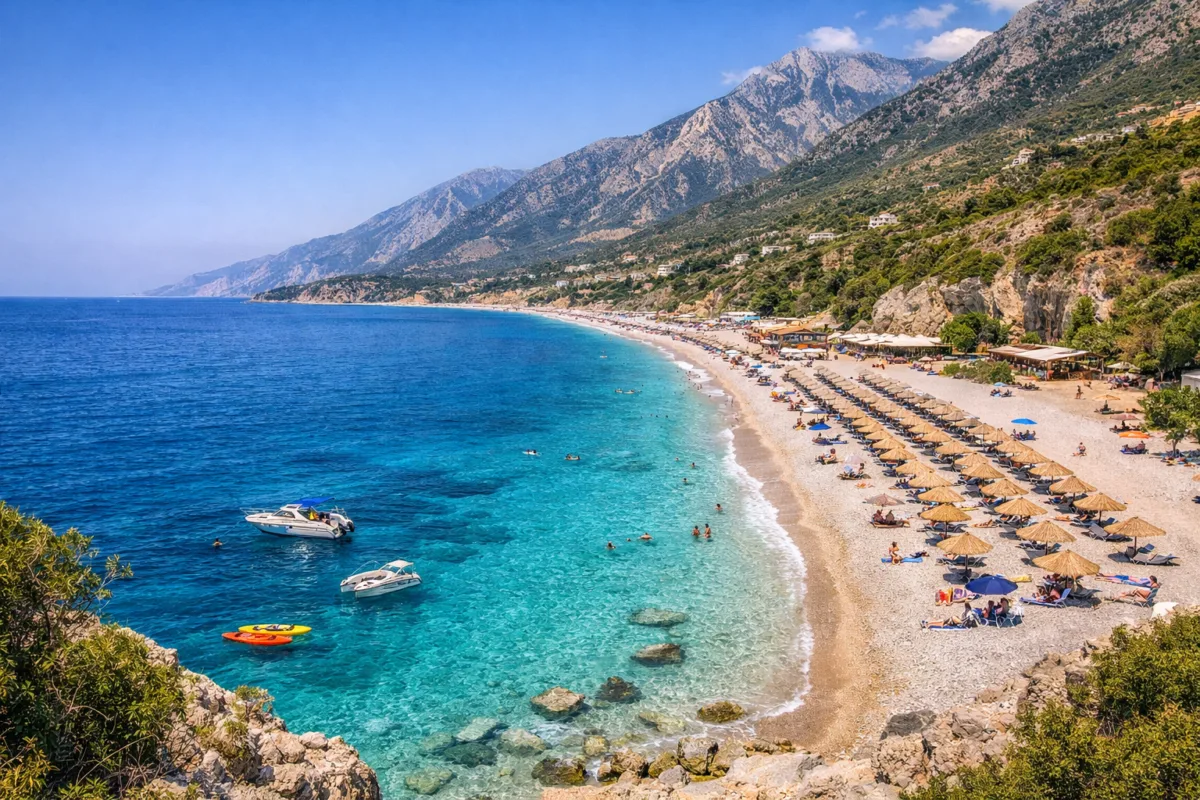
Water colour: Deep blue-green Ionian – pebble shelf drops quickly into clear water
Crowd level: Low to moderate – growing slowly but still far quieter than Greek equivalents
Best month: June or September
How to get there: Steep switchback road down from Dhermi village – well worth the nerve it costs
If Gjipe is the more adventurous option, Dhermi is the Albanian beach that edges toward comfortable without losing its soul. The beach is long and wide, with the kind of water that makes you genuinely wonder why you’ve been paying three times as much to go to Greece. The village above it – a cluster of stone Ottoman-era houses with mountain views behind and Ionian views ahead – is one of the most beautiful settlements on the entire Riviera.
Accommodation in Dhermi is cheap and often excellent. Small family guesthouses typically charge €25-45 per night for a private room with breakfast included. The seafood restaurants on the beach road serve grilled octopus, sea bass, and cold Korça beer at prices that feel like a misprint if you’ve just come from Croatia or the Greek islands.
Local Insight: Dhermi has developed noticeably since 2019 but remains, by any Mediterranean standard, genuinely quiet and affordable. Visit in June before the Albanian and Italian summer crowds arrive, or in September when prices drop and the sea is still warm from three months of summer sun.
3. Sakarun Beach – Croatia – Island of Dugi Otok
Water colour: Flat, transparent Adriatic – more lake than sea in appearance, warm from late June
Crowd level: Low – Dugi Otok is undervisited compared to Hvar, Brač, and Korčula
Best month: Late June to mid-September
How to get there: Ferry from Zadar (1.5 hrs) then local bus or hired bike from Božava
Croatia’s Dalmatian coast is one of the most beautiful in Europe – and one of the most visited. The islands of Hvar, Korčula, and Brač draw enormous numbers of tourists every summer. Dugi Otok (‘Long Island’) lies just a short ferry from Zadar and receives a fraction of their visitors.
Sakarun, on the northern tip of the island, is a protected bay where the water barely reaches waist height for fifty metres from shore, shading through every possible tone of blue and green. The sand is white and fine. Surrounding pines run right down to the beach. Because Dugi Otok has no direct ferry from Split – the main tourist gateway to the islands – it’s mostly visited by Croatians and sailing boats rather than coach tours.
Heads Up: Ferry schedules to Dugi Otok are limited, especially outside peak season. Check the Jadrolinija timetable before planning your trip and build in flexibility – some days only have one or two sailings. The island has no ATMs in smaller settlements, so bring enough cash.
4. Stiniva Cove – Croatia – Island of Vis
4. Stiniva Cove – Croatia – Island of Vis
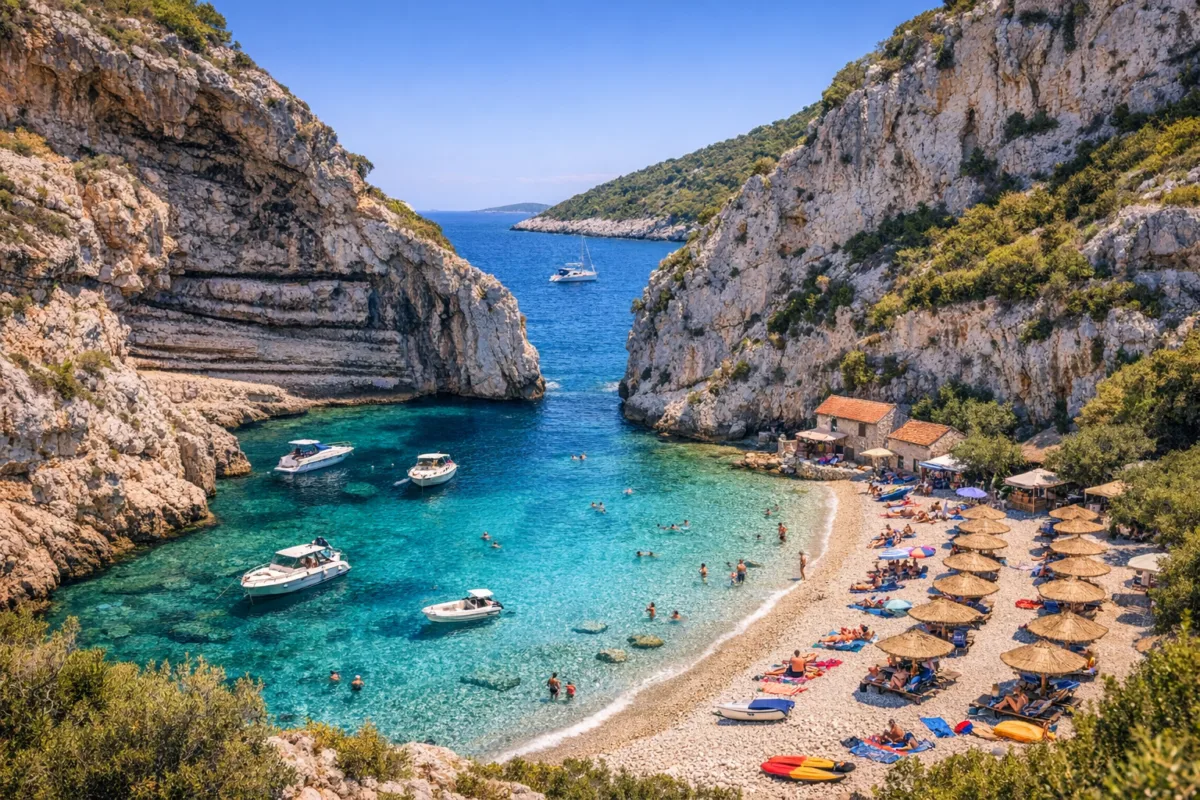
Water colour: Deep, cold, extraordinarily clear inside the cliff-enclosed cove
Crowd level: Low to moderate – physical access naturally limits numbers
Best month: July-August for warmest water; June for solitude
How to get there: Steep 30-min hike from the road above, or by boat from Komiža
The island of Vis is the furthest inhabited island from the Croatian mainland and the last to open to foreign tourism – it was a Yugoslav military base until 1989. That history gave it an authenticity the closer islands lost decades ago: working fishing villages, a pace of life that hasn’t adjusted itself to tourist expectations, and Stiniva.
Stiniva is Vis’s signature natural wonder – a tiny cove surrounded on three sides by fifty-metre limestone cliffs, accessible through a narrow rock opening barely wide enough to swim through. From inside, the oval of turquoise water framed by white rock walls and the tiny entrance to the open sea beyond is one of the most beautiful natural scenes in the Mediterranean. The hike down from above takes thirty minutes and is steep enough that most people descend once and return by boat.
Pro Tip: Take the morning boat from Komiža to Stiniva – you arrive before the heat peaks and before the day-trip boats from Split reach the cove. By noon in August, Stiniva can feel busy despite its difficult access. By 9am, you may have it almost to yourself.
5. Milos Beach – Greece – Lefkada Island

Water colour: Calm, warm, turquoise Ionian with sandy bottom – perfect clarity
Crowd level: Low – no road access means only those who make the effort arrive
Best month: June-September
How to get there: ~1.5 hr boat from Agios Nikitas, or difficult cliff hike – no road exists
Most people have heard of Lefkada – it is the Ionian island connected to the Greek mainland by a causeway, popular with sailors and windsurfers. But Milos Beach on Lefkada’s remote west coast (not to be confused with the separate island of Milos) is the best-kept secret of the Ionians: a sweeping crescent of golden sand beneath towering white cliffs, accessible only by boat or by a demanding path that most visitors are firmly discouraged from attempting alone.
The cliffs above Milos glow orange and white in the afternoon light, and the combination of vertical drama and the flat, completely calm, turquoise water – sheltered from Ionian winds by the walls – creates a setting that looks designed rather than naturally occurring. A taverna boat brings supplies and cold drinks. No sunbed rental. No facilities. The whole effect is extraordinary and, honestly, a little hard to believe when you’re actually standing in it.
6. Myrtos Beach – Greece – Kefalonia Island
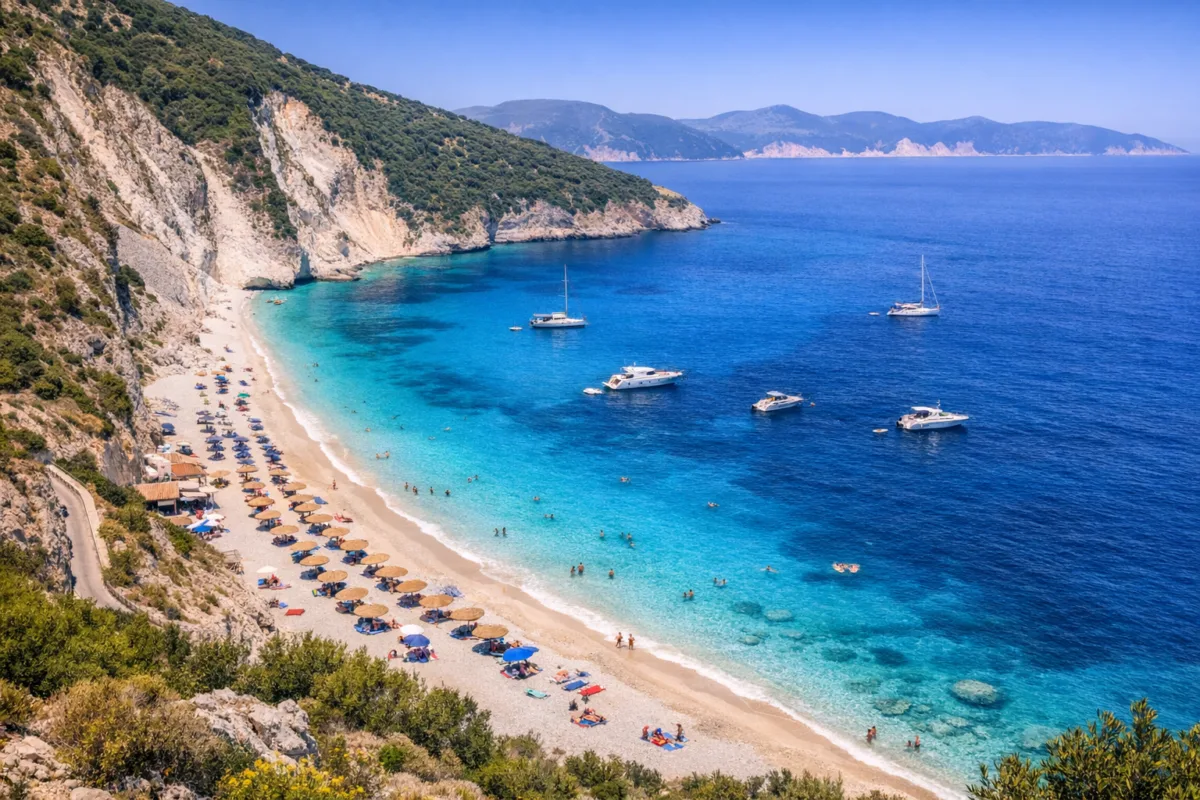
Water colour: Dramatic deep Ionian blue – cold due to depth, no shallow gradual entry
Crowd level: Low to moderate – Kefalonia is accessible but Myrtos is a committed detour
Best month: May-October
How to get there: 12km from Argostoli by car – winding mountain road that is itself part of the experience
Myrtos consistently wins polls for the most beautiful beach in Greece. Because Kefalonia is larger and less convenient than the famous islands, it never gets the crowds those polls suggest it should. The drive down to it on a switchback mountain road – with vertical drops to one side and the Ionian appearing in fragments through the trees – deserves mention alongside the beach itself.
The approach reveals Myrtos incrementally: first the blue through a gap in the mountains, then the white pebbles materialising below the cliff edge, then the full picture arriving as you round the final bend. Stop at the viewpoint before descending. The beach from above, framed by limestone walls and the hairpin road cutting across the top of the frame, is one of the great views in the Mediterranean. Come for the view. Stay for the swim.
7. Paleokastritsa – Greece – Corfu
Water colour: Multiple coves with different depth and colour – some turquoise, some deep green-blue
Crowd level: Moderate – popular with Greeks, much less so with the package tourists who dominate northern Corfu
Best month: May-June or September-October
How to get there: 20km from Corfu Town by car, or bus from the main station
Corfu has a reputation as a British package holiday island, and for the north coast resorts, that reputation is earned. But the west coast around Paleokastritsa is a completely different world – six separate coves of extraordinary water, each with a different character, connected by cliff paths and boat trips between them. The Byzantine monastery of Theotokos has been sitting on the headland above since the 13th century, surrounded by cypress trees, watching the light on the water below change through every season.
Come in May or early June, when the bougainvillea is in full flower, the sea is 20°C, and the Greek school holidays haven’t started. The water in the innermost cove – where a cliff overhang creates a natural cave – is so clear you can see the pebbles seven metres down. The taverna above the main beach serves grilled calamari and cold Mythos and has done so since roughly 1975. Order both.
8. Playa de Gulpiyuri – Spain – Asturias, Green Coast

Water colour: Atlantic blue-green, calm inside the sinkhole bowl, cold (17-19°C in summer)
Crowd level: Very low – beach is tiny and naturally self-limiting in terms of capacity
Best month: July-August (only warm enough for swimming in full summer)
How to get there: Short easy walk from a small car park near Llanes – 15 minutes flat
Northern Spain – the Green Coast of Asturias and Cantabria – is one of Europe’s most dramatically beautiful and least-visited coastlines. While the rest of Europe fries on Mediterranean beaches, this northern coast sits in cool Atlantic air with green mountain valleys running to the sea, medieval towns above fishing harbours, and some of the strangest beaches on the continent.
Playa de Gulpiyuri is the most unusual beach in Europe. It is a beach with no visible connection to the sea – a sinkhole pocket of white sand filled by salt water that arrives through underground limestone tunnels from the open Atlantic, 100 metres away. When the tide rises, the water bubbles up through the sand and fills the interior cove. When the tide falls, it drains back out. From above it looks like a perfectly round paddling pool dropped into a cow field. From inside it feels like a secret the Atlantic keeps.
Heads Up: Gulpiyuri is tiny – perhaps 40 metres across at full size. On summer weekends the car park fills by 10am. Arrive on a weekday, get there before 9am, or visit in the late afternoon when coach tours from Llanes have already left.
9. Praia do Barril – Portugal – Tavira Island, Eastern Algarve
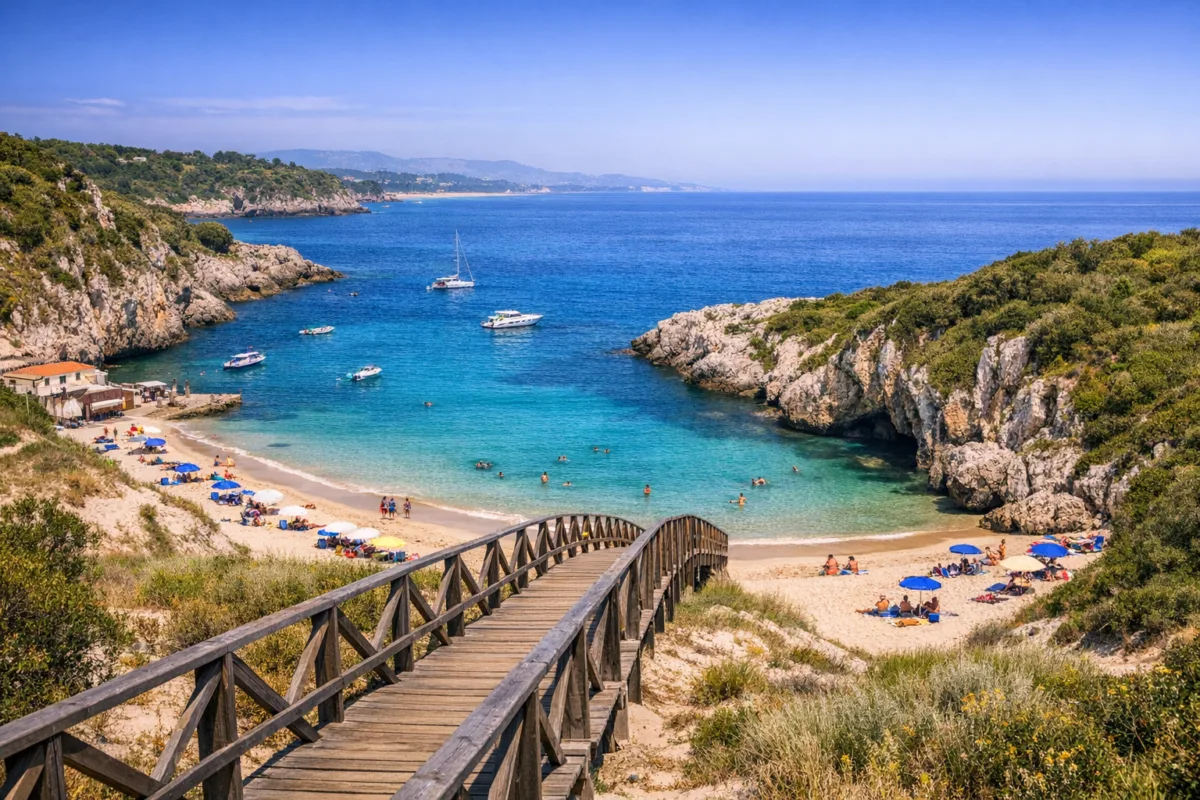
Water colour: Clear Atlantic blue, moderate wave action, cooler than the Mediterranean
Crowd level: Low to moderate – the short journey by miniature train keeps numbers naturally manageable
Best month: May-October
How to get there: Miniature train from Pedras del Rei across the tidal lagoon, or a 20-min walk on the causeway
We covered the famous Algarve beaches – Marinha, Benagil, Camilo – in our Portugal budget travel guide. But the eastern Algarve around Tavira is the part most visitors miss entirely, and Praia do Barril is the most atmospheric way to arrive anywhere on the Portuguese coast.
The miniature train that crosses the tidal lagoon has been running since the 1960s, originally built to carry fishing workers to the island. You step off into a landscape that hasn’t changed much since then: a graveyard of rusted boat anchors from the long-defunct tuna fishing industry, followed by a short walk through pine forest, and then the beach – a long, flat, Atlantic-facing shore of pale sand and moderate surf with plenty of space for everyone. The eastern Algarve in general is everything the western Algarve used to be: quiet, affordable, and genuinely Portuguese rather than optimised for foreign tourism.
10. Praia da Bordeira – Portugal – Costa Vicentina, West Algarve
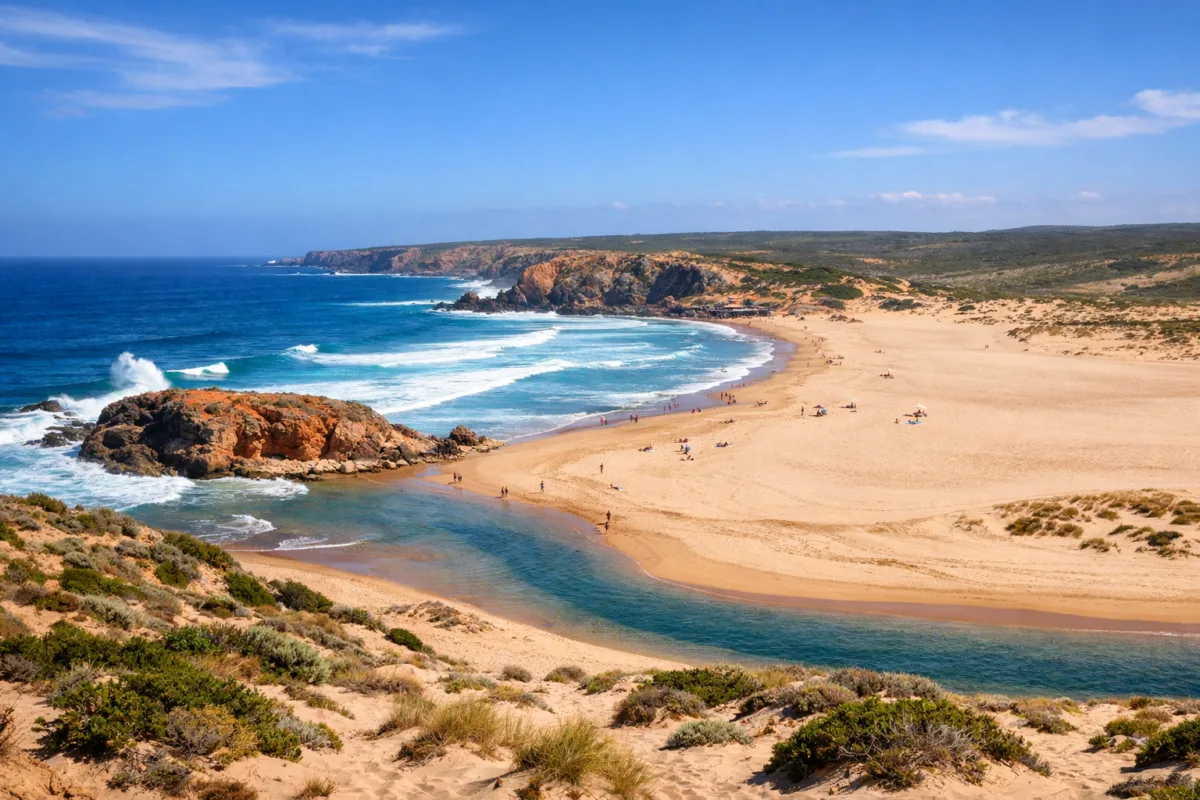
Water colour: Raw Atlantic – powerful, cold (18-20°C), world-class surf conditions
Crowd level: Very low – remote location, no facilities, cold water, strong wind
Best month: April–October for walking; year-round for surfers in wetsuits
How to get there: Car essential – 3km from Carrapateira village, small car park at the top of the dunes
This is what the Algarve looked like before anyone built a hotel on it. Praia da Bordeira sits within the Costa Vicentina Natural Park – Europe’s most south-westerly natural park, which has protected 110 kilometres of Atlantic coastline from development – and it is one of the most spectacular beaches in Europe. More than a kilometre wide at low tide. The Rio Bordeira running along its southern edge. Limestone cliffs rising to both north and south. And the Atlantic arriving in long, powerful, unbroken swells that have crossed thousands of miles of open ocean to get here.
This is not a Mediterranean-style sunbathing beach. The wind off the Atlantic is constant, the sea is serious, and the surrounding landscape of dunes and sea cliffs and open sky is elemental in a way that genuinely moves people. Bring a windbreak, a packed lunch, and a few hours with nowhere else to be.
Pro Tip: Carrapateira village, 3km from the beach, has two excellent restaurants, a small surf school, and board rental. Compare car hire prices for Faro Airport at GetRentACar – a car is completely essential for this stretch of the west Algarve.
11. Plage de Roccapina – France – Southern Corsica

Water colour: Mediterranean – clear, warm, 24-26°C in July and August
Crowd level: Very low – a poor access track filters out almost all casual visitors
Best month: June-September
How to get there: 3km rough track off the N196 – high-clearance vehicle advisable, then a short walk to the shore
Corsica is the most mountainous island in the Mediterranean, with a landscape more like the Alps than the Côte d’Azur and a coastline that alternates between dramatic granite cliffs, fine sandy coves, and water that would embarrass most Caribbean resorts. It is also French, and the French are, by and large, very good at keeping the best parts of Corsica to themselves.
Plage de Roccapina is protected from the road by a poor three-kilometre track, which functions as the most effective natural tourist filter on the island. Those who make the journey find a beach of unusual pink granite sand – the granite itself gives the sand its warm colour – beneath a 100-metre rock formation that looks exactly like a reclining lion and has been sitting there since geological time arranged it. The water is the colour of a swimming pool and the temperature of a bath in high summer. The beach has no permanent facilities, no sunbed rental, and no road noise. Just the pink rock, the blue water, and the sound of the sea.
12. Cabo de Gata Beaches – Spain – Andalusia

Water colour: Warm, very clear Mediterranean – excellent snorkelling, visibility of 15-20 metres
Crowd level: Very low – Spain’s driest corner sees far fewer tourists than the Costa del Sol two hours west
Best month: May-June or September-October
How to get there: Car essential – nearest airport is Almería, approximately one hour away
Two hours east of Málaga along the coast, the tourist infrastructure of the Costa del Sol ends and the Cabo de Gata-Níjar Natural Park begins. The change is immediate and complete. The apartment blocks and beach clubs give way to volcanic cliffs, salt flats, abandoned 18th-century watchtowers, and a coastline that looks more like the Canary Islands than mainland Andalusia.
The beaches here – Playa de Mónsul, Cala de Enmedio, Los Genoveses – range from wide sandy arcs to tiny volcanic-pebble coves, all with Mediterranean-clear water and almost no facilities whatsoever. Mónsul in particular, with its volcanic rock formations rising from the sand like something assembled by a set designer, is one of the most cinematically striking beaches in Europe. Ridley Scott used it as a film location, and it shows.
Local Insight: The villages inside the Cabo de Gata park – San José, Las Negras, Agua Amarga – are small, genuinely local, and inexpensive compared to any resort further west. A grilled fish lunch at Las Negras costs €10-14. In August everything is perfect; in May and October everything is perfect and very nearly empty.
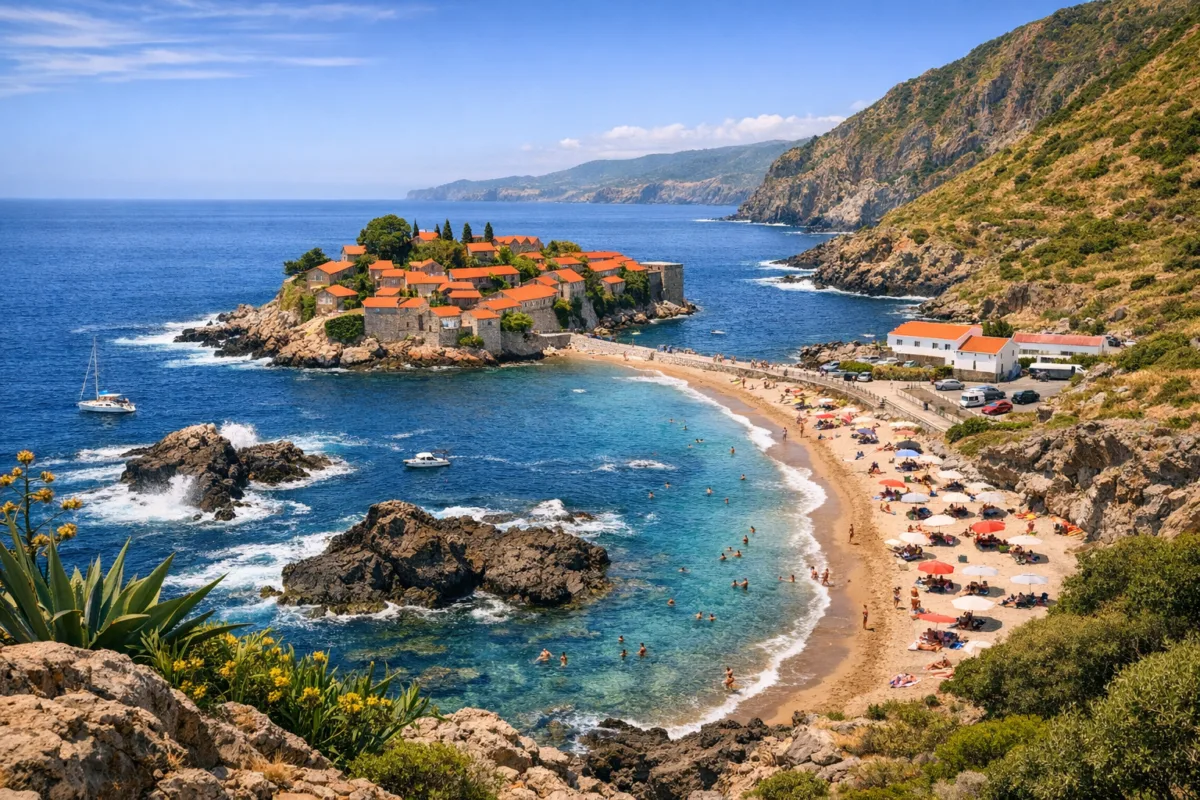
13. Sveti Stefan Beach – Montenegro – Adriatic Coast
Water colour: Very clear, calm Adriatic – warm from June through September
Crowd level: Low to moderate – Montenegro is growing quickly but still far quieter than Croatia
Best month: June-September
How to get there: Car or bus from Budva – 30 minutes south along the coast road
Montenegro is where the Adriatic coast continues after Croatia – literally just a short drive south across the border – and it remains significantly less visited, less developed, and less expensive than its northern neighbour. The Bay of Kotor alone, a deep fjord-like inlet enclosed by medieval walled towns and vertical karst mountains, is one of the great views in Europe. The beach coast stretching south from Budva adds another reason to come.
Sveti Stefan is the postcard image of Montenegro – a tiny 15th-century stone island connected to the mainland by a narrow causeway, now operating as the Aman resort at €1,000+ a night. The public beaches on either side of the causeway are, however, entirely free. The pink-sand coves flanking the island have one of the great free views in European travel: the medieval silhouette of the island rising from the Adriatic, framed by mountains behind and deep blue water on three sides, all available to anyone who shows up with a towel.
Pro Tip: Montenegro uses the Euro despite not being an EU member, which makes budgeting simple. The country is roughly 40% cheaper than Croatia for food, accommodation, and activities. Find flights into Tivat Airport on Aviasales and compare accommodation prices at Hotellook.
14. Ponta da Ferraria – Portugal – São Miguel, Azores
Water colour: Atlantic meets volcanic thermal spring – unique mix of cold ocean and warm geothermal water
Crowd level: Very low – the Azores attract adventure travellers, not beach crowds
Best month: June-September
How to get there: Car from Ponta Delgada, 45 minutes – access path from a small car park above the rocks
The Azores – nine volcanic islands 1,500 kilometres west of Lisbon in the middle of the Atlantic – are Europe’s best-kept island secret. Direct flights now run from London, Lisbon, and several US cities, but the archipelago still attracts a fraction of the visitors of Madeira, Tenerife, or any Greek island. São Miguel, the largest island, has volcanic calderas filled with brilliant green lakes, resident sperm whales viewable from shore, and Ponta da Ferraria – a tidal rock pool fed by volcanic springs at 27-29°C that meets the cold Atlantic at its outer edge.
Bathing here at high tide when waves wash over the rim and mix cold ocean with warm volcanic water is one of the most unusual swimming experiences anywhere in Europe. The Azores are also the best-value sun destination in the European Atlantic: accommodation is 40-60% cheaper than the Algarve, local restaurants serve enormous portions of fresh Atlantic fish for €8-14, and the island genuinely rewards slow, curious travel over beach-lounging.
15. Reynisfjara Black Sand Beach – Iceland – South Coast
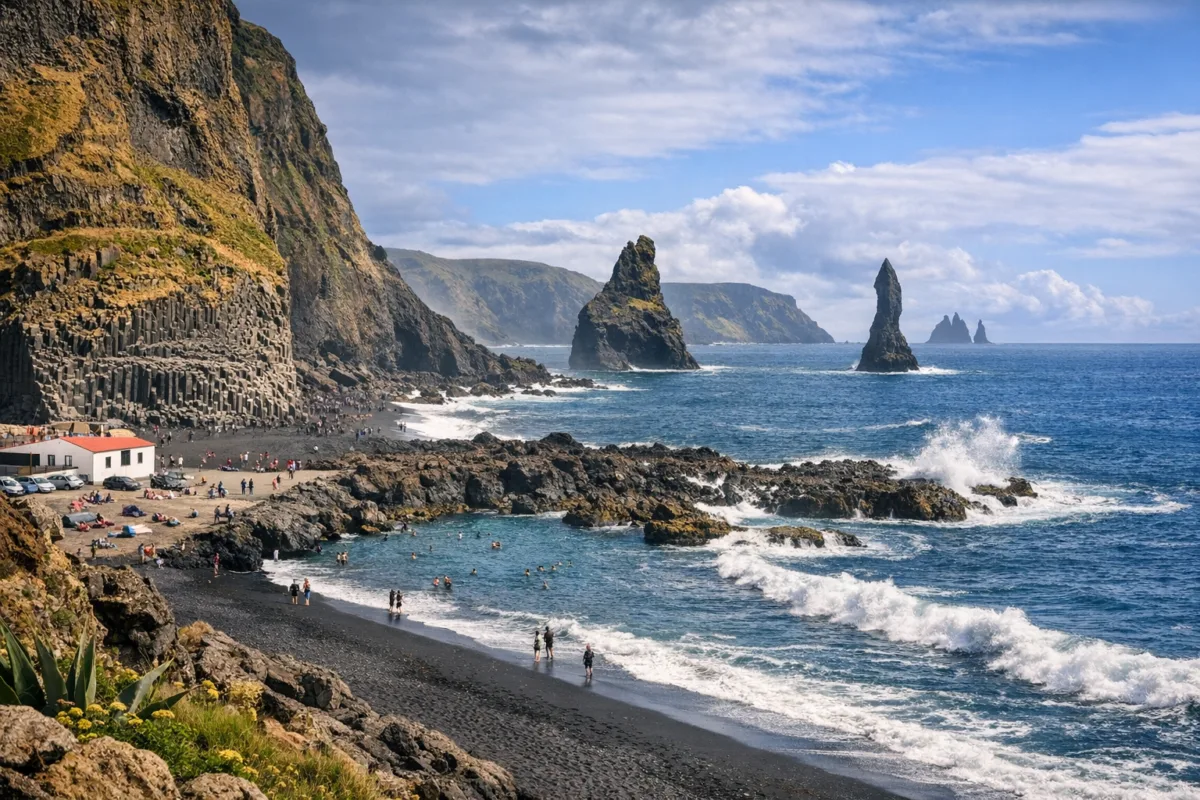
Water colour: North Atlantic – dark, cold (5-10°C), dangerous surf – this is not a swimming beach
Crowd level: Low to moderate – Iceland’s south coast draws fewer visitors than Jokulsarlon or Skógafoss
Best month: June-August for safest weather; November-February for aurora overhead
How to get there: 30 minutes from Vík by car – easy access, well signed from the Ring Road
Reynisfjara is not a beach in any Mediterranean sense. You do not swim here. You do not sunbathe here. The water temperature is 6°C and the Atlantic swells arrive without warning from thousands of miles of open ocean, and people have been seriously injured and killed by sneaker waves – waves that arrive much higher and faster than the surrounding surf – at this exact spot.
What Reynisfjara is, is the most viscerally, dramatically powerful beach setting in Europe. Black volcanic sand stretched under a sky that does something different every ten minutes. Basalt column formations – the Reynisdrangar sea stacks rising from the water, the cave columns of Hálsanefshellir right beside the beach – that look assembled by an ancient civilisation rather than deposited by geology. Waves the colour of deep water arriving in unbroken lines on a shore that curves away in both directions to the horizon.
Visit this beach and no other beach in Europe will look quite the same afterwards. It recalibrates the whole thing.
Heads Up: Sneaker waves at Reynisfjara are extremely dangerous and have killed visitors. Stay well above the high-tide line at all times. Never turn your back on the ocean. Never stand on the rocks close to the water. Heed every warning sign. The beach is beautiful and the risk is entirely real – respect both.
Getting to Europe’s Hidden Beaches: Flights, Ferries & Everything in Between
The common thread across all 15 destinations in this guide is that they require more effort than the famous alternatives. That effort is the filter that keeps them worth going to. It is also entirely achievable with the right planning.
Flights to Europe
For transatlantic and international flights to European gateway cities, Aviasales compares fares across dozens of airlines simultaneously. For cashback on bookings, WayAway adds a percentage return on every flight – useful on longer-haul purchases. If your flight is delayed or cancelled, AirHelp handles EU261 compensation claims on a no-win-no-fee basis, so there’s no reason not to register your disrupted flight with them.
Car Rental – Essential for Most of These Beaches
Twelve of the 15 beaches in this guide require a rental car to reach in any reasonable time. Compare prices across all major providers – including local operators that global aggregators miss – at GetRentACar. Book at least two weeks ahead for summer dates in Albania, Montenegro, and Portugal, where availability tightens quickly in July and August.
Ferries and Sea Transport
For island destinations – Vis, Dugi Otok, Corsica, the Azores – ferry schedules are the critical planning piece. Sea Radar covers sea transport routes across European waters, including Adriatic ferries to Croatian islands and Atlantic connections. Always check schedules before booking non-refundable flights – island ferry timetables change seasonally and can be limited outside July and August.
Accommodation at Hidden Destinations
Most hidden beach destinations have limited accommodation – small guesthouses, family apartments, and basic hotels rather than large resorts. Hotellook searches across all booking platforms including smaller regional sites that global aggregators miss, making it the best single tool for finding accommodation in less-visited places. For self-catering apartments and weekly rentals, Intui is worth checking alongside for better weekly rates.
Staying Connected Abroad
Mobile coverage at remote beach destinations ranges from reliable (Portugal, Spain, mainland Croatia) to patchy (Albanian Riviera, remote Corsica, rural Iceland). An eSIM active before departure removes all roaming concerns. Airalo and Yesim both offer Europe-wide packages covering all 15 destinations in this guide. For access to geo-restricted streaming services while abroad, NordVPN works reliably across European networks.
Travel Insurance
Remote beach travel – particularly in the Azores, Iceland, the Albanian mountains, and Corsican interior – involves terrain and activities where comprehensive insurance is non-optional. Ekta Travel Insurance offers flexible policies covering hiking, water sports, and adventure activities, with good coverage for the less-visited European destinations that some standard policies exclude.
Tours and Local Experiences
For boat trips to sea caves, guided snorkelling at Cabo de Gata, kayak tours around Corfu’s coves, and whale-watching departures in the Azores, WeGoTrip has a strong European catalogue with English-language booking. Particularly useful for first-time visitors to Albania, Montenegro, and the Azores where a knowledgeable local guide adds genuine context. For events, shows, and festivals near your beach destination, Ticket Network covers major European venues with English-language booking.
Luggage Storage for Beach Days
If your accommodation doesn’t offer early check-in and you want to head straight to the beach after landing, Radical Storage has storage locations across Europe’s major gateway cities – Lisbon, Barcelona, Athens, Rome – so you can drop your bags and get moving immediately.
Plan Your European Beach Trip with These Free Tools
Before you book anything, use the free planning tools on Hidden Travels:
- AI Travel Budget Estimator – calculate your total trip cost for any European destination based on travel style and group size
- Packing List Generator – custom beach packing list for Mediterranean, Atlantic, or Nordic conditions
- More Destination Guides – deeper coverage of Albania, Portugal, Croatia, Greece, Spain, and Iceland
- Budget Travel Hub – money-saving strategies that work across every one of these destinations
Frequently Asked Questions
Q1: Which hidden European beach is the best overall?
It depends entirely on what you want. For the combination of water colour, crowd levels, and sheer affordability, Gjipe Beach in Albania wins – Ionian clarity, almost zero tourism infrastructure, extraordinary food in the villages nearby, and prices that feel like Europe a decade ago. For dramatic scenery rather than classic swimming, Reynisfjara in Iceland is incomparable. For the most practical balance of beauty, accessibility, and value, Cabo de Gata in Spain covers every base simultaneously.
Q2: Is it safe to travel to Albania for a beach holiday?
Yes – considerably more than the outdated reputation suggests. Albania was genuinely difficult and occasionally unsafe in the 1990s; it has changed dramatically since. The Albanian Riviera in particular is safe, welcoming, and well set up for independent travel. Roads can be challenging, some beaches have no facilities, and tourist infrastructure is less developed than Greece or Croatia – which is entirely the point. Violent crime against tourists is rare. The same common-sense precautions you’d take anywhere in southern Europe apply here.
Q3: What is the best month for European beach travel?
For Mediterranean destinations, June and September are the answer – water temperature is at or near its warmest from accumulated summer heat, crowds are dramatically lower than July and August, prices drop 30-50%, and the light is better for photography. For Atlantic destinations – Portugal, northern Spain, the Azores, Iceland – June through August offers the best weather and warmest water, though the Atlantic rarely exceeds 22°C even in peak summer.
Q4: How do I find hidden beaches that aren’t on this list?
The most reliable methods: Google Maps satellite view – zoom into unfamiliar coastlines and look for coves with no road access and no blue map pins. AllTrails for hiking routes that end at beaches. Regional tourism boards rather than national ones (they promote lesser-known places that national boards overlook). And most reliably of all – asking the person running your accommodation where they go for a swim on their day off. That one works every single time, in every country, without exception.
Q5: Do I need a visa for Albania or Montenegro?
Both have visa-free arrangements with EU member states, the UK, USA, Canada, and Australia for stays up to 90 days. Albania is not an EU or Schengen member; Montenegro is an EU candidate country – neither is currently part of the Schengen Area. Check the specific entry requirements for your nationality directly at the relevant embassy websites before booking, as visa rules do occasionally change.
Q6: Are these hidden beaches suitable for families with children?
Several are excellent for families: Sakarun Beach in Croatia is extremely shallow, calm, and sandy – ideal for young children. Paleokastritsa in Corfu has multiple sheltered coves at different depths. Dhermi in Albania has a gentle entry and long beach. Avoid Reynisfjara (extremely dangerous waves), Praia da Bordeira (strong surf and wind), and Gjipe (steep access path) for young children or non-swimmers. Always check local conditions before taking children to any unfamiliar beach.
Final Thoughts: The Empty Beach Is Always Out There
There is a moment that happens on every hidden beach I’ve been to – without exception, regardless of country, coast, or weather. It happens after you’ve found your way there and taken off your shoes and stood for a minute looking at the water. It’s a moment of quietly surprised satisfaction: I found it. I’m here. And it’s better than I thought it would be.
The crowd anxiety that comes with planning a European beach holiday – the worry that everywhere worth going will be packed, overpriced, and vaguely disappointing – turns out to be specifically about the famous places. The famous places are packed and expensive. But the coast of Europe is enormous, and the famous places occupy perhaps five percent of it. The other ninety-five percent is out there, mostly quiet, waiting for the people willing to do a little extra work to get there.
These 15 beaches are a starting point. Go to one of them. Then ask the person running your accommodation where they go for a swim on their day off. Follow that answer. That is always where the real thing is.
Start planning your European beach adventure today. Find flights on Aviasales, earn cashback with WayAway, rent your car at GetRentACar, book accommodation via Hotellook, activate your eSIM with Airalo or Yesim, sort ferry routes via Sea Radar, book tours with WeGoTrip, and protect every moment with Ekta Travel Insurance. Browse all our Europe destination guides and budget travel tips for the complete picture.
Go find your empty beach.
Hidden Travels Team | hiddentravels.site