
Here is a number that should change how you think about packing: $160.
That’s what Ryanair charges for a checked bag on a return European flight in peak season. Add priority boarding (often necessary to guarantee carry-on bin space): another $36. Spirit Airlines charges up to $99 per checked bag each way on US domestic routes. On a return trip: $198. Just for the privilege of bringing more clothes than you need.
Budget travel has a dozen components – cheap flights, affordable accommodation, street food, smart transport choices. But packing light is the one that directly affects your cost before you even reach the airport. It is also the one that most travelers get consistently wrong, year after year, until the day someone teaches them the system.
This guide is that system.
What follows is the complete packing framework for budget travelers: exactly what to bring, what to leave behind, how to fit a week or more of travel into a single carry-on bag, and why doing so will save you hundreds of dollars per year while making every trip easier, faster, and more spontaneous.
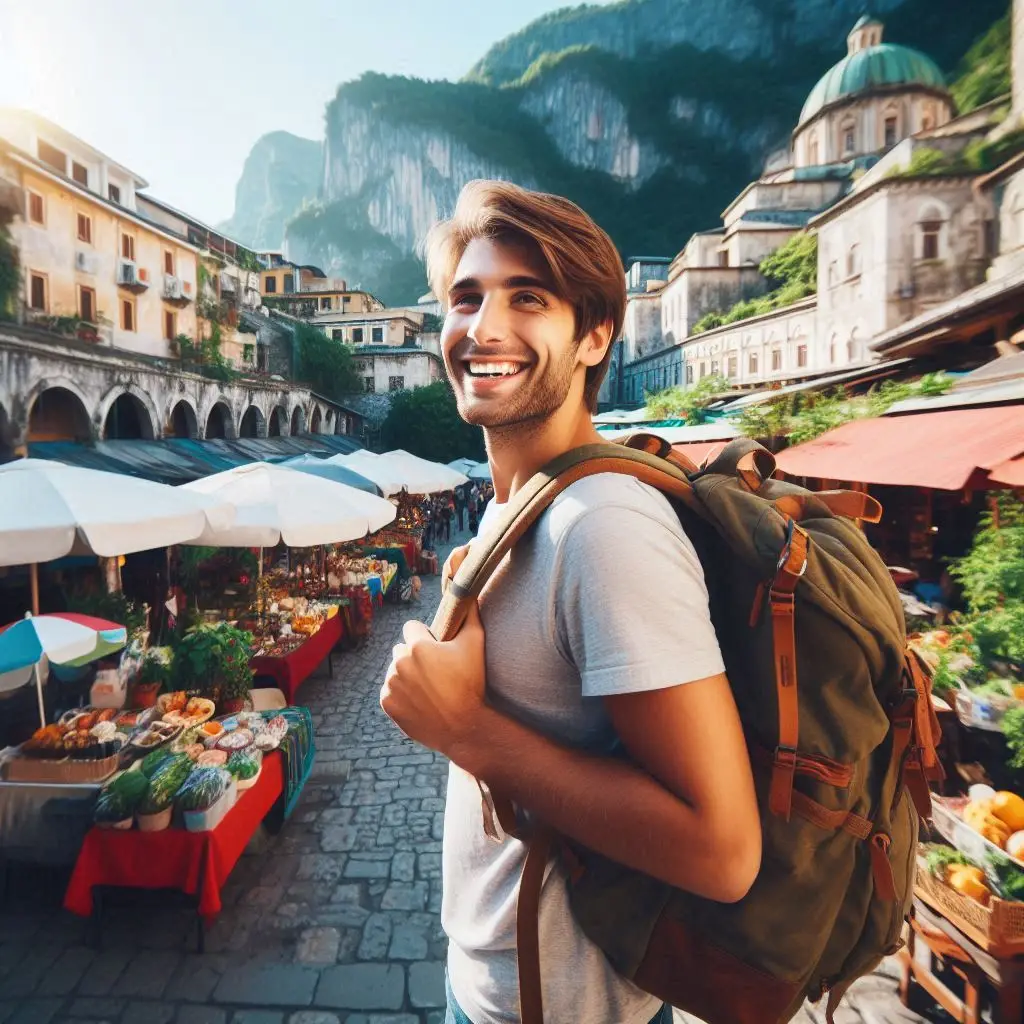
The goal is not minimalism for its own sake. The goal is strategic lightness: bringing everything you genuinely need and nothing you do not – so that you board every flight without fees, clear every airport faster, and arrive at every destination with your energy intact instead of your back broken.
The Financial Case for Packing Light: How Much You Actually Save
Let’s put real numbers to the packing light argument before getting into the list itself.
| Airline | Checked Bag Fee (Each Way) | Return Trip Cost | 4-Trip Annual Cost |
| Ryanair (Europe) | $45–80 | $90–160 | $360–640 |
| easyJet (Europe) | $30–70 | $60–140 | $240–560 |
| Spirit (USA domestic) | $49–99 | $98–198 | $392–792 |
| Frontier (USA domestic) | $49–79 | $98–158 | $392–632 |
| Wizz Air (Europe) | $30–70 | $60–140 | $240–560 |
| AirAsia (SE Asia) | $15–40 | $30–80 | $120–320 |
A budget traveler who takes four return trips per year and checks a bag every time pays $240–792 in baggage fees alone – before spending a dollar on the actual travel experience. Eliminating checked bags on those four trips could fund an entire extra trip.
Our free Packing List Generator builds you a destination-specific carry-on list so you know exactly what to bring for any trip and can confidently leave the checked bag behind.
The 5 Golden Rules of Budget Traveler Packing
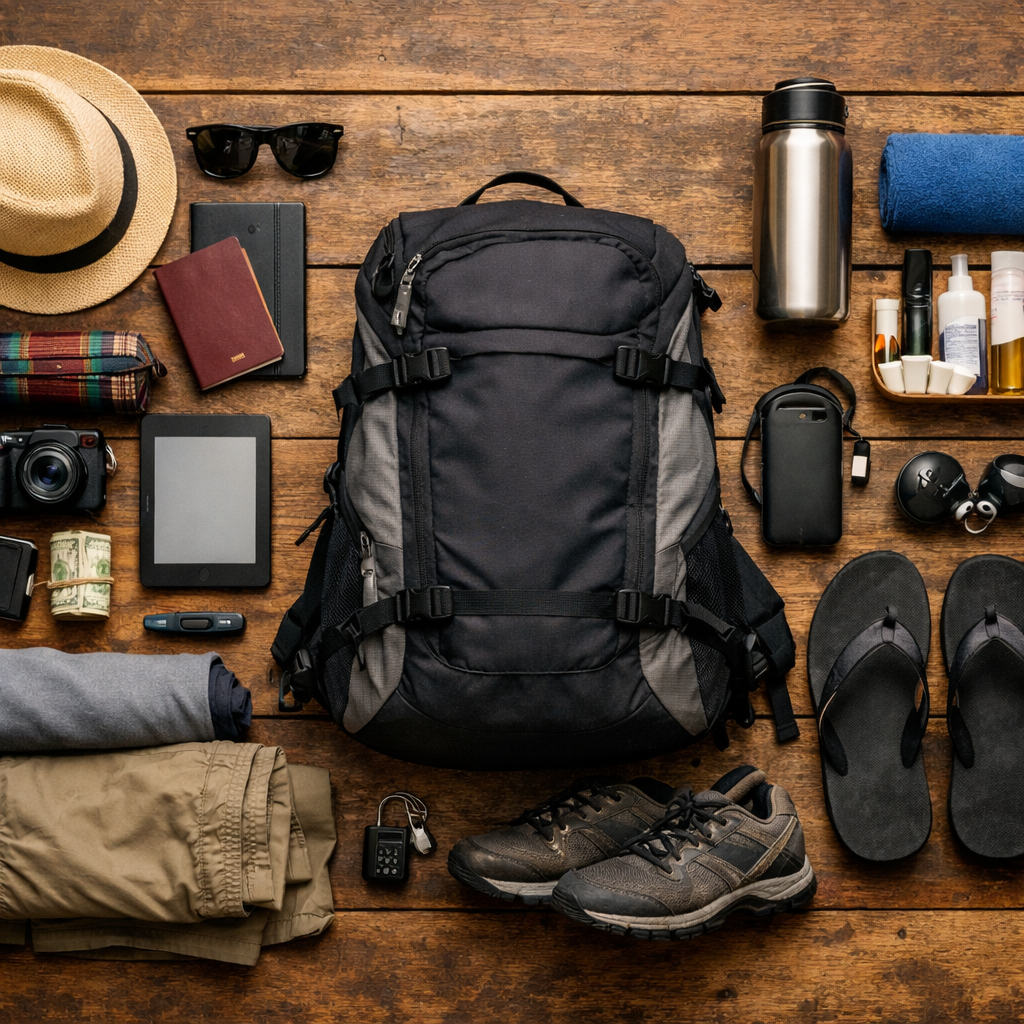
| Hack #1: One Bag Only – Always One carry-on bag is the non-negotiable foundation of budget travel packing. Not a checked bag plus a carry-on. Not a checked bag for longer trips. One bag, always, for any trip up to three weeks (and with the right system, longer).The carry-on limit for most airlines is 10-12kg and dimensions of approximately 55 x 40 x 20cm (22 x 16 x 8 inches). A 20-26 litre backpack or a small rolling carry-on fits within these limits and is more than enough for any trip.Best travel backpack size: 20-26 litres for warm-weather trips. 26–32 litres for cold-weather trips requiring layers.Packing cubes: One of the single best investments a budget traveler can make. They compress clothing, create organisation, and make airport security fast. |
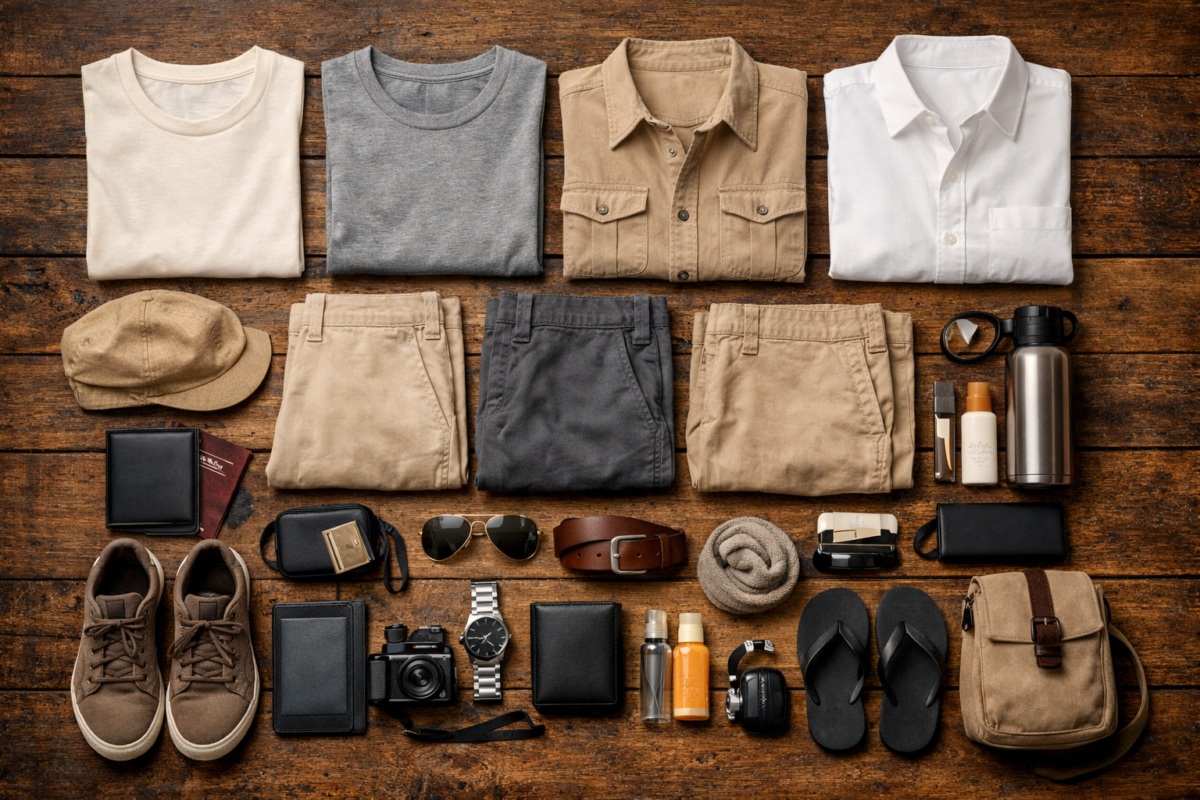
| Hack #2: Choose a Neutral, Versatile Capsule Wardrobe The reason most travelers overpack is emotional rather than practical: they pack for every possible scenario rather than the most likely scenarios. The solution is a capsule wardrobe – a small number of neutral-coloured, versatile pieces that mix and match to create multiple outfit combinations.The core principle: Every item of clothing you pack should work with at least two other items. A navy t-shirt that goes with shorts and with trousers is worth packing. A novelty printed shirt that only works one way is not.Neutral colours only: Black, navy, grey, white, khaki. These mix and match. Bright colours and patterns don’t.Merino wool is transformative: One merino wool t-shirt can be worn 3-5 days without washing, dries overnight, doesn’t smell, and packs to almost nothing. Worth the investment for any traveler. |
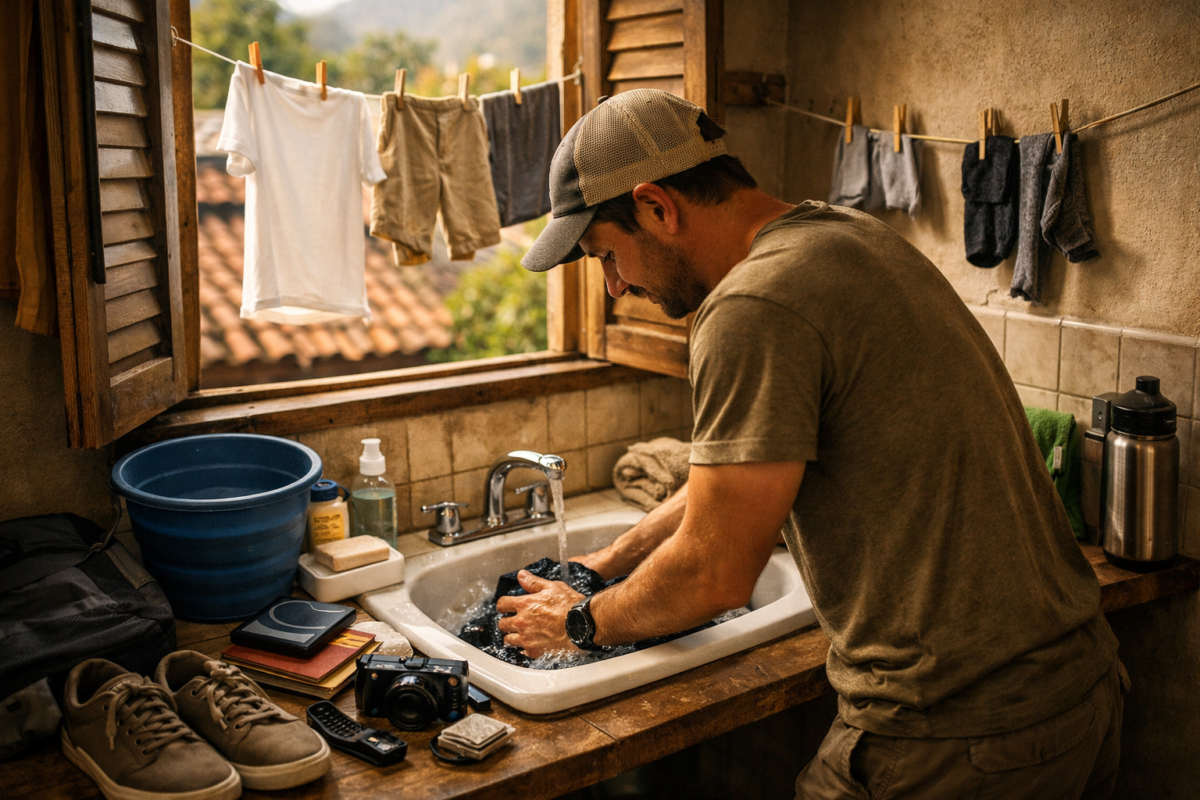
| Hack #3: Do Laundry on the Road The reason you need less clothing than you think is that laundry exists everywhere you’re going. Hostels have washing machines ($2-4 per load). Laundromats exist in every city. Hotels offer laundry service. Handwashing in a sink with a travel soap bar takes 10 minutes and is free.Rule of thumb: Pack for 5-7 days, no matter how long your trip. If you’re travelling for 3 weeks, you do laundry twice. This keeps your bag light for a 3-day trip and a 30-day trip alike.Quick-dry fabrics only: Pack clothing that dries overnight when handwashed. Cotton dries slowly; synthetic fabrics and merino wool dry fast. |
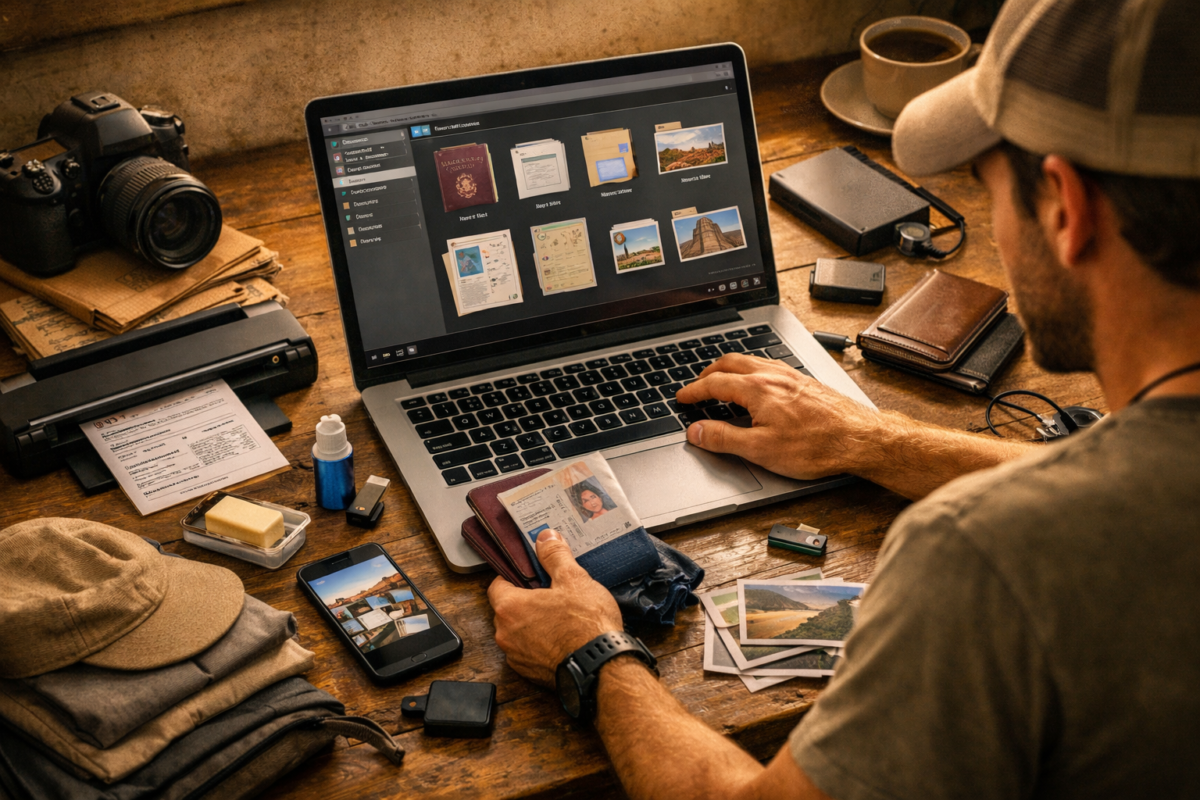
| Hack #4: Digitise Everything Possible Books, maps, guidebooks, physical tickets, printed hotel confirmations, currency exchange notes – every physical item that can be replaced by an app or a PDF should be. Your phone holds your boarding pass, your accommodation confirmation, your offline map, your translation app, your currency converter, and your travel documents.Essential travel apps: Maps.me or Google Maps (offline), Google Translate (offline language packs), your airline app (mobile boarding passes), your bank app (card freeze feature), and the Hidden Travels Currency Converter. Digital documents: Photograph your passport, insurance documents, and accommodation confirmations. Store in a cloud folder accessible from any device. |
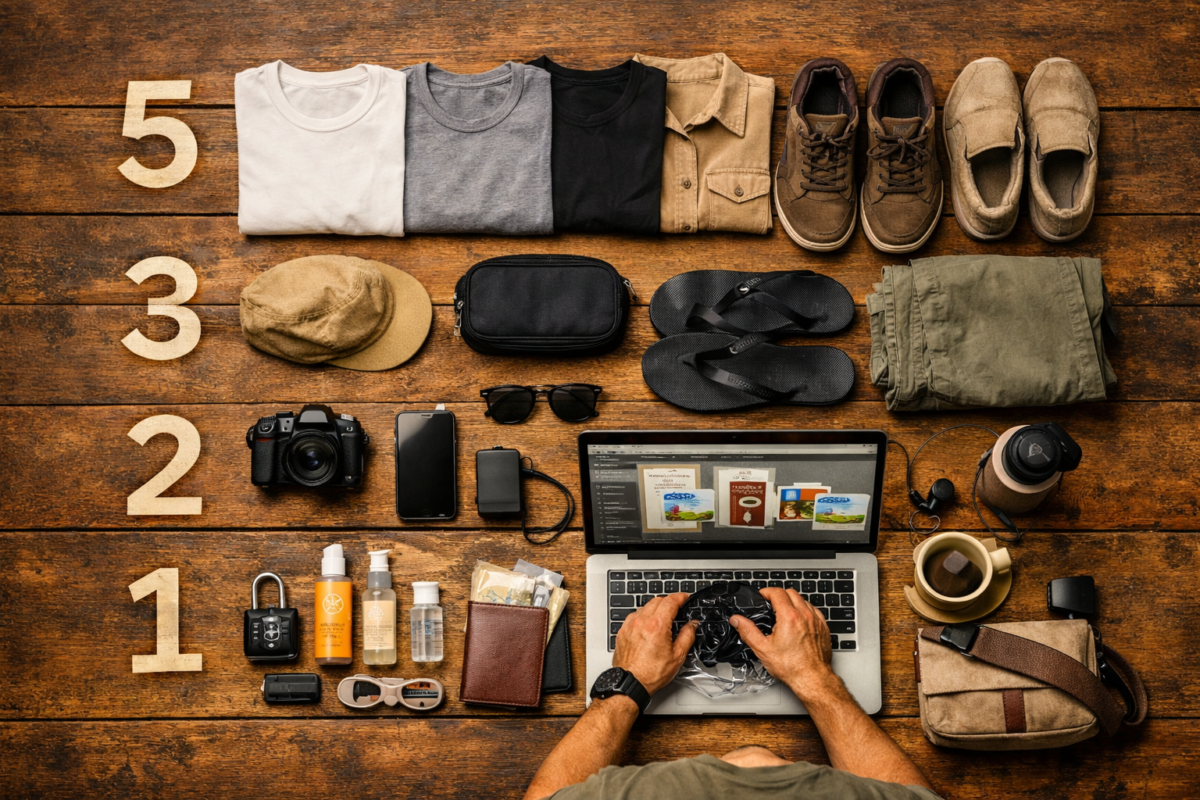
| Hack #5: Use the 5-4-3-2-1 Packing Formula For a standard warm-weather trip of 5-10 days, the 5-4-3-2-1 formula produces a carry-on that covers everything without waste:5 pairs of underwear (lightweight, quick-dry)4 pairs of socks (2 regular, 2 no-show or hiking)3 tops (2 t-shirts or shirts, 1 lightweight long-sleeve or hoodie)2 bottoms (1 shorts or skirt, 1 trousers or jeans)1 dress layer (light cardigan, packable rain jacket, or merino wool layer)That’s a full week of travel clothing that fits in half a carry-on. Adjust the formula for cold-weather trips by swapping quantity for thermal layers. |
The Complete Budget Traveler Packing List
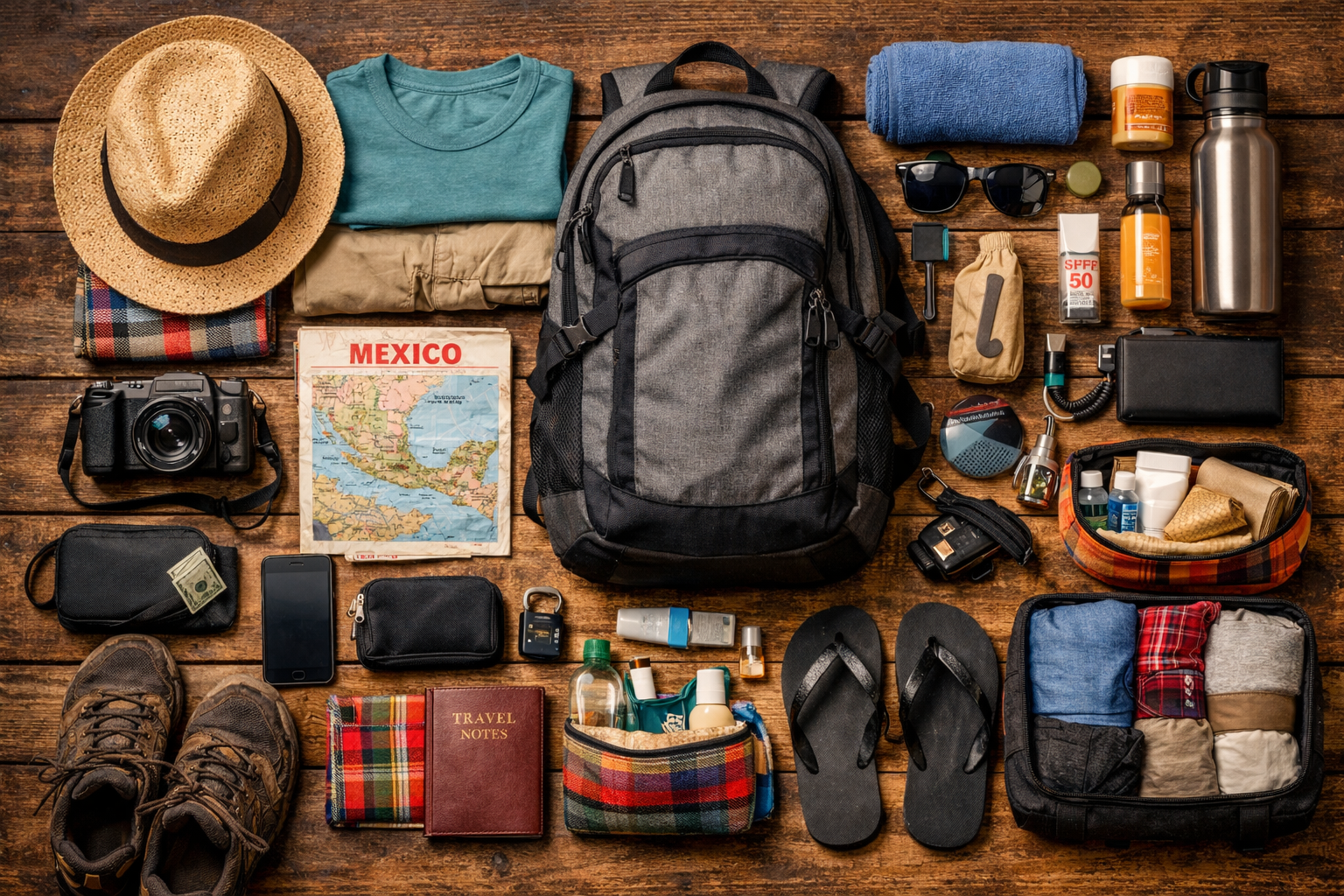
What follows is the master packing list – organised by category, with notes on what to prioritise, what to skip, and what to buy at your destination instead of packing from home.
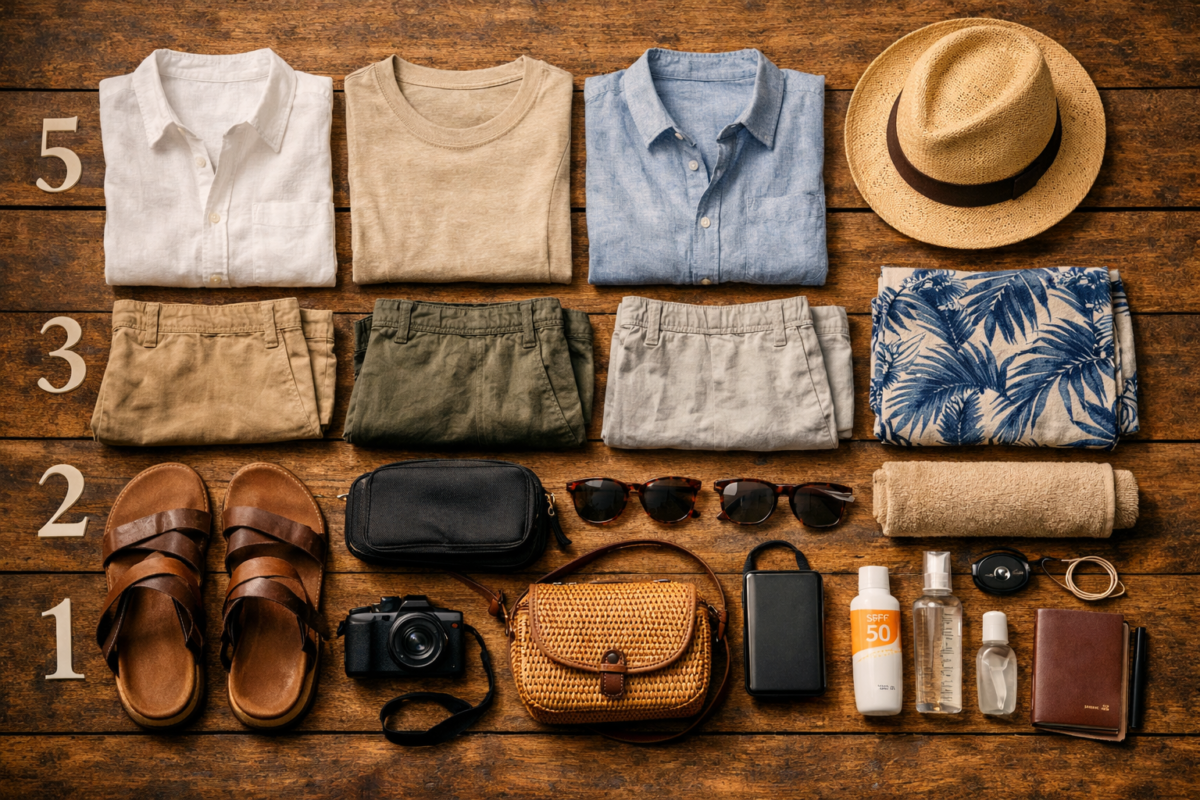
| Clothing: The Core CapsuleWarm-Weather Trips (Southeast Asia, Mexico, Bali, Caribbean, Mediterranean Summer) 3-4 t-shirts or lightweight shirts (neutrals – navy, white, grey, olive)1 lightweight long-sleeve shirt or layer (for temples, AC, evening)2 pairs of shorts or 1 shorts + 1 lightweight trousers1 lightweight dress or smart casual outfit (for nicer restaurants or events)5 pairs of underwear (quick-dry synthetic or ExOfficio)3-4 pairs of socks (include 1 pair hiking socks if applicable)1 lightweight packable rain jacket (doubles as a windbreaker)1 packable down vest or thin hoodie (for cold transport / AC) Cold-Weather Trips (Northern Europe, Canada, Japan Winter, Mountain Destinations)2-3 merino wool base layer tops (wear multiple days without washing)1 mid-layer fleece or warm hoodie1 packable down jacket (critical investment – compresses to tiny size)1 waterproof outer shell jacket1-2 pairs of trousers (1 smart casual, 1 hiking/outdoor if needed)1 pair thermal leggings (doubles as base layer and pyjamas)5 pairs of underwear (merino wool preferred for warmth and odour resistance)4-5 pairs of socks (include 2 warm wool pairs)1 warm hat and lightweight gloves (pack or buy at destination) |
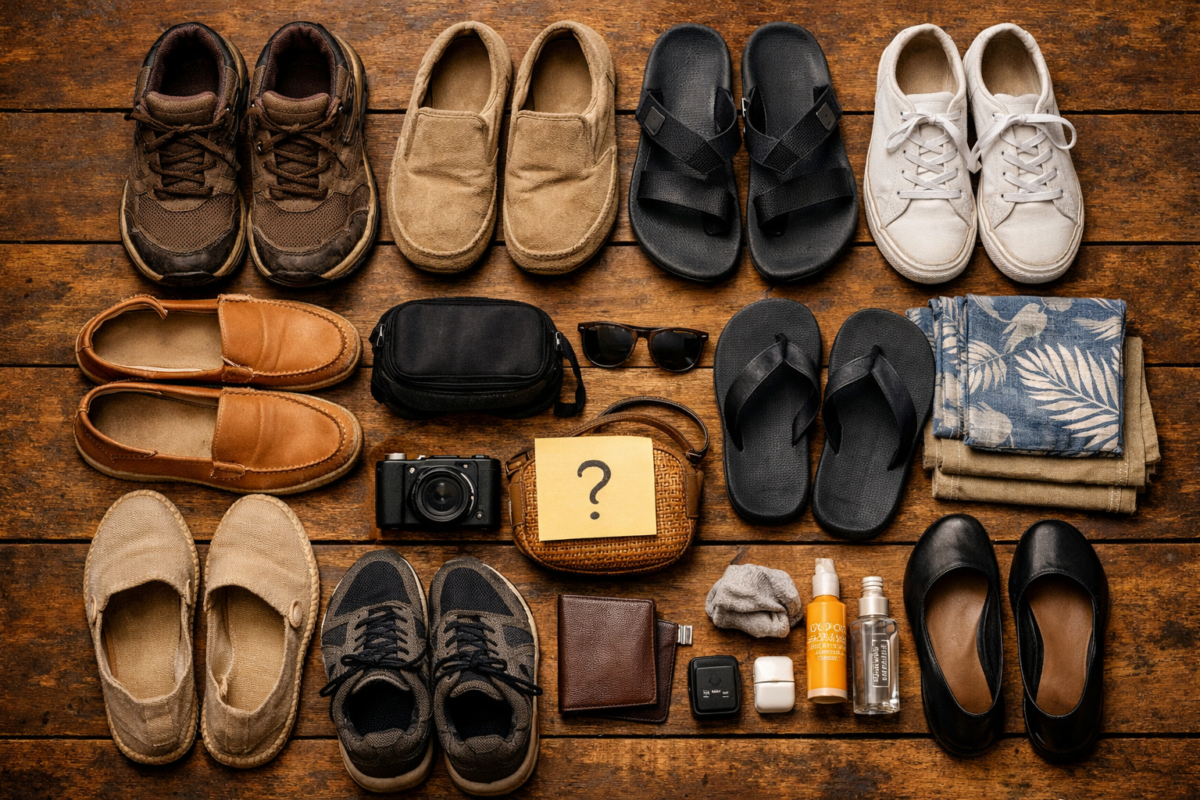
| Footwear: The One-Pair-Too-Many Trap Shoes are the single heaviest and most space-consuming category in any bag – and the category where travelers most consistently overpack. The rule: bring two pairs maximum. Three is usually one too many.Pair 1 – Main walking shoes: Lightweight trainers/sneakers for most travel styles, or trail runners if you plan significant hiking. Choose neutral colours (white, grey, black) that work with all outfits.Pair 2 – Sandals or flip flops: For beach destinations, hostel showers, pool days, and hot evenings. Reef-friendly sandals also serve as temple footwear in Southeast Asia.What to skip: Dress shoes (rarely needed; smart trainers work for most restaurant occasions). Heavy hiking boots (unless your trip is specifically a multi-day trekking trip).Pro tip: Wear your heaviest shoes on the plane. They never go in the bag. |
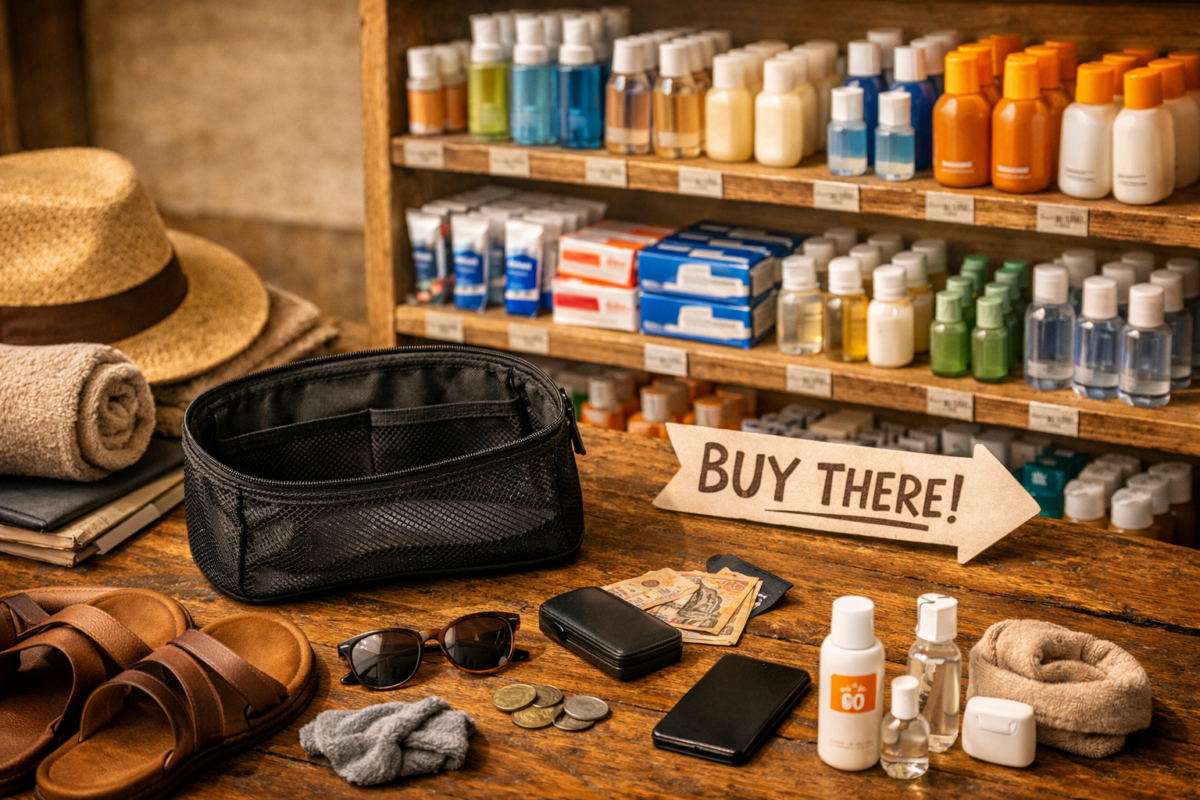
| Toiletries: Buy at Destination, Do not Carry From Home The most overpacked category in almost every traveler’s bag. Heavy liquids, full-size shampoos, multiple skin care products – all of it available to buy at your destination for the same or lower price than at home, and none of it worth taking up precious carry-on weight.What to Pack1 small solid shampoo bar (no liquid, no spillage, airport security compliant)1 solid conditioner bar (optional but worth it for longer trips)1 travel-size toothpaste (50ml or less for airport security)1 toothbrush (compact travel model)Solid or mini deodorantSmall pack of tissues + hand sanitiserAny prescription medication (full supply + extra)Reef-safe sunscreen (especially important for Bali, Mexico, Southeast Asia)Lip balm with SPFWhat to Buy at Destination (Don’t Pack)Full-size shampoo and conditioner (hostels often provide; supermarkets everywhere)Body wash or soap (available everywhere for cents)Insect repellent (buy on arrival in tropics; cheaper and often stronger locally)Feminine hygiene products (available in all destinations covered in this series)Sunscreen beyond a starter supply (buy locally – TSA limits and weight savings) |
| Electronics: The Budget Traveler’s Tech Essentials Technology has simplified the budget traveler’s life enormously – one smartphone now replaces guidebooks, cameras, maps, translators, and boarding passes. Here is what actually earns its place in the bag.EssentialSmartphone (fully charged, with these apps: Offline maps, airline app, Google Translate, banking app, Hidden Travels tools)Universal travel adapter: One compact model with USB-A and USB-C ports replaces multiple country-specific adapters.Portable charger / power bank: 10,000mAh minimum. Essential for long transit days and destinations where power is unreliable.USB-C and Lightning charging cables: One of each, short versions.Earphones or earbuds: For long flights, overnight buses, and hostel dorms.Optional Based on Trip TypeLaptop or tablet: For digital nomads or longer trips. If you need one, a 13-inch ultralight laptop (MacBook Air, Dell XPS 13) adds 1.3-1.5kg but enables remote work.Travel camera: Modern smartphone cameras are extraordinary. A separate camera is optional unless photography is a core purpose of the trip.E-reader: Replaces multiple books and weighs 150-200g. Worth it for trips of 2+ weeks.What to SkipLaptop if you have a smartphone and don’t need to workPhysical guidebooks (replaced by smartphone apps and downloaded PDFs)Excessive cables and chargers (most destinations have USB charging options)Travel hair dryer (hostels and hotels almost always have one) |
| Connectivity Essentials: Stay Connected Without Roaming Fees Being connected abroad is a safety necessity, not a luxury. Set up a destination eSIM through Airalo before you leave home – it activates digitally, no physical SIM needed, and covers 200+ countries with plans from $5. For multi-country trips, Yesim offers regional plans that auto-switch as you cross borders.And protect your data on every public network with NordVPN – hostel Wi-Fi, airport networks, and cafe connections are all security risks without a VPN. Covers 6 devices simultaneously. |
| Documents & Money: What Every Budget Traveler NeedsPhysical Documents to Carry Passport (check expiry – most countries require 6 months validity beyond your travel dates)Copies of passport photo page (2 physical copies; photos also stored in cloud)Travel insurance documents (physical copy + digital)Emergency contact card (physical, in wallet separate from passport)Visa documents if applicable (printed confirmations)MoneyPrimary travel debit card: Wise or Revolut for fee-free international spending and ATM withdrawals. Essential for budget travelers.Backup card: A second card from a different bank, stored separately from your primary. If your main card is lost or blocked, the backup saves your trip.Emergency cash: $100-200 USD equivalent in widely accepted currency (USD or EUR for most destinations). Stored separately from your wallet.Money belt or hidden pouch: For crowded destinations and transit. Not fashionable but practical in pickpocket-prone areas.Always check live exchange rates before spending with our free Currency Converter. |
| Health, Safety & Comfort: The Non-NegotiablesHealth Essentials Travel-size first aid kit: antiseptic wipes, plasters/band-aids, blister treatment, pain reliefDiarrhoea treatment (Imodium or equivalent – critical for Southeast Asia and Mexico)Antihistamine tablets (allergies, insect bites)Any prescription medication (full course plus 1-week extra)Water purification tablets or SteriPen (for trekking or uncertain water destinations)Comfort & SleepLightweight sleep mask (hostels are rarely dark enough)Foam earplugs (hostel dorms, overnight buses, aircraft)Inflatable travel pillow (overnight flights and buses)Packable microfibre towel (many hostels don’t provide; quick-dry and ultralight)SafetyCombination padlock for hostel lockers (75mm is the standard locker size)Lightweight cable lock (for securing backpack to seat or rack on trains and buses)Travel Insurance – Not OptionalThis is the most important item on this entire list. Comprehensive travel insurance through Ekta Traveling Insurance covers medical emergencies, evacuation, trip cancellation, and theft – for $3-8 per day. Buy it before every trip, not after something goes wrong. |
| Flight Protection: Claim What You are Owed Before any trip, check if past flight disruptions have left you with unclaimed compensation. AirHelp searches your flight history for eligible EU claims (up to €600 per person) and handles the entire process on a no-win, no-fee basis. Many travelers discover they’re owed significant compensation they never claimed. |
| Luggage Storage on Travel Days Even the best-packed bag becomes a burden on transition days between accommodation. Radical Storage has secure storage locations in cities worldwide – near airports, stations, and tourist areas. Drop your bag for a few dollars and spend your last hours actually experiencing the city. |
Destination-Specific Packing Adjustments
| Destination | Add to Base List | Leave Behind |
| Southeast Asia (Bali, Thailand, Vietnam) | Sarong (temple dress code), reef-safe sunscreen, light scarf | Heavy jacket, boots, formal wear |
| Japan | 1 smart outfit (restaurants), compact umbrella, extra socks | Revealing clothing, heavy bags (impractical on transport) |
| Europe (summer) | Layers for variable weather, small day bag | Heavy boots, too many shoes |
| Europe (winter) | Down jacket, thermal base layers, waterproof boots | Summer clothing (buy if needed), heavy toiletries |
| Mexico / Latin America | Reef-safe sunscreen (cenotes), insect repellent, Spanish phrasebook app | Heavy layers unless highlands |
| Canada road trip | Layering system, warm hat/gloves, hiking boots if trekking | Formal wear, excess shoes |
| Middle East | Modest loose clothing (shoulders + knees covered), light scarf | Revealing clothing, shorts in conservative areas |
| Africa safari | Neutral khaki/olive colours, binoculars, sturdy walking shoes | Bright colours, perfume, white clothing |
What Budget Travelers Should Never Pack
These are the items that appear in most travelers’ bags and should never be there:
- Full-size toiletries: They’re heavy, they exceed liquid limits, and they’re available everywhere. Switch to solid bars and buy the rest at destination.
- More than 2 pairs of shoes: One pair of shoes is not enough. Three is one too many. Two – one walking, one casual/beach – is almost always sufficient.
- Physical guidebooks: Beautiful objects, terrible packing choices. Everything in a guidebook is available on your phone, offline, for free.
- ‘Just in case’ clothing: The single biggest source of packing regret. Every item packed ‘just in case’ weighs 200g and is almost never used. Pack for what you will actually do, not every hypothetical scenario.
- A laptop when a smartphone does the job: For most leisure travel, a smartphone handles everything. The laptop stays home.
- Multiple device chargers: One multi-port USB charger handles all devices. Multiple wall adapters and charging blocks are dead weight.
- Travel hair dryer: Every hostel, guesthouse, and hotel provides one. Or your hair dries naturally. It weighs 400g and takes significant space.
- Padded jacket for warm destinations: Bali does not need a puffer jacket. A lightweight long-sleeve for AC and evenings is sufficient.
The Pre-Departure Packing Checklist
| Category | Item | Packed? |
| Clothing | Capsule wardrobe per 5-4-3-2-1 formula | □ |
| Footwear | Main shoes (worn on plane) + sandals/second pair | □ |
| Toiletries | Solid shampoo + toothbrush + toothpaste + sunscreen | □ |
| Electronics | Phone + charger + universal adapter + power bank | □ |
| Connectivity | eSIM activated (Airalo or Yesim) + NordVPN installed | □ |
| Documents | Passport + insurance docs + copies + emergency cash | □ |
| Money | Primary travel card + backup card | □ |
| Health | First aid kit + prescription meds + stomach meds | □ |
| Comfort | Sleep mask + earplugs + padlock for locker | □ |
| Travel Insurance | Policy active (Ekta or equivalent) | □ |
| Flight protection | AirHelp registered for disruption protection | □ |
| Planning tools | AI Budget Estimator + Packing List + Currency Converter bookmarked | □ |
Related Travel Resources
Looking for more ways to save money and travel smarter? Explore our carefully selected guides, expert advice, and free planning tools to make every trip more affordable and stress-free.
Budget Travel Guides
- Discover practical money-saving travel hacks to reduce costs on accommodation, transportation, food, and activities.
- Learn how to find cheap flights using flexible booking strategies, fare alerts, and price comparison tools.
Destination Planning
- Browse our in-depth destination guides for local insights, travel itineraries, and must-visit attractions.
- Need a personalized itinerary? Our travel planning services help you create customized trips tailored to your budget and travel style.
Free Travel Planning Tools
Plan every detail of your trip with our powerful travel tools:
- Stay organized with the packing list generator, ensuring you never forget your travel essentials.
- Check destination conditions before departure using the weather checker.
- Estimate your trip expenses accurately with the AI budget estimator for smarter financial planning.
- Calculate real-time exchange rates with the currency converter to manage international travel costs with confidence.
Continue Your Travel Journey
From budget-friendly travel strategies and destination inspiration to AI-powered planning tools and personalized travel services, Hidden Travels provides everything you need to travel smarter, spend less, and enjoy unforgettable adventures.
Frequently Asked Questions (FAQ)
How do I fit everything into a carry-on for a 2-week trip?
Use the 5-4-3-2-1 formula as your clothing base, switch all toiletries to solid bars and travel sizes, pack only two pairs of shoes (wearing the heavier pair on the plane), use packing cubes to compress and organise, and plan to do laundry once mid-trip. A 26-litre backpack or small rolling carry-on handles two weeks comfortably for most warm-weather destinations.
What size carry-on bag should a budget traveler use?
For warm-weather travel, a 20-26 litre backpack is ideal – light, fits in overhead bins and under seats, and works as a day bag at your destination. For cold-weather travel requiring more layers, a 26-32 litre bag gives more space while still meeting most airline carry-on limits. Always check the specific airline’s size and weight limits before travelling, as budget carriers have stricter rules than full-service airlines.
Is merino wool really worth the extra cost?
Yes, for any traveler who takes more than two trips per year. Merino wool t-shirts ($60-100) can be worn 3-5 days without washing, dry overnight when handwashed, resist odour effectively, regulate temperature across a wide range, and pack to a fraction of the space of cotton. Over a year of travel, the reduced laundry needs and fewer garments required pay for the premium cost.
What are the most important things to pack for Southeast Asia?
For Southeast Asia specifically: a sarong (mandatory temple dress code in Bali, optional but useful in Thailand and Cambodia), reef-safe sunscreen (protects cenotes and coral reefs), lightweight clothing that covers shoulders and knees for temple visits, insect repellent (buy locally – stronger and cheaper), a microfibre towel (beaches, waterfalls, hostel shower areas), and stomach medication. Everything else is available to buy locally at low cost.
Should I use a backpack or a rolling suitcase for budget travel?
A backpack is almost always the better choice for budget travel: it’s more versatile on cobblestone streets and unpaved paths, fits in overhead bins and under bus seats more easily, leaves both hands free, and allows faster movement through airports and transit. Rolling suitcases work well for urban city breaks and cruise-style travel but become liabilities in markets, narrow streets, hostels with stairs, and rural destinations.
Can I really carry-on only for cold weather destinations like Canada or Japan in winter?
Yes – with the right system. The key is layering rather than bulking: a merino base layer, a mid-layer fleece, and a packable down jacket cover temperatures well below freezing and compress to a fraction of the space a single heavy winter coat requires. Add thermal leggings, warm wool socks, and a packable waterproof shell and you have a complete cold-weather system in half a carry-on. Buy a cheap warm hat and gloves at your destination.
Pack Less, Travel More, Spend Less
Here is the thing that every experienced traveler eventually learns: the best version of any trip is the one where your bag is light enough that you forget you’re carrying it.
When your bag is light, you board flights without fees. You move between cities spontaneously without worrying about luggage storage. You take the night bus instead of the expensive hotel because you can carry everything on board. You arrive at destinations energized rather than exhausted by the weight of bringing your entire wardrobe to a beach town.
Packing light is not deprivation. You don’t miss what you didn’t bring. You never once, mid-trip, wish you’d packed that second pair of formal shoes or the full-size shampoo.
What you do feel, consistently, is freedom. The freedom that comes from knowing that your entire life for the next two weeks fits in one bag on your back, and that you can go anywhere, change plans at any moment, and arrive anywhere in the world ready to start exploring immediately.
That’s what packing light gives you. And it starts with the list above.
Build your destination-specific packing list with our free Packing List Generator. Estimate your trip budget (with baggage savings factored in) using our AI Travel Budget Estimator. And explore more budget travel guides at the Hidden Travels Budget Hub.
© Hidden Travels — hiddentravels.site
Inspiring Travelers. Sharing Hidden Stories. One Adventure at a Time.