
⚠️ Affiliate Disclosure: This post contains affiliate links. Booking through our links earns us a small commission at no extra cost to you. We only recommend services we trust.
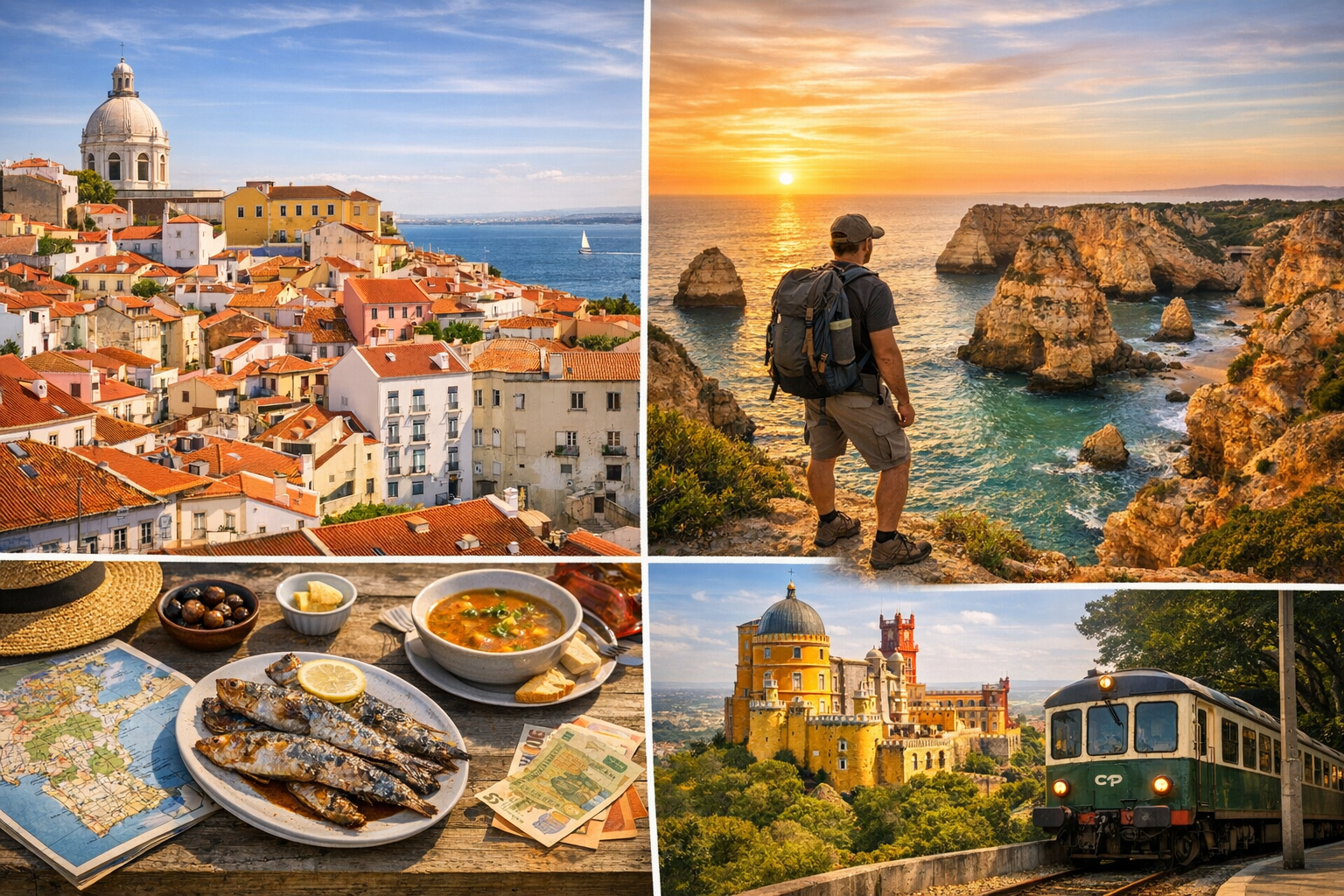
I am sitting at a small marble table outside a pastelaria in Alfama, Lisbon’s oldest neighbourhood, eating the best custard tart of my life. It cost 90 cents. The coffee beside it – a perfect, dense, aromatic bica – was 80 cents. From where I’m sitting, I can see the castle on the hill, the terracotta rooftops cascading down to the river, and a tram the colour of a tangerine grinding slowly around a corner.
My total spending for today, including a hostel bed, three meals, an afternoon at a museum, and two glasses of wine with dinner: just under $48.
This is Portugal. Possibly the best-value destination in all of Western Europe, and one of the most extraordinarily beautiful countries on Earth. And the incredible thing – the thing that budget travelers who’ve discovered it don’t always want to admit publicly – is that spending less here doesn’t mean experiencing less. It means sitting at that marble table. It means the €1.50 glass of Vinho Verde at a local tasca. It means the free miradouros, the free beaches, the free Atlantic light that turns everything gold in the late afternoon.
This 7-day Portugal budget travel guide is built around a $50/day budget for a solo traveler – covering accommodation, food, transport, and activities across Lisbon, Porto, and the Algarve. Couples can stretch this further. And if you’re flexible on the hostels, you can go even lower.
Pro Tip: Before you travel, use our AI Travel Budget Estimator at AI Budget Estimator to build a personalised Portugal budget based on your travel style and group size.
Why Portugal Is the Best Budget Destination in Europe Right Now
Portugal has been quietly winning European travel awards for years, but it only recently exploded onto the mainstream radar – and prices have risen accordingly in the tourist hotspots. But compared to Spain, France, Italy, or the UK, Portugal remains significantly cheaper in almost every category:
- Food: A full meal at a local restaurant (prato do dia – dish of the day) costs €8–12 including wine and bread
- Coffee: €0.70-1.00 for an espresso; the UK equivalent is £3.50-4.50
- Wine: A perfectly good bottle of Portuguese wine costs €3-5 in a supermarket; €12-18 in a restaurant
- Transport: Metro tickets in Lisbon from €1.65; buses between major cities from €7-15
- Accommodation: Hostel dorms from €15-22/night; private rooms in guesthouses from €35–55
- Beaches: Hundreds of the best beaches in Europe – every single one is free
- Culture: Many of Lisbon and Porto’s best museums are free on Sunday mornings
Add to this 300+ days of sunshine per year, one of Europe’s lowest crime rates, world-class food and wine, extraordinary history, and a public transport network that actually works – and the question isn’t why you should visit Portugal on a budget. It’s why you haven’t already.
Pro Tip: Check current EUR exchange rates before you travel using our Live Currency Converter at hiddentravels.site/travel-tools/currency-converter/ – knowing the exact rate helps you budget accurately and spot tourist traps.
Real Portugal Daily Budget Breakdown: $50/Day Is Possible
Here’s exactly how the $50/day budget breaks down in practice. Note: prices in USD at approximately €1 = $1.08.
| Expense | Avg. Daily Cost (Solo) |
| Accommodation (hostel dorm / budget guesthouse) | $17–22/night |
| Breakfast (pastel de nata + coffee at local café) | $1.80–2.50 |
| Lunch (prato do dia at a tasca) | $9–12 |
| Dinner (local restaurant, wine included) | $12–18 |
| Local transport (metro, tram, bus) | $3–5/day |
| Activities (many are free; 1 paid entry per day) | $0–8 |
| Snacks, water, miscellaneous | $3–5 |
| TOTAL DAILY ESTIMATE | $46–73 (avg. ~$50) |
Good to Know: Lisbon and Porto tourist centres (Bairro Alto, Baixa, Ribeira) have restaurants specifically targeting tourists with inflated prices. Walk one or two streets off the main drag and prices drop by 30-40% immediately. The best food is always where the locals eat.
7-Day Portugal Budget Itinerary: Day by Day
Days 1-3: Lisbon – Europe’s Most Beautiful Capital

Fly into Lisbon’s Humberto Delgado Airport – one of Europe’s most connected hubs, with direct flights from New York, Boston, Toronto, London, and virtually every major European city. From the airport, the metro to the city centre costs €1.65 and takes 20 minutes. Don’t take a taxi unless you have heavy bags.
Lisbon is built across seven hills above the Tagus River, and every neighbourhood has a different personality. For budget travelers, the golden triangle is Alfama (oldest, most atmospheric), Mouraria (local, diverse, excellent street food), and Intendente (hip, affordable, local restaurants).
Free Things to Do in Lisbon
- Miradouro da Graça – the best viewpoint in the city, completely free, local wine sold from a kiosk for €1.50
- Miradouro das Portas do Sol – overlooking Alfama’s terracotta rooftops and the Tagus
- Belém Tower exterior and surrounding riverside gardens
- Jerónimos Monastery exterior and the gardens of Praça do Império
- Wander Alfama’s labyrinthine medieval streets – genuinely the best free activity in Portugal
- Time Out Market (entry free; budget €8–12 for a food market meal from top Lisbon chefs)
- LX Factory on Sundays – vintage market, street food, independent shops, free entry
- Fado music heard through open windows in Alfama on summer evenings – no charge required
Paid Lisbon Highlights (Worth Every Cent)
- National Tile Museum (Museu do Azulejo): €5 – the world’s finest collection of Portuguese azulejo tiles, in a beautiful 16th-century convent
- Lisbon Oceanarium: €21 – one of Europe’s best aquariums, worth it for families and ocean lovers
- Sintra day trip: Train from Rossio station €4.40 return; palace entry €10-14 each – Sintra is unmissable
Pro Tip: Sintra deserves a full day. The village is 40 minutes from Lisbon by train, and the combination of Pena Palace (a psychedelic 19th-century royal palace perched on a clifftop), Moorish Castle, and the mysterious Quinta da Regaleira make it one of the most extraordinary places in Europe. Go on a weekday – weekends are mobbed.
Budget Eating in Lisbon
For the full Lisbon food experience on a budget, focus on:
- Prato do dia (dish of the day): Every local tasca offers a daily special – typically a main, bread, wine or water, and sometimes a dessert – for €8–12. It is always the best value in the house.
- Pastel de nata: The iconic custard tart from Pastéis de Belém (the original since 1837) costs €1.50. Get two. Then get two more.
- Bifanas: Pork sandwiches from street stalls in the Baixa for €2.50-3.50 – the original Lisbon fast food.
- Ginjinha: A sour cherry liqueur served in a tiny chocolate cup from street kiosks near Rossio Square for €1.50. A Lisbon ritual.
Days 4-5: Porto – The City That Invented Soul

Take the Rede Expressos or Flixbus from Lisbon to Porto – a 3.5-hour journey that costs as little as €7–15 if booked in advance. Alternatively, search for domestic flights on Aviasales – they sometimes undercut the bus on sale days.
Porto is everything Lisbon is, but rawer, grittier, and more emotionally intense. The city tumbles down granite hillsides to the Douro River, all crumbling baroque facades, hand-painted azulejo churches, and narrow lanes that smell of grilled sardines and wood smoke. It is one of the most naturally photogenic cities in the world, and almost nobody here is performing for tourists.
Free Things to Do in Porto
- Igreja de Santo Ildefonso – the azulejo-covered church exterior facing the cathedral square
- Miradouro da Vitória – arguably the best viewpoint in Porto, virtually unknown to tourists
- Walk across Ponte Dom Luís I – the iconic double-decker bridge, free on foot
- Ribeira district riverside walk – the old waterfront, free to wander
- Livraria Lello bookshop – free with a €5 voucher redeemable against any book purchase (worth it)
- Foz do Douro – where the Douro meets the Atlantic; walk the coastal promenade for free
- Bairro da Sé – the oldest neighbourhood, stunning decayed architecture, free to explore
Port Wine Cellars – The Essential Porto Experience
Cross the bridge to Vila Nova de Gaia where the famous port wine lodges line the southern bank of the Douro. Graham’s, Taylor’s, Quinta do Crasto, and Ramos Pinto all offer excellent cellar tours and tastings. Prices range from €8-20 per person depending on how many wines you taste. For a budget option, Caves Ferreira and Real Companhia Velha offer solid introductory tastings for €8-12.
Pro Tip: Book a port wine tasting in advance using WeGoTrip for small-group experiences in Porto that include a local guide, skip-the-queue access, and a proper tasting – often cheaper than walk-up prices at the cellar door.
Budget Eating in Porto
- Francesinha: Porto’s signature dish – a meat sandwich drowned in a spiced tomato and beer sauce, covered in melted cheese. €8-12. Order it at Lado B or Rua da Alegria neighbourhood restaurants, not tourist-facing spots.
- Bacalhau à brás: Shredded salt cod with onions, eggs, and olives – a national obsession, €9-13 at any tasca
- Tripas à moda do Porto: The city’s most historic dish (tripe stew, €8–11) – locals are called ‘tripeiros’ because of it. Not for everyone, but authentically Porto.
- Mercado do Bolhão: The beautifully restored 19th-century market. Grab a bifana or fresh fruit and eat standing up like a local.
Days 6-7: The Algarve – Budget Beaches and Sea Cliffs
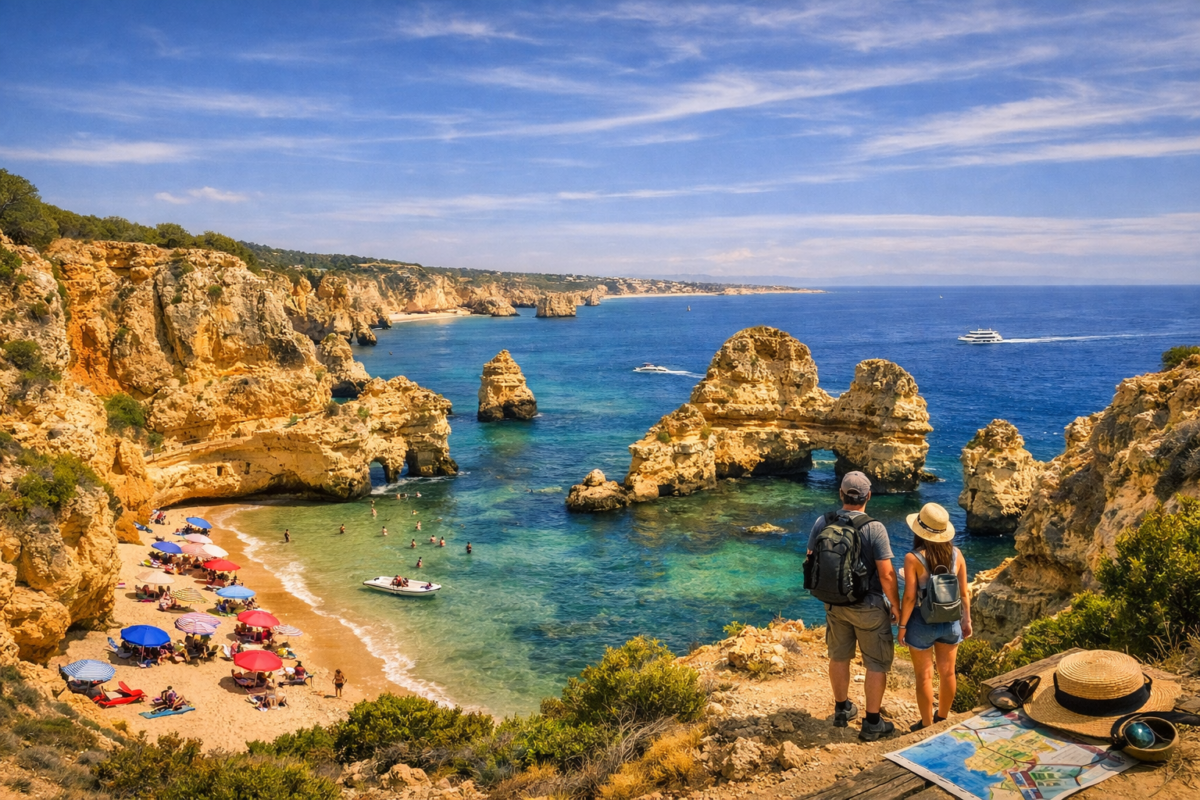
From Porto, take an overnight bus or early morning coach to the Algarve – Portugal’s southern coast, 300km of beaches, golden limestone cliffs, sea caves, and the cleanest water in Europe. The journey takes 5-6 hours from Porto (via Lisbon) and costs €15–25 by Rede Expressos.
The Algarve’s most famous resorts – Albufeira, Vilamoura, Quarteira – are overpriced and over-touristed. Head instead to Lagos, Sagres, or the west coast for the real Algarve: wild beaches, fishing villages, and a pace of life that feels untouched by the 21st century.
Best Free Beaches in the Algarve
- Praia da Marinha (Lagoa): Arguably the most beautiful beach in Europe. Honey-coloured limestone arches, turquoise water, small hidden coves. Free – just pay for parking (€3-5).
- Praia do Camilo (Lagos): A small beach accessed down a wooden staircase through the cliffs. Extraordinarily beautiful. Free.
- Praia do Castelejo (Vila do Bispo): A wild, windswept west-coast beach where surfers and seabirds share the break. Free, remote, spectacular.
- Praia de Benagil (Lagoa): Home to the famous Benagil Cave – a sea cave with a natural skylight accessible by kayak or SUP (rental €15/hr). The beach itself is free; getting inside the cave is worth every cent.
- Sagres and Cabo de São Vicente: Europe’s most south-westerly point, where the Atlantic crashes against 75-metre cliffs and the light at sunset is genuinely otherworldly. Free – just park and walk.
Pro Tip: Rent a car for your Algarve days – the best beaches are spread along 300km of coast and impossible to reach by public transport without spending an entire day on buses. Compare rental prices at GetRentACar for the best available rates from Faro Airport.
Budget Accommodation in the Algarve
Lagos is the best budget base in the Algarve. The Old Town has excellent hostels (from €18/night dorm), a thriving backpacker social scene, great cheap restaurants, and is walking distance from multiple world-class beaches. Hotellook compares prices across all booking platforms instantly – essential for finding deals in this high-demand region.
Getting to Portugal: Flights & Transport Tips
From the USA & Canada
Lisbon is one of the easiest European capitals to reach from North America, with direct flights from New York (JFK, Newark), Boston, Miami, Toronto, and Montreal on TAP Portugal, American, United, and Air Transat. Search for the best transatlantic fares on Aviasales or use WayAway to earn cashback on every flight you book.
Typical return fares from New York to Lisbon: $420-680 in shoulder season (May, September, October); $550-900+ in July and August. Book 8–12 weeks in advance for the best prices.
From the UK
Lisbon and Porto are among the most competitive routes in European aviation. Ryanair, easyJet, TAP, and British Airways all fly multiple times daily from London (Heathrow, Gatwick, Stansted, Luton) and regional airports. Fares from £25-80 one-way if booked in advance. Porto is often cheaper than Lisbon and almost as well-connected.
From Europe
Lisbon and Porto are served by virtually every major European carrier from dozens of cities. TAP Portugal’s hub status means excellent connections. Overnight buses from Madrid (€25-40, 7 hours) and Seville (€20-30, 4 hours) are also popular budget options.
Getting Around Portugal
- Intercity buses (Rede Expressos, Flixbus): The cheapest option. Lisbon to Porto €7–20; Lisbon to Faro €15–25. Comfortable, air-conditioned, reliable.
- Trains (CP Comboios de Portugal): Scenic and comfortable. Lisbon to Porto Alfa Pendular €25-35; regional trains cheaper. Book at cp.pt
- City metro/tram: Lisbon and Porto both have excellent metro systems. Day passes €6.45 in Lisbon. The famous Trams 28 and 15E are great but packed – metro is faster for actual transport.
- Car rental: Essential for the Algarve, Alentejo, and rural areas. Best rates at GetRentACar. Road tolls add €10-20/day on motorways – factor this in.
Connectivity – Stay Connected for Less
Portugal has excellent 4G/5G coverage in cities and main towns, patchy in rural areas. International travelers should get an eSIM before flying – Airalo offers Europe-wide data packages from around $5/week that activate the moment you land. Avoid roaming charges entirely.
Best Time to Visit Portugal on a Budget
Portugal’s climate is one of its great selling points – but timing affects both experience and price significantly:
- March-May (Spring – Best Overall): Wildflowers covering the Alentejo and Algarve, mild 18–23°C temperatures, significantly lower accommodation prices than summer, minimal crowds. The single best time to visit Portugal on a budget.
- June (Early Summer – Sweet Spot): Warm enough to swim (water reaches 20°C), before peak-season prices kick in on July 1st. Lisbon’s Santos Populares festival on June 12-13 is free street party heaven.
- July-August (Peak Season): Hot (30-40°C in the south), crowded, expensive. Accommodation prices double or triple in the Algarve. Still wonderful – but hard to do on $50/day in coastal resorts.
- September-October (Golden Season): Warm sea (22-24°C), thinner crowds, harvest festivals, superb food and wine season. Prices drop 30-40% from August peak. Arguably the single best month to visit: September.
- November-February (Winter – Cheapest): Cool (12-17°C), rainy in the north, sunny in Algarve. Lisbon and Porto are virtually crowd-free. Hostel beds from €12/night. Not for beach trips – perfect for cities, history, and food.
Pro Tip: Avoid Portuguese public holidays, especially the last week of August and the week surrounding Corpus Christi (June). Domestic tourism surges and prices spike sharply. Check a Portuguese holiday calendar before booking.
15 Money-Saving Tips for Portugal
- Eat lunch, not dinner, at restaurants: The prato do dia is only available at lunch. The same restaurant’s dinner menu costs 40-60% more.
- Drink at the bar, not at the table: In Portuguese cafés, standing at the bar is often 20-30% cheaper than sitting at a table. This is normal and accepted.
- Buy wine at supermarkets: Pingo Doce and Continente supermarkets sell excellent Portuguese wines for €2.50-5. Have pre-dinner drinks at the hostel.
- Use the Viva Viagem transport card: Load credit onto a reusable card for Lisbon’s metro, bus, and tram – it’s cheaper per journey than single tickets.
- Free museum Sundays: Many major Portuguese museums are free on Sunday mornings until 2pm, including the National Museum of Ancient Art and the Carmo Archaeological Museum.
- Walk everywhere in cities: Lisbon and Porto are fundamentally walkable cities. The hills are steep but the views are free.
- Book overnight buses instead of hotels: The Lisbon-Porto overnight Flixbus runs around midnight and saves you a night’s accommodation (~€20-22).
- Use local markets for fruit and lunch: Mercado do Bolhão (Porto) and Mercado de Campo de Ourique (Lisbon) offer fresh, cheap, fantastic food.
- Travel by ferry across the Tagus: The Cacilhas ferry from Lisbon costs €1.35 and offers spectacular river views. Far cheaper than a boat tour.
- Download the CP app for train deals: Comboios de Portugal offers advance purchase discounts of up to 50% on intercity trains.
- Stay in neighbourhood guesthouses, not central hotels: A guesthouse in Intendente or Mouraria costs half the price of equivalent quality in Baixa-Chiado.
- Never exchange currency at the airport: Use a Revolut, Wise, or N26 card for fee-free spending abroad – you’ll save 3-5% on every transaction versus bureau de change rates.
- Check for free walking tours: Most major Portuguese cities offer free (tip-based) walking tours. Excellent way to orientate, learn history, and meet other travellers.
- Avoid the famous tram 28 as transport: Tram 28 is a tourist attraction masquerading as transport. Use it once for the experience, then take the faster, cheaper metro.
- Travel insurance is not optional: Medical care in Portugal is excellent but not free for non-EU visitors. Ekta Travel Insurance offers affordable comprehensive coverage – don’t skip it.
Frequently Asked Questions
Q1: Is $50/day really achievable in Portugal?
Yes – but with some nuance. In Lisbon and Porto, $50/day is achievable if you stay in hostel dorms (€15-22/night), eat the prato do dia for lunch, self-cater breakfast, and use public transport. In the Algarve during July and August, accommodation prices rise sharply and $50/day becomes tight – budget $60-70 for peak-season coastal areas. In smaller towns, the Alentejo wine region, and off-season, $35-40/day is genuinely achievable.
Q2: Do I need a visa to visit Portugal?
Portugal is a Schengen Area member. US and Canadian citizens can visit for up to 90 days without a visa. UK citizens (post-Brexit) can also visit for 90 days in any 180-day period without a visa. Australians, New Zealanders, and Japanese citizens are also visa-exempt. EU citizens have full freedom of movement with no time limit. Check the Portuguese border service website (sef.pt) for the current list of visa-exempt nationalities.
Q3: Is Portugal safe for solo travelers?
Portugal consistently ranks among the top 5 safest countries in the world on the Global Peace Index – safer than the USA, UK, France, and most of Europe. Petty theft (pickpocketing) exists in tourist areas of Lisbon, particularly on tram 28 and around Praça do Comércio. Use a money belt or hidden pouch for passports and cards. Violent crime against tourists is exceptionally rare.
Q4: What is the best city in Portugal for first-time visitors?
Lisbon for its combination of history, architecture, food, nightlife, and easy airport connections. Porto for those seeking a more authentic, local experience with better budget value and the world’s best wine cellars. The ideal first trip includes both cities – 3 nights Lisbon, 2 nights Porto – with a day trip to Sintra and 2 days in the Algarve.
Q5: What should I pack for a Portugal trip?
Light layers for spring and autumn (mornings can be cool, afternoons warm), comfortable walking shoes (cobblestones are beautiful but brutal on feet), a reusable water bottle (tap water is drinkable everywhere), sunscreen for summer, and a small day pack. Full packing checklist at Packing List Generator
Q6: Can I use English in Portugal?
Yes, widely and comfortably. English proficiency in Portugal is among the highest in Europe – consistently ranking in the top 10 in the EF English Proficiency Index. In Lisbon, Porto, and tourist areas, virtually everyone in hospitality, retail, and transport speaks excellent English. In rural villages, less so – but a few words of Portuguese (obrigado/obrigada for thank you, por favor for please) are always appreciated and often rewarded with genuine warmth.
Final Thoughts: Portugal Rewards the Budget Traveler
Here is the truth about budget travel in Portugal: the best experiences don’t cost much, because the best experiences in Portugal are the country itself.
It’s the light on the Tagus at 6pm. It’s eating bacalhau in a restaurant where the owner is also the waiter and the cook and the grandmother brought the wine from the cellar herself. It’s standing on Cabo de São Vicente at sunset, at the extreme western edge of the European continent, with 600km of Atlantic stretching south toward Africa, and feeling with absolute clarity how small and fortunate you are.
Portugal is a country that costs less and gives more than almost anywhere else in the Western world. You don’t need €200/day to love it. You need an appetite – for food, for history, for beauty, for being genuinely surprised. At $50/day, Portugal will feed all of that, and then some.
Start planning your Portugal trip today. Find the best flights at Aviasales, earn cashback with WayAway, compare accommodation at Hotellook, and use our AI Travel Budget Estimator to plan your exact costs. Portugal is waiting – and it’s more affordable than you think.
happy travels.
Hidden Travels Team | hiddentravels.site