
⚠️ Affiliate Disclosure: Some links in this post are affiliate links – we earn a small commission if you book through them, at no extra cost to you. We only recommend services we genuinely use and trust.
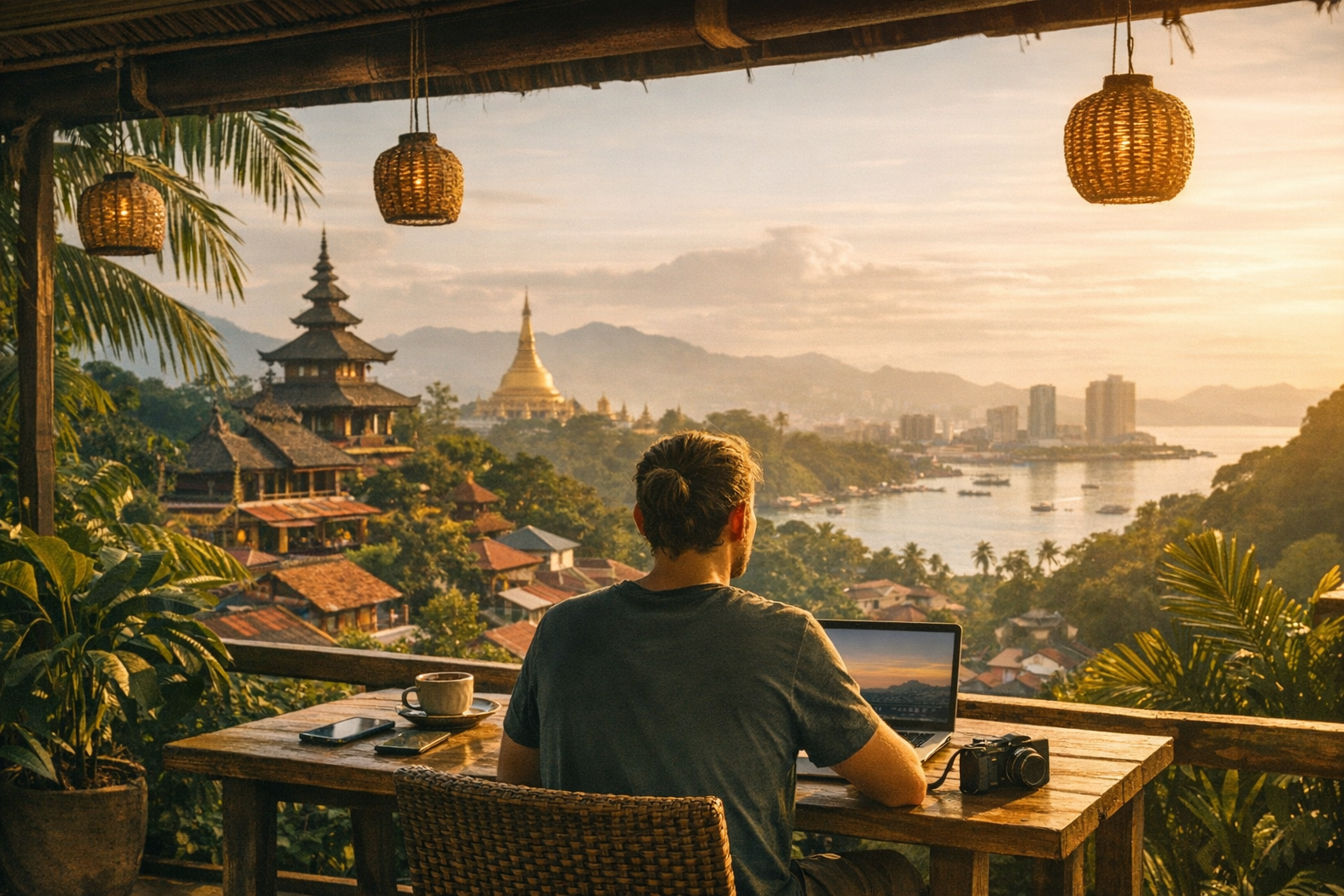
I am writing this from a co-working space on the fourth floor of a building in Chiang Mai, Thailand, where it is 8am and the city is coming alive below the window – motorbikes, temple bells, the smell of khao tom from the rice porridge stall on the corner. My rent for the month is $380. The co-working membership is $80. The meal at the end of the working day will cost $2.50 and will be the best pad kra pao I’ve eaten anywhere, made by a woman who has been cooking it at the same cart for twenty years.
I have been working remotely from Southeast Asia for three years across six countries, and the question I get asked most often – by people at the beginning of this, trying to decide whether to try it – is some version of: Is it actually as good as it looks online?
The honest answer is: yes, in ways that are different from what the Instagram version suggests. The Instagram version is a laptop on a beach, which is genuine but also occasionally impractical (sand in the keyboard, glare on the screen, no reliable power source). The real version is a well-designed co-working space in a city with extraordinary food and a cost of living that allows you to save money while working and travelling simultaneously – and to live at a standard of comfort that your income wouldn’t buy in London, New York, or Sydney.
This guide is the honest, specific, operational version of digital nomad life in Southeast Asia. The visa situations. The internet quality by city. The co-working spaces that are worth the money. The cities that are best for focused work, the ones that are better for adventuring with a laptop, and the ones that look good on Instagram but will destroy your productivity inside two weeks.
It covers seven cities across five Southeast Asian countries, with real monthly cost breakdowns, real internet speeds, and real assessments of what it’s like to try to do a full day’s work while being somewhere extraordinarily interesting.
Pro Tip: Before you plan your Southeast Asia nomad base, use our AI Travel Budget Estimator to calculate realistic monthly living costs for each city. Use the Live Currency Converter to compare what your income converts to in each country’s currency.
Why Southeast Asia Works for Remote Workers
The equation that drives Southeast Asia’s appeal to remote workers is simple: the internet is fast, the cost of living is low, the food is extraordinary, the weather is warm, and the geography is sufficiently varied and beautiful that the backdrop of daily life is never boring. Each of these things is available individually elsewhere. The combination is unusually concentrated here.
Cost of living: Monthly costs of $800-1,500 cover comfortable accommodation, co-working space, three restaurant meals a day, local transport, and a social life in most Southeast Asian cities. The same lifestyle in London, San Francisco, or Sydney costs $3,000-6,000+. For remote workers earning salaries or freelance rates calibrated to Western markets, this differential is the difference between living with financial anxiety and living with meaningful savings.
Internet infrastructure: Southeast Asia’s internet has improved dramatically over the last decade. Fibre connections are standard in co-working spaces and good apartments in Bangkok, Chiang Mai, Hanoi, Ho Chi Minh City, Kuala Lumpur, and Singapore. 4G/5G mobile data is cheap and fast in all urban areas. The ‘unreliable Asian internet’ cliché is twenty years out of date in the cities covered in this guide.
Food: Working in a city where a full lunch costs $2-3 and is genuinely extraordinary removes one of the main daily friction costs of nomad life. The food in Southeast Asia is not a consolation for being far from home. It is, for many remote workers, one of the primary reasons for being here.
Community: The accumulation of remote workers and digital nomads in Southeast Asia over the last decade has created communities of like-minded people in most of the cities in this guide – co-working spaces that function as social centres, language exchange events, climbing walls and yoga studios full of people who work from laptops. Loneliness, the classic nomad problem, is easier to address here than in most places.
Nomad Insight: The most important thing nobody tells you before your first extended stay in Southeast Asia: the rhythm of the place changes your working patterns in ways you don’t entirely control. The afternoon heat (35-38°C in Thailand from March to May) genuinely reduces cognitive performance after 3pm. The street food culture means the best eating happens at 7am and 7pm rather than at lunch. The social life of the nomad community tends to run late. Your working day will rearrange itself around these facts whether you plan it to or not – typically for the better.
7 Best Digital Nomad Cities in Southeast Asia

1. Chiang Mai Thailand – The Undisputed Nomad Capital
Chiang Mai has been the anchor city of the Southeast Asia digital nomad circuit for over a decade, and it retains that status for good reasons: a high concentration of co-working spaces, a lower cost of living than Bangkok, a manageable size that makes it possible to cycle everywhere, a surrounding landscape of mountains and jungle that provides weekend outdoor options, and a food scene that is arguably the finest in Thailand.
Monthly costs (comfortable, single person):
- Private room in guesthouse/apartment: $250–450
- Co-working space (monthly membership): $60–120
- Food (mostly local restaurants and markets): $250–400
- Transport (scooter rental or songthaew): $30–60
- TOTAL: approximately $590–1,030 per month
Internet: Excellent in co-working spaces and good cafés – 100–300Mbps fibre is standard. Mobile data (AIS or True Move H SIM cards, 30–60GB data for $10–20 per month) is fast and reliable throughout the city.
Best co-working: CAMP (the free co-working café at Maya Mall that invented the ‘buy a coffee, work all day’ model), Punspace (multiple locations, professional, great community), and Hub53 (music-themed, great atmosphere). The Nimman area has the highest density of cafés with reliable WiFi and power outlets of any neighbourhood in Thailand.
Visa situation: Thailand’s 30-day tourist visa is issued on arrival (or with Thailand e-Visa in advance) for most Western nationalities. The Thailand Long-Term Resident Visa (LTR) offers a 10-year visa for remote workers earning $80,000+ per year. For shorter stays, the 60-day tourist visa plus one 30-day extension gives 90 days – then a border run to Myanmar or Laos resets the clock. Thailand has been discussion a specific digital nomad visa since 2023; check the current status before planning.
Heads Up: The ‘border run’ visa strategy – driving to the Burmese or Laotian border, crossing briefly, and returning with a new tourist stamp – is technically outside the spirit of tourist visa rules and Thailand has periodically tightened enforcement. The LTR visa or a proper non-immigrant visa is a better long-term solution if you’re staying 90+ days.
Best Season for Chiang Mai
November–February (cool season) is the most comfortable for working: 20–28°C, low humidity, clear skies, outdoor cafés pleasant. March–May is smoke season – agricultural burning in the surrounding hills fills the valley with haze and reduces air quality to occasionally dangerous levels. Check the Chiang Mai air quality index (AQI) at iqair.com before committing to the city in these months. June–October is the rainy season – wet afternoons, but mornings are usually clear and the landscapes are extraordinarily green.
2. Bangkok – Thailand – The World-City Nomad Base
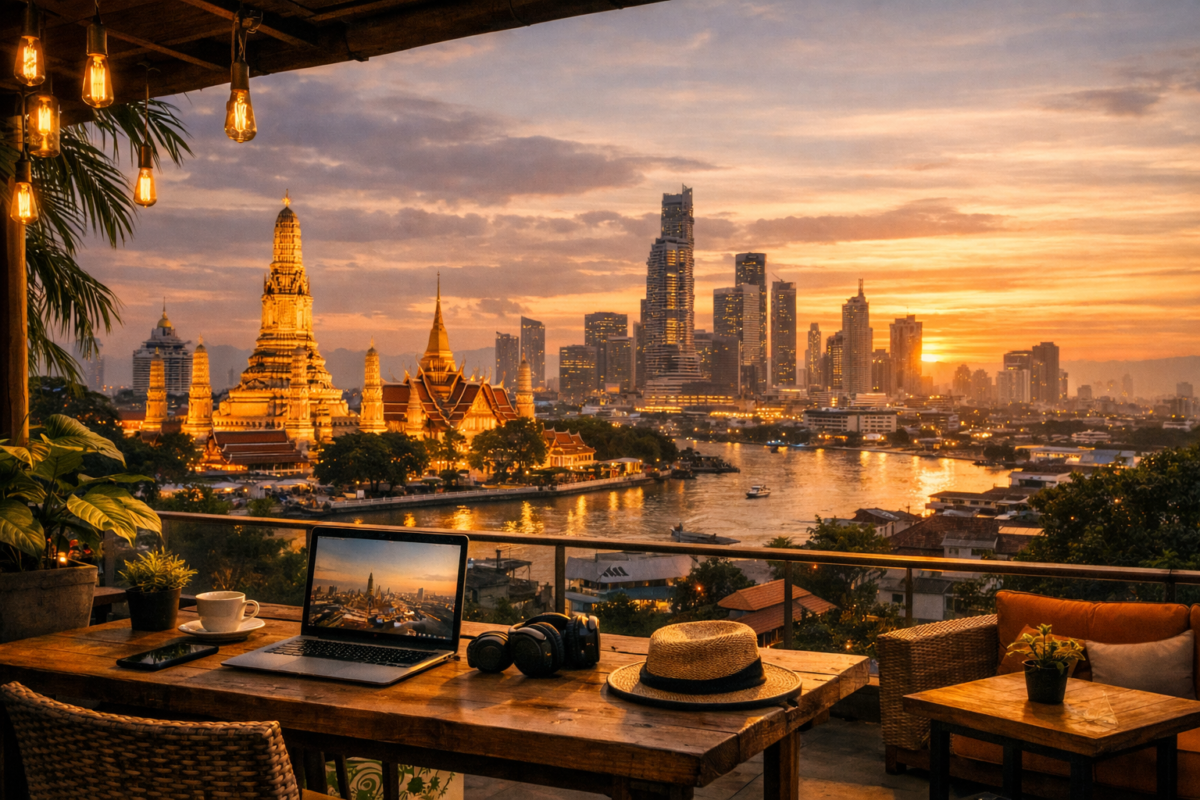
Bangkok is not a slow city. It is one of the great megacities of the 21st century – sprawling, 24-hour, overwhelming in the best possible way – and working from it is a fundamentally different experience from working from Chiang Mai. You trade the manageable scale and community feel for access to one of the finest cities on Earth, with world-class restaurants, galleries, rooftop bars, and a public transport system (the BTS Skytrain and MRT metro) that actually works.
Monthly costs (comfortable, central):
- Studio apartment or serviced room (Sukhumvit/Silom): $450–900
- Co-working space: $80–150
- Food (local and mixed): $350–600
- Transport (BTS/MRT + occasional Grab): $60–100
- TOTAL: approximately $940–1,750 per month
Internet: Excellent. AIS, DTAC, and True Move H all offer fast 5G in central Bangkok. Co-working spaces (WeWork has multiple Bangkok locations; Hubba is the leading local co-working brand) consistently offer 300+ Mbps fibre. Coffee shop WiFi in Silom and Sathorn is generally very reliable.
Bangkok’s best digital nomad areas are Silom (business district, excellent coffee shops, good transport links), Ari (a quieter, more local neighbourhood increasingly popular with creative remote workers – good cafés, low traffic, residential feel), and On Nut (eastern Sukhumvit, genuinely affordable by Bangkok standards, good co-working spaces, younger crowd).
Pro Tip: Bangkok accommodation pricing varies enormously. Use Hotellook to compare across all platforms for short-term stays. For longer-term (monthly) accommodation, direct negotiation with serviced apartment buildings in On Nut or Ari typically yields 30-40% discounts versus nightly rates.
3. Hoi An & Da Nang – Vietnam – The Emerging Nomad Corridor
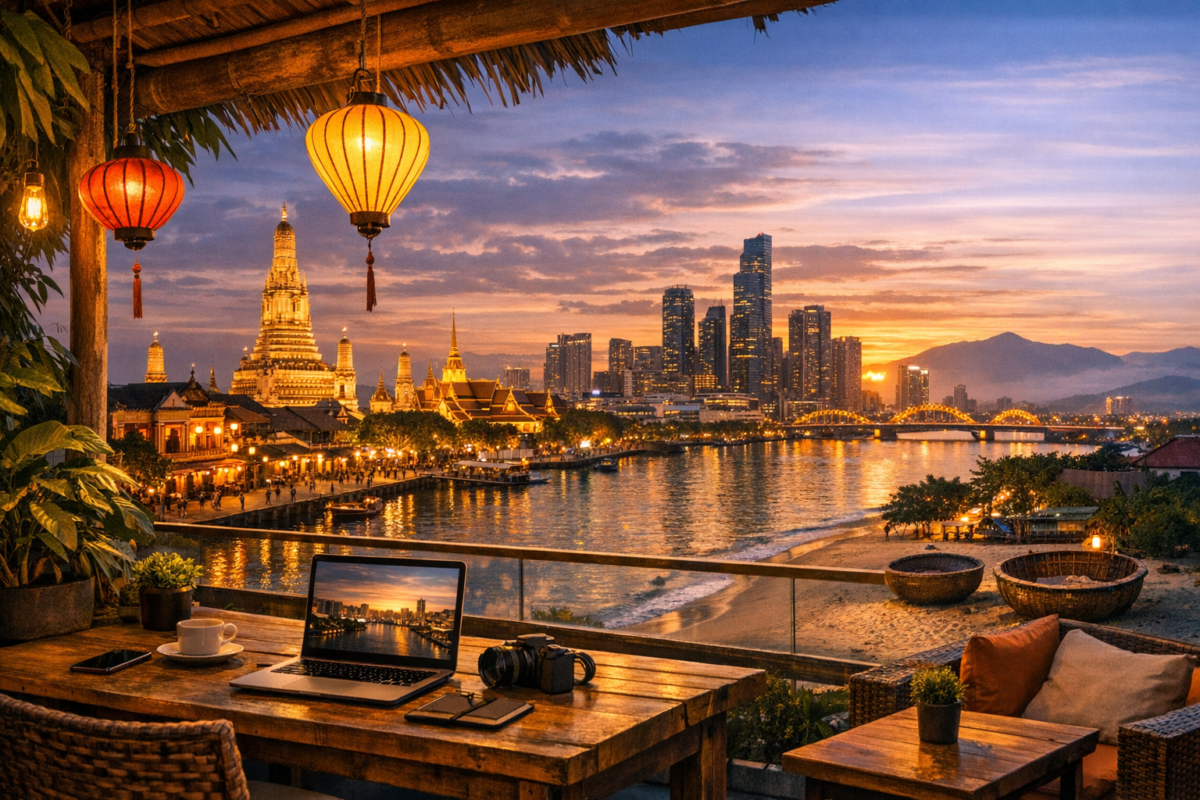
Vietnam has become one of the most popular nomad destinations in Southeast Asia over the last five years, and the central coast corridor – Da Nang as the functional city base and Hoi An as the beautiful ancient town 30km south – offers a combination that few other nomad destinations can match: exceptional food, very low cost of living, increasingly reliable internet, and a landscape (mountain passes, white sand beaches, UNESCO heritage town) that rewards being somewhere.
Monthly costs (Da Nang, comfortable):
- Modern apartment or guesthouse: $300–500
- Co-working (Te Qua Space, Toong, Soho): $50–100
- Food (Vietnamese restaurants and street food): $150–300
- Motorbike rental: $50–80
- TOTAL: approximately $550–980 per month
Internet: Significantly improved over the last five years. Viettel and Vinaphone 4G/5G cover Da Nang and Hoi An well. Fibre in co-working spaces and newer apartments is fast (50–200Mbps). The key variable is consistency – power cuts and outages are more frequent in Hoi An (older infrastructure) than Da Nang. Keep a 4G backup SIM active.
Visa: The Vietnam e-Visa grants 90 days single entry (or 90 days multiple entry) for most Western nationalities. Cost: $25. Apply at evisa.xuatnhapcanh.gov.vn at least 3 days before travel. Vietnam does not currently have a digital nomad-specific visa; the e-Visa and 90-day tourist stamp are the practical options. No border run required – the 90-day e-Visa is sufficient for most working stays.
Nomad Insight: Hoi An is beautiful but not ideal for high-productivity focused work. The tourist-facing nature of the Ancient Town, the narrow streets (no vehicles, slow walking pace), and the social pull of the cafés and restaurants make it a place where working days tend to be shorter and more interrupted than you planned. Many nomads use Da Nang as their productive base and Hoi An as a weekend and evening destination – which is the correct arrangement.
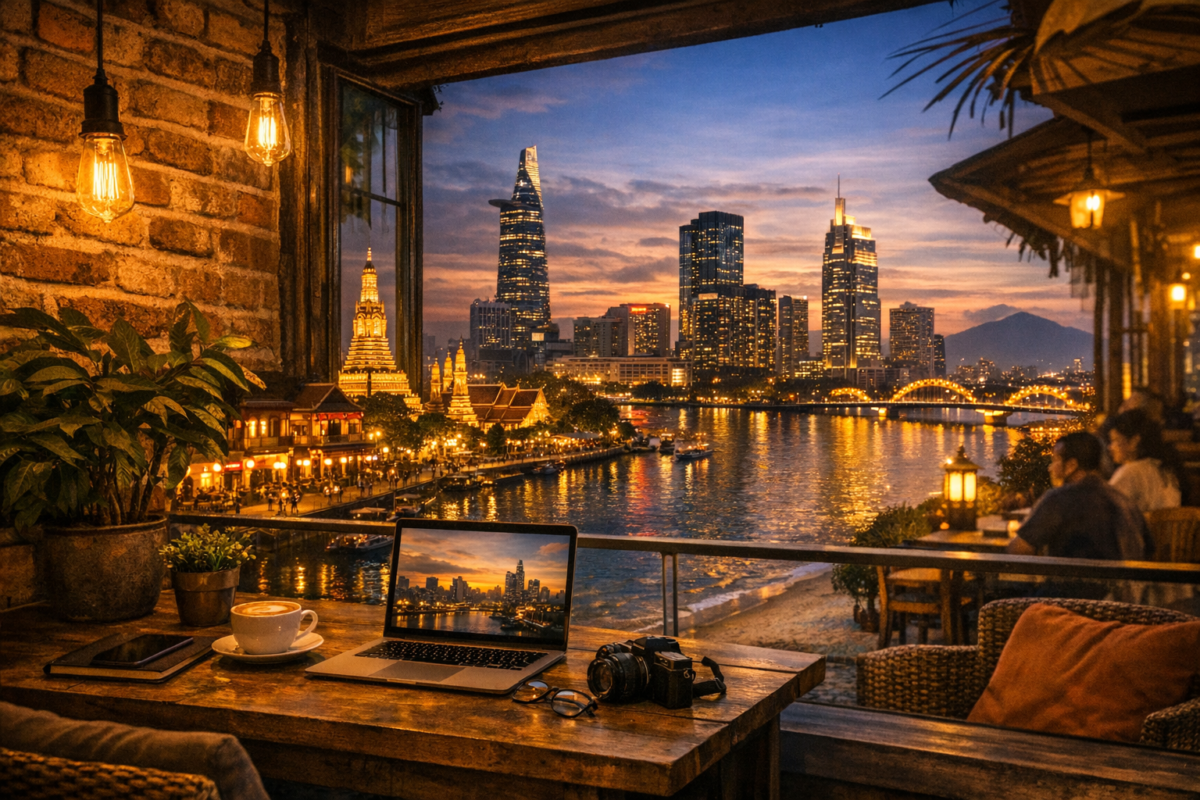
4. Ho Chi Minh City (Saigon) – Vietnam – The Hustler’s City
Ho Chi Minh City is Vietnam’s economic engine – a city of 10 million people that moves at a pace that makes Bangkok feel slightly unhurried. The energy is extraordinary and exhausting, the food culture is among the finest in Southeast Asia, and the cost of living is low even by Vietnamese standards. It is the right city for people who thrive on urban intensity and the wrong city for people who need quiet to work.
Monthly costs (HCMC, comfortable):
- Apartment in Thao Dien or Bui Vien adjacent areas: $350–600
- Co-working (Toong, Dreamplex, Saigon Hub): $60–120
- Food: $150–350
- Transport (Grab motorbike or taxi): $40–80
- TOTAL: approximately $600–1,150 per month
Best area for nomads: Thao Dien (District 2, expat and nomad-heavy, villa apartments, good coffee shops, feels like a different city from central HCMC – quieter, greener, excellent schools nearby). Bui Vien (backpacker area, very cheap, very loud, not for serious work). Pham Ngu Lao (budget-friendly, central, lively, manageable noise level during working hours).
Food Note: HCMC is where you eat banh mi from Huynh Hoa on Le Thi Rieng street (the city’s most famous banh mi, $1.50, extraordinary), broken rice (com tam, $2–3 at a local shop, the definitive HCMC working lunch), and pho from a cart at 6:30am before the first call of the day. The food in HCMC is a reason to be here independent of the nomad infrastructure.
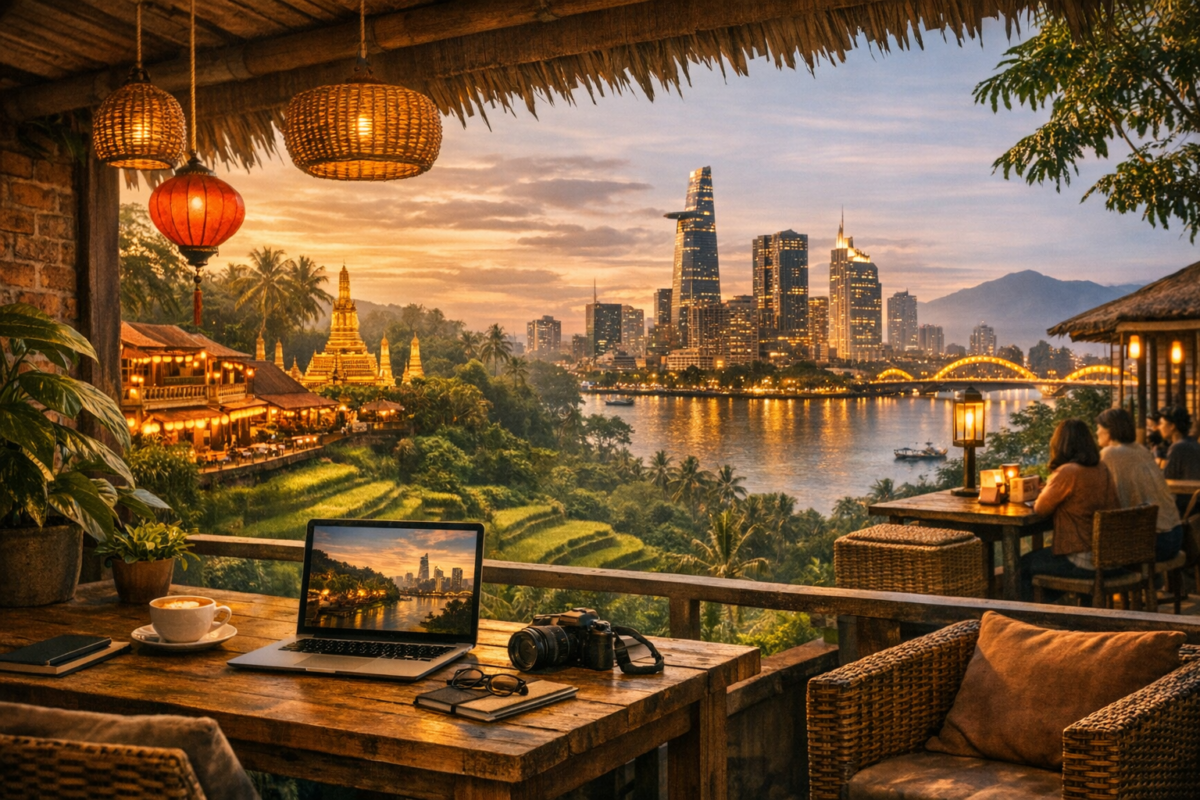
5. Bali (Canggu & Ubud) – Indonesia – The Nomad Playground
Bali is the most Instagram-optimised digital nomad destination in Southeast Asia – and that is both its greatest strength and its most significant problem. The infrastructure for remote work in Canggu (the beach town that became the nomad capital of Bali) is genuinely excellent: dozens of well-designed co-working spaces, fast fibre internet, a social community of nomads and entrepreneurs, and a setting of rice paddies, beach sunsets, and Hindu temple ceremonies that is genuinely, literally beautiful.
The problem is that the nomad scene in Canggu has become so concentrated and so self-referential that it can feel less like being in Bali and more like being in a very pleasant bubble that happens to be located in Bali. The prices have risen significantly over the last five years – Canggu is no longer cheap by Southeast Asian standards – and the density of co-working spaces, specialty coffee shops, and avocado toast restaurants can make it hard to remember that you’re in Indonesia.
Monthly costs (Canggu, comfortable):
- Guesthouse or villa room: $400–800
- Co-working (Dojo, Outpost, Livit): $100–180
- Food (mix of local warung and nomad cafés): $250–500
- Scooter rental: $60–90
- TOTAL: approximately $810–1,570 per month
Ubud offers a different Bali – the cultural and artistic centre of the island, surrounded by rice terraces and temples, quieter and more focused than Canggu, with a growing co-working scene (Outpost Ubud, BaliSpirit HQ, Hubud) and a slightly more meditative pace that many nomads find more productive. Monthly costs in Ubud are typically 15–25% lower than Canggu.
Visa: Indonesia’s Digital Nomad Visa (officially the Visiting Visa for Remote Work) was introduced in 2023 – offering 60 days extendable to 180 days for remote workers. Requirements include proof of employment outside Indonesia and income of $2,000+/month. Most nomads still use the 30-day on-arrival visa extendable to 60 days, then do a visa run to Singapore or KL. Check the current visa status at the Indonesian embassy website before planning – rules have changed several times.
Heads Up: Bali has specific rules about working remotely that are worth understanding. Indonesian law technically prohibits foreigners from working (generating income) within Indonesian territory without a work permit – and ‘work’ can include remote work for overseas clients. This is rarely enforced against tourists doing laptop work at cafés, but it is a legal grey area that the digital nomad visa is designed to resolve. Use the official DNV if available.
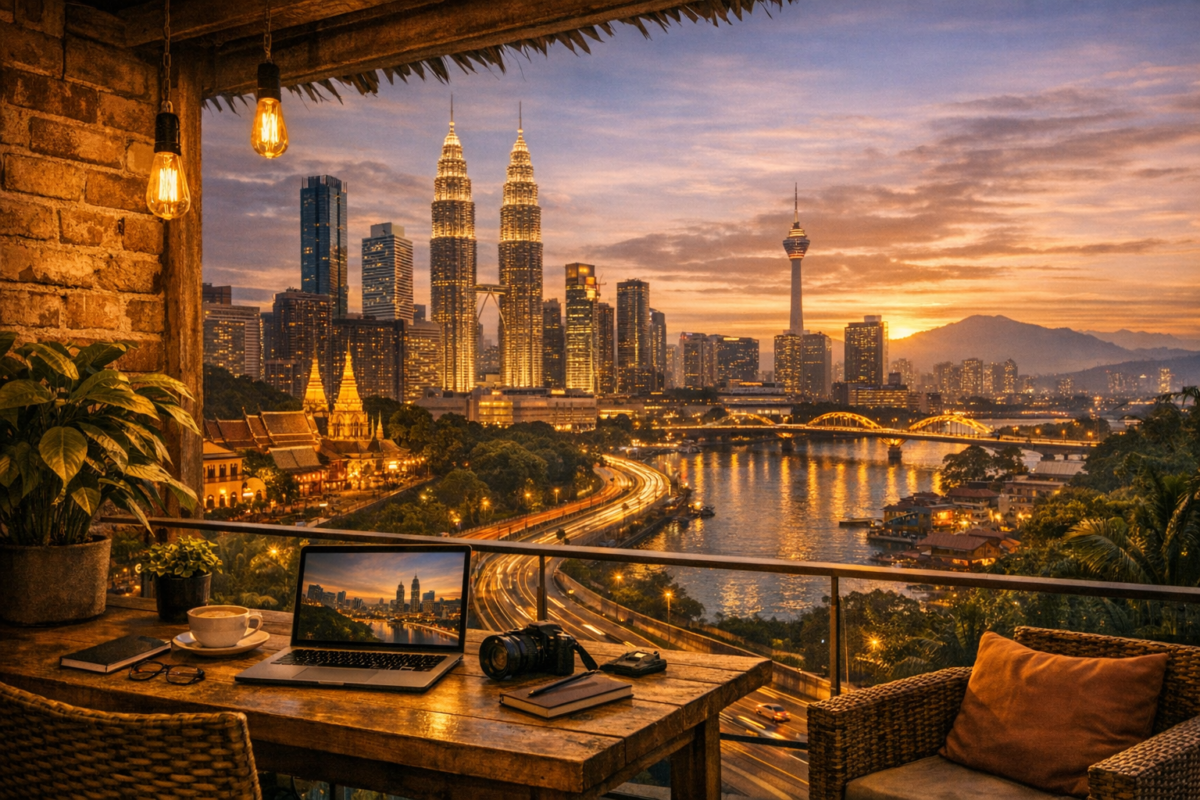
6. Kuala Lumpur – Malaysia – The Underrated Infrastructure City
Kuala Lumpur is the most underrated digital nomad city in Southeast Asia. It has excellent infrastructure – the MRT rail network, fast and reliable internet (Maxis, Digi, and Celcom all offer competitive fibre and mobile plans), an international airport with connections to everywhere, and a cost of living that, while higher than Vietnam or Cambodia, is lower than Singapore and still affordable relative to Western cities.
KL’s nomad scene is smaller than Bangkok’s or Bali’s, but the city compensates with a level of cultural diversity – Malay, Chinese, Indian, and expat populations living in overlapping communities – that makes it genuinely interesting to inhabit. The food, in particular, is one of the great underappreciated food cities of Asia: roti canai at 7am from a mamak stall, Hainanese chicken rice for lunch, Penang-style char kway teow for dinner, durian from a fruit cart at midnight. All of it extraordinary, all of it cheap.
Monthly costs (KL, comfortable):
- Modern apartment (Bangsar, KLCC, Bukit Bintang): $500–900
- Co-working (Common Ground, WORQ, Colony): $100–180
- Food: $200–400
- MRT transport: $30–60
- TOTAL: approximately $830–1,540 per month
Visa: Malaysia’s DE Rantau Digital Nomad Pass offers 3–12 months for digital nomads earning $24,000+/year. A single entry social visit pass (30–90 days, depending on nationality) covers shorter stays. Malaysia Truly Asia’s My Nomad Visa is one of the most clearly structured digital nomad visa offerings in the region – check the current terms at esd.imi.gov.my.
Pro Tip: Malaysia’s national parks (Taman Negara – ancient rainforest 4 hours from KL; Kinabalu in Sabah; the Cameron Highlands) are excellent for weekend escapes from the city. The Cameron Highlands in particular — tea plantations, forest walks, cool temperatures, extremely good strawberries — is one of the finest two-day breaks available from any Southeast Asian nomad base.
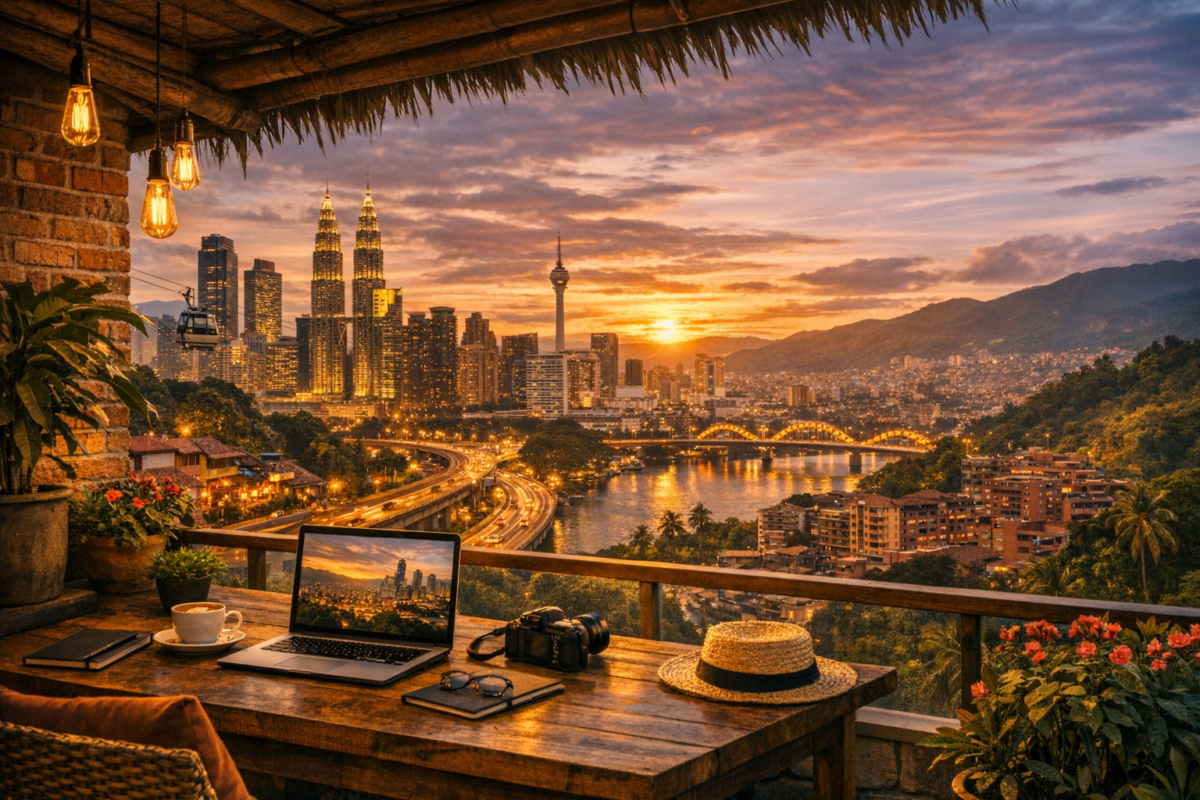
7. Medellín, Colombia – A Bonus: The Western Hemisphere Alternative
Medellín is not in Southeast Asia. I’m including it because for nomads based in the Americas – or for anyone planning a South America trip alongside Asia – it represents the Western Hemisphere’s strongest equivalent to the Southeast Asia nomad experience: a city with fast internet, low cost of living, year-round spring weather (the ‘City of Eternal Spring’ sits at 1,495 metres and maintains 22–28°C year-round), a large and established nomad community, and a cultural transformation story over the last 30 years that makes it genuinely fascinating to be in.
Monthly costs (Medellín, El Poblado or Laureles):
- Apartment: $400–700
- Co-working (Selina, Atomhouse, Kairos): $80–150
- Food: $250–450
- Metro/Uber: $40–80
- TOTAL: approximately $770–1,380 per month
Medellín’s Colombia digital nomad visa (D-Digital Nómada) offers 2 years for applicants earning $684+/month from outside Colombia. One of the most accessible digital nomad visas in the world by income threshold.
The Complete Digital Nomad Toolkit for Southeast Asia
Connectivity: eSIM and Local SIM Strategy
The single most important connectivity decision for any Southeast Asia nomad: get an eSIM before you leave home. Airalo and Yesim both offer regional Southeast Asia packages and country-specific plans. Activate on departure and you arrive with data – no airport SIM queue, no fumbling with physical SIMs at borders. Yesim’s Southeast Asia regional plan covers Thailand, Vietnam, Indonesia, Malaysia, and Singapore in one package, which is ideal for multi-country nomads.
For longer stays in a single country, supplement with a local SIM (typically CA$10–20 per month for 30–60GB high-speed data): AIS or True Move H in Thailand, Viettel or Vinaphone in Vietnam, Telkomsel in Bali, Maxis or Digi in Malaysia.
VPN – Essential for Southeast Asia
Several Southeast Asian countries have restricted internet access (Vietnam blocks some international sites; Indonesia occasionally blocks platforms; Thailand has intermittent restrictions during political events). A VPN is also essential for accessing home-country banking apps, streaming services, and maintaining privacy on shared co-working WiFi networks. NordVPN is the most widely used by nomads in Southeast Asia – it works reliably on local networks, has servers in all relevant countries, and handles the occasional ISP-level block without issues.
Tech Note: Always test your VPN before you land. Some VPN protocols are throttled in Vietnam and Indonesia – use the obfuscated server setting (NordVPN calls it ‘obfuscated servers’) if you’re getting reduced speeds through the VPN. WireGuard protocol is fastest on good connections; OpenVPN is more reliable on restricted networks.
Flights and Getting Between Countries
Southeast Asia has an excellent low-cost carrier network (AirAsia, VietJet, Scoot, Batik Air) covering most inter-city routes for $20–60 per flight booked 2–4 weeks ahead. For international arrivals and long-haul flights from Europe, North America, or Australia, search Aviasales for the best available fares across all carriers simultaneously. Earn cashback on every booking with WayAway. If a flight is cancelled or significantly delayed, AirHelp handles compensation claims – particularly relevant on EU-regulated routes.
For ground transfers between airports and accommodation, GetTransfer covers most Southeast Asian cities with fixed-price pre-booked transfers. In Bangkok, HCMC, and Bali, InDrive is an excellent alternative to Grab for city rides – often cheaper on the same routes.
Accommodation Strategy
For the first week in a new city, stay in a guesthouse or hostel rather than committing to a monthly apartment. Every nomad city has a price range for monthly accommodation that is not visible from booking platforms – direct negotiation with guesthouse owners for 28+ day stays regularly yields 40–60% discounts from posted weekly rates. Use Hotellook to find short-term accommodation while you scout the monthly market. Facebook Groups (‘) are the best resource for current monthly rental availability in most nomad cities.
Health Insurance and Travel Insurance
Long-term nomad health insurance is a separate category from travel insurance. For stays of 3+ months, standard travel insurance may not cover you adequately. Ekta Travel Insurance offers flexible policies including longer-term options suitable for extended nomad travel – compare the specific coverage terms for the countries you’re planning to stay in. SafetyWing and Cigna Global are also widely used by the nomad community for international health coverage.
Luggage Storage Between Bases
Moving between Southeast Asian nomad bases often involves time in Bangkok or Kuala Lumpur airports with excess luggage. Radical Storage has locations in major Asian gateway cities. Most co-working spaces and hostels also offer secure luggage storage for members and past guests – ask before paying for airport storage.
Guided Experiences and Tours
Weekend trips from nomad bases – hiking, island hopping, cultural tours – are one of the great benefits of being based in Southeast Asia. WeGoTrip has a strong Southeast Asia catalogue covering Chiang Mai trekking, Bali rice terrace tours, Vietnam motorbike tours, and more. For events, concerts, and major cultural festivals (Songkran in Thailand, Tet in Vietnam, Nyepi in Bali), Ticket Network covers major venues. For sea-based activities (sailing, diving tours from Thai islands or Bali), Sea Radar covers sea transport and tour routes across the region.
Southeast Asia Visa Quick Reference for Digital Nomads
Visa rules change frequently. Always verify current requirements with official embassy websites before travel. Here is the current general position for most Western nationalities:
- Thailand: 30-day visa-free or e-Visa (60 days) for most Western passports. LTR visa (10 years) for qualifying remote workers. No specific digital nomad visa as of 2025 – check current status.
- Vietnam: 90-day e-Visa for most Western nationalities ($25). No digital nomad visa. Extendable by leaving and re-entering.
- Indonesia (Bali): 30-day visa on arrival extendable to 60 days. Digital Nomad Visa (B213 visa) for remote workers – 60 days extendable to 180 days. Check current status at imigrasi.go.id.
- Malaysia: 90-day visa-free for most Western passports. DE Rantau Digital Nomad Pass (12 months, income requirement $24,000/year). Check at esd.imi.gov.my.
- Singapore: 30-day visa-free. Expensive for long stays. Usually used as a hub rather than a nomad base. Tech Pass for tech professionals.
- Philippines: 30-day visa on arrival, extendable. No specific digital nomad visa. Remote workers use tourist visa with extensions.
- Cambodia: 30-day tourist visa on arrival ($30), extendable. E-Visa available. No digital nomad visa. Very low cost of living.
Heads Up: Tax residency is a separate and important consideration from visa status. Spending significant time in a country may trigger tax obligations in that country regardless of your visa type. This is a jurisdiction-specific, complex area – consult a tax professional who specialises in digital nomad taxation before planning any stay of 90+ days, and especially before staying long enough to potentially trigger tax residency.
When to Be Where: Seasonal Planning for Southeast Asian Nomads
Southeast Asia’s climate is dominated by monsoon patterns that vary significantly by country and coast. Planning your nomad circuit around the weather – rather than fighting the rainy season in the wrong place – makes a significant practical and quality-of-life difference.
- November–February (Best for Thailand, Vietnam, and Malaysia): Cool dry season in Northern Thailand (Chiang Mai: 20–28°C). Best weather on Vietnam’s central and northern coast. KL dry season. Avoid Bali’s west coast (wet season).
- March–May (Shoulder Season – Beat the Heat): Chiang Mai smoke season (March–May). Good for Bali. Vietnam’s central coast dry season peaks. Malaysia hot and humid.
- June–August (Bali, Vietnam South, and Malaysia): Bali’s dry season — the best weather on the island. HCMC and southern Vietnam good. Thailand monsoon but Chiang Mai is often fine with morning sun.
- September–October (Transitions): Great for KL. Vietnam’s central coast typhoon risk (check forecasts carefully). Bali still good into early October.
Pro Tip: Check weather patterns at all your planned nomad bases using our Weather Checker. Planning your geographic moves to follow good weather – Thailand November–March, Bali April–October, Vietnam flexibly – is one of the most impactful quality-of-life decisions a Southeast Asia nomad makes.
Plan Your Southeast Asia Nomad Life with These Free Tools
- Live Currency Converter – real-time conversion for THB, VND, IDR, MYR, SGD, and all other SEA currencies
- Weather Checker – monitor seasonal weather at each planned base city before committing to dates
- Packing List Generator – generate a custom nomad packing list for long-term Southeast Asia travel – laptop protection, adapters, tropical clothing
- Travel Planning Services – need a custom multi-city Southeast Asia nomad itinerary? Our team builds plans around your work schedule, visa constraints, and budget
Frequently Asked Questions
Q1: How much money do you need to live as a digital nomad in Southeast Asia?
You can live comfortably and save money on $1,500/month in most Southeast Asian nomad cities. At $2,500/month you live very well – co-working space, private apartment, daily restaurant meals, weekend travel, and meaningful savings. Below $1,000/month is possible in lower-cost cities (Cambodia, Vietnam, northern Thailand) if you’re willing to share accommodation and self-cater. The AI Travel Budget Estimator gives city-specific estimates based on your lifestyle preferences.
Q2: Is the internet actually reliable enough for video calls and professional work?
In the cities in this guide – yes, reliably. Co-working spaces in Bangkok, Chiang Mai, HCMC, Da Nang, KL, and Canggu maintain 100–500Mbps fibre that handles video conferencing, cloud uploads, and any standard remote work function without issue. The key is choosing a co-working space or an apartment with a fibre connection rather than relying on café WiFi for important calls. Have a 4G/5G mobile backup active for the occasional outage. Backup internet via hotspot from a strong local SIM is the difference between a minor inconvenience and a missed deadline.
Q3: Is it legal to work remotely from Southeast Asian countries?
This is the legal grey area that almost every digital nomad navigates. Technically, working (generating income) within a country’s territory on a tourist visa may violate that visa’s terms in most Southeast Asian countries. In practice, the specific scenario – a foreign national working remotely for clients or employers outside the country they’re in – is rarely prosecuted and in many countries exists in a deliberately ambiguous regulatory space. The digital nomad visas being introduced (Indonesia, Malaysia, Thailand LTR) are designed to create a legal framework for exactly this situation. The safest approach is to use a proper digital nomad visa where available.
Q4: What are the biggest challenges of the Southeast Asia nomad life?
The honest challenges: timezone management (working for European or American employers while based in UTC+7 to UTC+9 means very early morning or late evening calls – this is manageable but requires planning and clear communication with employers or clients). Social loneliness (the nomad community is warm but transient – people arrive and leave constantly, and building lasting friendships requires active effort). Productivity drift (the extraordinary quality of life available in Southeast Asia can make it hard to stay focused on work – the beach, the food, the people, the temples are all genuinely compelling alternatives to the laptop). Health (food safety, heat, tropical diseases, and the occasional bout of traveller’s sickness are real – comprehensive health insurance and basic precautions are essential).
Q5: Which Southeast Asian city is best for first-time nomads?
Chiang Mai for almost everyone. The nomad infrastructure is established and reliable, the cost of living is low enough to remove financial stress, the city is navigable and manageable, the food is outstanding, the surrounding landscape is beautiful, and the community of other nomads and long-term travellers is large enough that you are never isolated. It is not the most exciting city in Southeast Asia (Bangkok wins that comfortably) but it is the best place to figure out whether the nomad lifestyle actually works for your specific combination of work requirements, social needs, and budget.
Q6: How do I handle banking and money while nomading in Southeast Asia?
The standard toolkit: Wise or Revolut for multi-currency accounts with real exchange rates and low fees. A backup credit card with no foreign transaction fees (Charles Schwab in the US; Starling or Chase in the UK; both reimburse foreign ATM fees). Local ATM withdrawals for cash (ATM fees in Thailand: 200 THB (~$6) per withdrawal – minimise with larger, less frequent withdrawals). Keep digital and physical copies of your passport and card details in separate secure locations. Never carry your passport and all your cards simultaneously in the same wallet in crowded areas.
Final Thoughts: Southeast Asia Is Where the Nomad Life Actually Works
The question people ask before their first Southeast Asia nomad stint is whether it will be as good as it looks. The question people ask after the first month is how long they can extend their visa.
There is something specific that happens when you are in a place where the cost of daily life is low enough that financial anxiety is not a constant background noise, where the food is extraordinary enough that every meal is worth paying attention to, and where the landscapes and cultures and cities are sufficiently varied and interesting that the backdrop of daily life never becomes routine. You stop performing the idea of work-life balance and start actually having it.
Southeast Asia does not solve every problem that remote work creates. The timezone challenges are real. The transience is real. The occasional week when the internet is bad and the accommodation is noisy and the creative work just won’t come – that happens here too, same as anywhere. But the ratio of those weeks to the weeks where you look up from your laptop at 5pm and think I am very lucky to be here is considerably better than in most other arrangements available to a person who works from a laptop.
Start planning your Southeast Asia nomad life today. Find the best flights on Aviasales, earn cashback with WayAway, activate your eSIM with Airalo or Yesim, protect your data with NordVPN, book accommodation at Hotellook, sort airport transfers via GetTransfer, and protect your health and trip with Ekta Travel Insurance. Browse our full Destination Guide Library and budget travel hub for more.
Open the laptop. Close the map app. Order the pad kra pao.
Hidden Travels Team | hiddentravels.site