
For most of my twenties, I believed that full-time travel was something that happened to other people. People with trust funds, or tech salaries so large they could work for five years and retire to a life of airports and sunsets. People who ‘figured something out’ that I hadn’t. People whose circumstances were fundamentally different from mine.
Then I met a woman in a Lisbon hostel who had been traveling continuously for four years on an income of $22,000 a year. An English teacher in her fifties who had sold her house, invested the proceeds modestly, and designed a life that moved between low-cost countries – three months in Southeast Asia, four months in Eastern Europe, two months in Central America – spending less per year than she had on rent alone in London.
I met a graphic designer in Chiang Mai who had never earned more than $45,000 working in an office and was now earning $38,000 remotely while spending $1,100 a month on rent, food, transport, and everything else in northern Thailand. He described his life as the first time he’d felt financially comfortable.
These people were not wealthy. They had simply understood something that most people don’t: that in a world of radically different cost-of-living levels, the currency of freedom is not a large income – it is a portable income applied strategically to a geography of your choosing.
This guide is the one I wish someone had handed me. It covers the economics of travel full-time honestly, the real costs of long-term life on the road, the income strategies that actually work, the slow-travel approach that makes it financially sustainable, and every practical tool you need to go from ‘thinking about it’ to actually doing it.
The Myth That Keeps People at Home: You Need to Be Rich
Let’s address this directly. The belief that Travel full-time requires wealth is one of the most persistent and damaging myths in the travel world. It keeps millions of people stuck in lives they don’t want, waiting for a financial threshold they will never quite reach.
Here’s the economic reality: the cost of Travel full-time in most of the world’s most interesting destinations is dramatically lower than the cost of a fixed life in a Western city. Not slightly lower. Dramatically lower.
| Location | Monthly Cost of Living (Solo) | Annual Cost | Notes |
| London, UK | $2,800–4,200 | $33,600–50,400 | Rent $1,400–2,200, food, transport |
| New York City, USA | $3,200–4,800 | $38,400–57,600 | Rent $2,000–2,800+ in shared apartment |
| Toronto, Canada | $2,600–3,800 | $31,200–45,600 | Rising housing costs across the city |
| Chiang Mai, Thailand | $800–1,200 | $9,600–14,400 | Private room + all meals + activities |
| Mérida, Mexico | $900–1,400 | $10,800–16,800 | Colonial apartment + restaurants + transport |
| Tbilisi, Georgia | $700–1,100 | $8,400–13,200 | Excellent flat + wine + restaurants |
| Lisbon, Portugal | $1,400–2,000 | $16,800–24,000 | Budget to mid-range; growing but still affordable |
| Medellín, Colombia | $900–1,300 | $10,800–15,600 | Modern city infrastructure at low prices |
| Bali, Indonesia | $800–1,200 | $9,600–14,400 | Villa with pool in Canggu or Ubud possible |
| Ho Chi Minh City, Vietnam | $700–1,000 | $8,400–12,000 | One of SE Asia’s most affordable major cities |
A full-time traveler who earns $30,000 USD per year and spends 10 months in Southeast Asia / Eastern Europe and 2 months in Western Europe lives more comfortably – often far more comfortably – than the same person paying $2,500/month in rent in a Western city.
The math is not magic. It’s geography.
The Three Models of Travel Full-Time: Choose Your Path
Travel Full-time is not one thing. There are at least three distinct models, each with different financial requirements, different lifestyles, and different entry points.
| Model 1: The Digital Nomad — Remote Income + Geoarbitrage The most common and increasingly accessible model: you earn income remotely (through employment, freelancing, or a business) and live in countries where your income goes significantly further than it would at home.This is geoarbitrage – earning in a strong currency (USD, GBP, EUR) while spending in a weaker one (Thai baht, Georgian lari, Mexican peso). A $4,000/month remote salary feels modest in London; it feels generous in Chiang Mai. Who it suits: People with jobs that can go remote, freelancers, online business owners, developers, designers, writers, marketers, customer support professionals. Minimum income needed: $1,500–2,500/month is sufficient for comfortable full-time travel in Southeast Asia or Eastern Europe. $2,500–3,500/month gives you genuine comfort plus savings in most destinations. Key advantage: Sustainable indefinitely. Your income continues and potentially grows; your costs stay low. |
| Model 2: The Long-Term Backpacker — Savings + Slow Travel The classic model: save money before you go, then travel slowly through low-cost countries, extending your runway as far as possible. No remote income required – just sufficient savings and a commitment to stretching every dollar.The slow travel element is critical here. Moving quickly between destinations is expensive – transport costs stack up and you never unlock the long-stay discounts available to monthly renters. Staying in one place for 2–4 weeks at a time dramatically reduces daily costs. Who it suits: People who can take a career break, recent graduates, retirees and pre-retirees, people who have sold a property or received a lump sum.How much savings needed: $15,000–20,000 can fund 12–18 months of full-time travel in Asia and Eastern Europe. $25,000–35,000 extends this comfortably with a buffer. Key risk: Runway eventually ends. Works best combined with some income generation or as a defined-length sabbatical. |
| Model 3: The House Sitter / Work Exchanger — Accommodation-Free Travel The most creative model: eliminate accommodation – your biggest fixed cost – through house sitting, property caretaking, work exchanges (Workaway, WorldPackers), or volunteering placements that include room and board.A house sitter who uses Trusted Housesitters or similar platforms can live rent-free in beautiful homes worldwide in exchange for caring for pets and properties. On top of this, food and local costs in most destinations run $400–700/month, meaning some travelers manage full-time travel on under $1,000/month. Who it suits: Retirees, couples, animal lovers, people with flexible schedules and some references. How much income needed: $800–1,500/month can sustain this lifestyle in low-cost countries when accommodation is free. Key advantage: Extraordinarily low costs. Often the most immersive cultural experience available – you live in real homes in real neighborhoods. |
Earning Income While Traveling: What Actually Works
This is the section most wannabe full-time travelers want most urgently – and also the one with the most noise to cut through. Here are the income models that genuinely work at scale in 2025, ordered from most to least accessible.
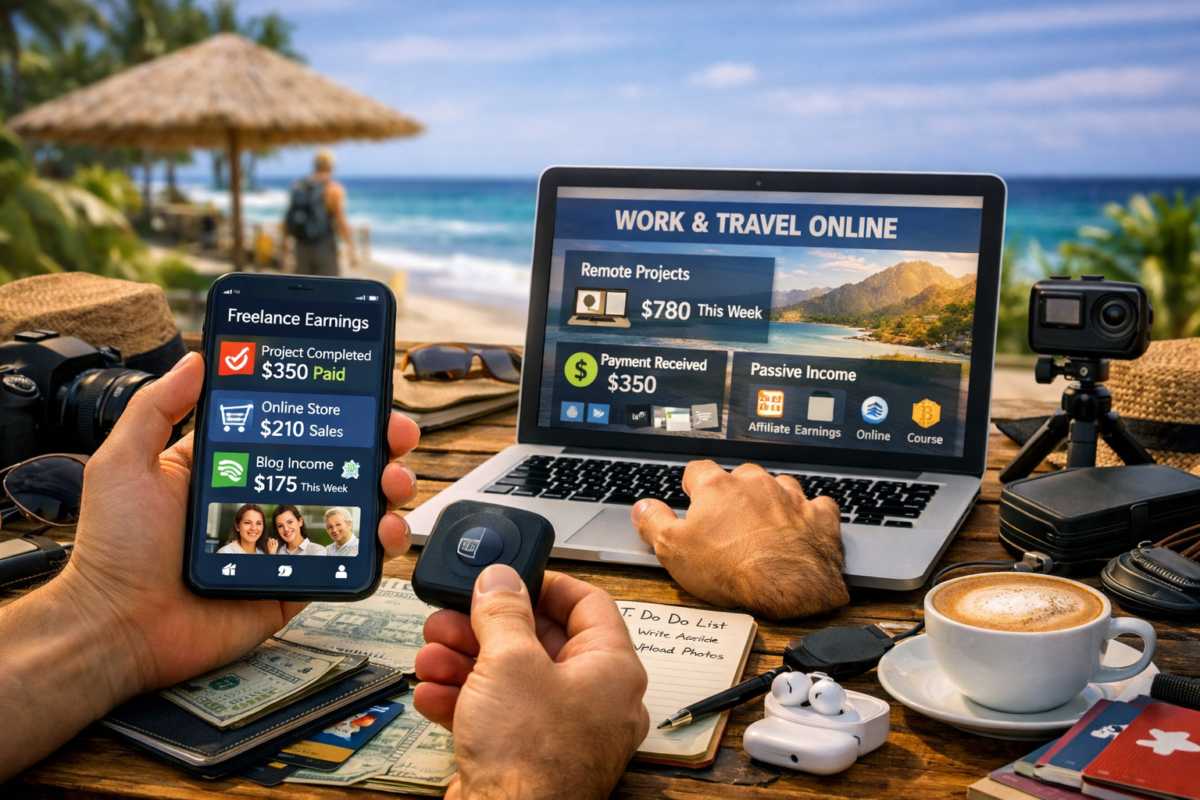
1. Remote Employment: The Fastest and Most Reliable Path
If you currently have a job that could theoretically be done remotely – and most knowledge work can – negotiating remote status is the fastest path to location independence. Remote work has normalized dramatically since 2020. Many employers who resisted it before now accept it as standard. The pitch is often simpler than people expect.
- How to negotiate: Demonstrate you can do the role fully remotely for a trial period, propose a 3-month pilot, and track outcomes rigorously. Come with a plan, not a request.
- If your current employer won’t budge: Job platforms like We Work Remotely, Remote.co, and FlexJobs list thousands of remote-first roles across virtually every industry.
- Income range: $30,000–120,000+ depending on role and industry. Fully compatible with Travel full-time.
2. Freelancing: Skill-Based Income with Complete Location Independence
Freelancers sell skills to clients on a project or retainer basis, with no fixed employer and no fixed location. The most in-demand remote freelance skills include writing and content creation, web development and software engineering, graphic design and video editing, digital marketing and SEO, virtual assistance and project management, and translation.
- Getting started: Platforms like Upwork, Fiverr, and Toptal connect freelancers with clients worldwide. Build a portfolio, set competitive rates, and grow through referrals.
- Income range: $1,000–8,000+/month depending on skill and client base. Takes 3‒6 months to build a reliable income stream.
3. Online Business: Scalable but Slower to Build
Online businesses – blogging, affiliate marketing, e-commerce, online courses, YouTube, newsletters, SaaS products – offer potentially scalable income with no ceiling. They also take the longest to build and have the highest failure rate. Best pursued as a side project alongside employment or freelancing rather than as a primary income strategy from day one.
- Realistic timeline: 6–18 months to generate meaningful income from content or affiliate sites. 12–24 months for an online course business. Results vary enormously.
4. Teaching English Online or In-Person
English teaching remains one of the most accessible income streams for native English speakers with no prior teaching experience. Online platforms like VIPKid, iTalki, Preply, and Cambly connect English teachers with students worldwide, working on your schedule from anywhere. In-person teaching in countries like South Korea, Japan, China, Thailand, and Taiwan typically provides accommodation alongside salary – effectively funding your stay.
- Income range: $15–30/hour online for freelance teaching. $1,500–2,500/month for in-country teaching roles, often with housing included.
The Economics of Slow Travel: Why Moving Slowly Saves More Than You Think
This is the single most important financial concept for long-term travelers, and the one most commonly overlooked by beginners.
Every time you move – book a new flight, take a long-distance bus, move to a new city – you pay a financial and psychological cost. You pay transport costs. You pay ‘new city’ premium prices at restaurants near your new accommodation before you’ve found the good local spots. You lose the long-stay discounts available to monthly renters. You lose the efficiency that comes from knowing your neighborhood.

| The Slow Travel Cost ComparisonTravel StyleMovementMonthly AccommodationMonthly FoodTotal Monthly Fast (move every 3–5 days)8–10 moves/month$900–1,200 (nightly rates)$600–900 (tourist areas)$1,500–2,100+Medium (1–2 weeks per place)3–4 moves/month$600–900 (mid-term rates)$400–600 (mix local/tourist)$1,000–1,500Slow (1+ month per place)1–2 moves/month$350–700 (monthly rental)$250–450 (local knowledge)$600–1,150 A traveler moving slowly at monthly rental rates in Southeast Asia or Eastern Europe spends roughly half what a fast mover spends in the same region. Over 12 months, that difference compounds to $6,000–15,000. |
How to Find Monthly Rentals Abroad
For longer stays of 2–4 weeks or more, compare short-term rental platforms alongside monthly apartment rental sites. Use Hotellook for accommodation comparisons, and ask at your first hostel or guesthouse about monthly rates – many properties offer significant discounts for 3–4 week bookings that never appear on booking platforms.
Best Geoarbitrage Destinations for Travel Full-Time
The concept is straightforward: live in a country where your income – earned in USD, GBP, or EUR – converts to a lifestyle significantly above average local income levels.
| Destination | Monthly Budget (Comfortable) | Why It Works | Remote Work Infrastructure |
| Chiang Mai, Thailand | $900–1,300 | Massive digital nomad community, fast internet, low food costs | Excellent – co-working spaces, coffee shops, fibre internet |
| Tbilisi, Georgia | $700–1,100 | Visa-free for 365 days for most nationalities, low cost of living | Growing – fast internet, active nomad scene |
| Medellín, Colombia | $900–1,400 | Spring-like climate year-round, vibrant culture, good infrastructure | Good – reliable internet, large nomad community |
| Lisbon, Portugal | $1,400–2,000 | EU base, excellent quality of life, NHR tax regime for eligible | Excellent – major tech hub, superb connectivity |
| Playa del Carmen, Mexico | $900–1,400 | Caribbean coast, large expat community, strong infrastructure | Good – reliable internet, many co-working spaces |
| Bali (Canggu), Indonesia | $900–1,300 | Year-round warmth, vibrant nomad ecosystem, villa living | Good – co-working scene established, connectivity improved |
| Ho Chi Minh City, Vietnam | $700–1,100 | Ultra-affordable, great food, strong internet in cities | Good – reliable in cities, growing nomad scene |
| Budapest, Hungary | $1,100–1,700 | EU access, stunning city, relatively low costs for Europe | Excellent – reliable infrastructure, large expat community |
Managing Money as a Full-Time Traveler
Full-time travelers who don’t manage money well do not stay full-time travelers for long. Here’s the financial framework that makes the lifestyle sustainable.

| Hack #1: Use a Fee-Free International Debit Card Standard bank cards charge 2.5–3% foreign transaction fees on every purchase. Over 12 months of full-time travel with $18,000 in spending, that’s $450–540 lost purely to bank fees. The solution: a Wise or Revolut card, which converts at the real mid-market exchange rate with minimal fees. Both have free tiers that cover most travel needs. |
| Hack #2: Always Know Your Exchange Rate Check real-time exchange rates before every significant transaction with our free Currency Converter. Full-time travelers making dozens of transactions per week in different currencies can lose 5–10% annually to poor exchange rate awareness. Knowing the rate protects you at every market, restaurant, and ATM. |
| Hack #3: Get an eSIM for Every Destination Roaming charges are incompatible with Travel full-time budgets. Set up destination eSIMs through Airalo before every move. For frequent movers across multiple countries, Yesim’s regional plans provide seamless coverage without buying new plans constantly. |
| Hack #4: Use a VPN Everywhere, Every Time Full-time travelers are almost entirely reliant on public Wi-Fi – cafes, co-working spaces, hostels, Airbnbs. Every single one of these networks is a security risk. NordVPN is non-negotiable for any long-term traveler accessing banking, client work, or personal accounts online. It also unlocks your home country’s streaming services and sometimes surfaces cheaper prices on flight and hotel booking platforms. |
| Hack #5: Never Travel Without Comprehensive Insurance Travel Full-time need more comprehensive insurance than vacation travelers, not less. You’re exposed to medical situations in multiple countries, potential equipment theft (laptop, camera), and trip disruption across longer periods. Ekta Traveling Insurance offers comprehensive plans suitable for long-term travelers. Review policy terms for duration limits and coverage of remote work equipment. |
| Hack #6: Claim Flight Compensation Every Time You’re Eligible Travel Full-time take more flights than almost anyone – and flight disruptions are inevitable at scale. Every delayed, cancelled, or overbooked EU flight is a potential compensation claim of up to €600. AirHelp handles claims on a no-win, no-fee basis and checks past 3 years of eligible flights. For a traveler taking 20+ flights per year, this adds up. |
Flight Strategy for Full-Time Travelers
Long-term travelers approach flights differently from vacation travelers. The goal is not the cheapest single flight but the most efficient overall transport strategy across months of movement.

Search Every Flight on Aviasales and WayAway
For every flight in your long-term itinerary, run the search on Aviasales for the best available fare, then book through WayAway for cashback on the booking. Over 20–30 flights per year, WayAway cashback compounds into a meaningful sum – effectively one or two free short-haul flights annually.
Design Loops, Not Lines
Open-jaw itineraries – flying into one city and out of another – reduce backtracking costs significantly. A Southeast Asia loop (fly into Bangkok, travel overland to Vietnam, Cambodia, and Laos, fly out of Hanoi) costs far less than returning to your starting point. Plan your movements as geographic loops rather than spokes from a hub.
Use Overnight Transport to Save Accommodation Costs
Every overnight bus, overnight ferry, or night train eliminates one night’s accommodation cost. For a Travel full-time making 20–30 intercity moves per year, substituting even 8–10 of these with overnight options saves $80–350 depending on destination – potentially $800–3,500 annually.
Use Intui Travel to find train and multi-modal route options, and GetRentACar when a rental car gives better access to regions off the main transport routes.
🧳 Luggage, Storage, and Transit Day Logistics
Full-time travelers become experts at transition day management. On days between accommodation, Radical Storage provides secure luggage storage near stations, airports, and city centres worldwide – a few dollars per bag lets you spend transition days exploring rather than dragging luggage.
For airport transfers on arrival in a new city, GetTransfer offers pre-booked fixed-price rides – eliminating the stress and overcharging risk of airport taxis in unfamiliar cities. For city rides, InDrive offers negotiated fares in 47+ countries.

Free Hidden Travels Tools for Full-Time Travelers
Before choosing your next base, use our free AI Travel Budget Estimator to build a realistic monthly cost breakdown for any destination – essential for geoarbitrage planning.
Time your base changes to the best weather window using our Weather Checker – moving with the seasons keeps conditions pleasant and costs low.
Pack carry-on only for every move with our Packing List Generator – for Travel full-time, checking a bag on every flight quickly becomes prohibitively expensive and logistically exhausting.
Real Full-Time Travel Budget: 12 Months, Real Numbers
| Month(s) | Base | Monthly Budget | Annual Contribution |
| Jan–Mar (3 months) | Chiang Mai, Thailand | $1,050/month | $3,150 |
| Apr (1 month) | Tbilisi, Georgia | $950/month | $950 |
| May–Jun (2 months) | Lisbon, Portugal | $1,750/month | $3,500 |
| Jul (1 month) | Travel month (Balkans loop) | $1,400/month | $1,400 |
| Aug–Sep (2 months) | Medellín, Colombia | $1,100/month | $2,200 |
| Oct (1 month) | Oaxaca, Mexico | $1,000/month | $1,000 |
| Nov–Dec (2 months) | Ho Chi Minh City, Vietnam | $850/month | $1,700 |
| Flights (est. 14 flights) | Various – via Aviasales | $1,800 total | $1,800 |
| Insurance (Ekta) | Annual comprehensive cover | $600–900 total | $750 |
| eSIM (Airalo/Yesim) | All destinations covered | $150–200 total | $175 |
| NordVPN | Annual subscription | $60 total | $60 |
| TOTAL | Full year, full-time travel | $15,685 |
$15,685 for a full year of continuous international travel across 7 countries and 4 continents. That’s $1,307/month average, or $43/day all-in including flights and insurance. A remote income of $2,000–$2,500/month makes this sustainable with genuine savings.
Frequently Asked Questions (FAQ)
How much money do I need to save before traveling full-time?
It depends on whether you plan to earn income on the road. If you have a remote income of $2,000–3,000/month, you need very little in savings – one to three months of runway while you establish your rhythm. If you plan to live off savings alone, $15,000–25,000 gives you 12–18 months of comfortable Travel full-time in affordable regions. Adding a side income (tutoring, freelance writing, virtual assistance) while on the road dramatically extends your runway.
Is Travel full-time lonely?
The short answer is: it can be, but far less often than people expect. Hostels are inherently social environments. Digital nomad communities in cities like Chiang Mai, Medellin, and Lisbon are genuinely welcoming. Online communities connect Travel full-time worldwide. The loneliness risk is real during slow periods or when you’re in a destination without an established traveler community – but most full-time travelers report social lives that are richer than their pre-travel existence.
What happens to my healthcare when I travel full-time?
Healthcare management is one of the most important practical considerations for Travel full-time. Comprehensive travel insurance covers acute medical situations in most destinations. For long-term dental and preventive care, many travelers schedule annual visits to countries with affordable private healthcare – Thailand, Mexico, Hungary, and Portugal are popular destinations for medical and dental tourism at a fraction of US or UK prices. Remote work employers sometimes maintain health insurance coverage for traveling employees; check your policy terms.
How do taxes work for full-time travelers?
Tax obligations for full-time travelers are genuinely complex and vary significantly by citizenship, time spent in various countries, and income source. Most countries tax citizens on worldwide income regardless of where they live. Some countries have tax treaties that reduce double taxation. The key is to get advice from a tax professional who specializes in expat or digital nomad situations before going full-time – not after. This is not an area for assumptions.
What’s the best way to earn income while traveling full-time?
Remote employment is the fastest and most reliable path if you currently have skills that translate to remote work. Freelancing is the most flexible long-term option with the highest income ceiling. Teaching English online is the most accessible option for native English speakers without a specific marketable skill. Building an online business (blog, course, content) takes the longest but can eventually become the most passive.
How do I stay productive working remotely while traveling?
The most successful full-time traveler-workers establish clear systems: dedicated work hours (mornings work well in most time zones for US-based remote workers or clients), reliable internet setup (check co-working spaces in advance for important deadline weeks), and geographic stability during intensive work periods. Chiang Mai, Medellin, and Lisbon have established co-working ecosystems specifically designed for this lifestyle. Moving slowly also helps – a new city every week is exhausting; a new city every month allows you to establish productive routines.
Is Travel full-time realistic for people with families?
Increasingly yes – the worldschooling movement demonstrates that families can travel full-time while providing excellent education for children. Countries like Mexico, Portugal, and Southeast Asia have growing communities of traveling families. The logistics require more planning (accommodation needs space, children need routines and social connection), but the lifestyle is achievable and increasingly well-documented by families who are doing it.
Travel Full-Time Is Not a Dream Reserved for Other People
Here’s the thing that the woman in the Lisbon hostel understood that most people don’t: the life you’re imagining – the one where you wake up in a different country on your own schedule, work in a cafe overlooking a city you’re still discovering, and spend your evenings in places that would take your breath away on a two-week vacation – is not a more expensive life. It’s often a cheaper one.
The math is real. The geoarbitrage is real. The remote work opportunities are real in a way they weren’t a decade ago. The infrastructure that supports this lifestyle – eSIMs, Wise cards, co-working spaces, nomad communities, short-term rentals, house sitting networks – has never been more developed.
What’s required is not a large income or an inheritance or a special set of circumstances. It’s a willingness to think differently about the relationship between where you live, what you earn, and what your money can do in different parts of the world.
The people living this life are not wealthy. They’re informed. And now, so are you.
Start calculating your full-time travel budget with our free AI Travel Budget Estimator. Find your cheapest flights with Aviasales and earn cashback on every booking with WayAway. And explore more budget travel inspiration at the Hidden Travels Budget Hub.
© Hidden Travels — hiddentravels.site
Inspiring Travelers. Sharing Hidden Stories. One Adventure at a Time.