
Let me address the elephant in the room immediately: yes, Japan has a reputation for being expensive. Ryokan inns, elaborate kaiseki meals, bullet train journeys, department store sushi – Japan can absolutely cost a fortune if you let it.
But here’s what most people getting their Japan travel advice from glossy magazines and luxury travel blogs do not tell you: Japan also has one of the most developed budget travel infrastructures of any country on earth. It has a convenience store culture that serves restaurant-quality meals for $3–5. It has capsule hotels and design-forward hostels from $20-35 a night. It has some of the world’s most beautiful temples, shrines, gardens, and public spaces – most of which are completely free to visit.
And here’s the other thing nobody mentions: since 2022, the yen has weakened significantly against the US dollar, British pound, and Canadian dollar, making Japan more affordable for Western travelers than it has been in decades. This time, your money goes further in Japan than it did five years ago.
This Budget travel in Japan guide will show you exactly how to experience Japan at its extraordinary best – the ancient temples, the food, the culture, the landscapes – on a budget of $60–85 per day. Not by cutting corners on experience, but by traveling the way smart Japan veterans actually travel.
Why 2026 Is the Best Year to Visit Japan on a Budget
The timing for a budget trip to Japan has rarely been better, for three specific reasons.
- The yen remains favorable. The USD/JPY exchange rate has been running at historically advantageous levels for Western travelers. What cost $100 a few years ago now costs considerably less in real terms. Always verify the current rate before your trip with our Live Currency Converter.
- Budget flights to Japan have multiplied. More low-cost carriers now fly direct or near-direct routes to Tokyo and Osaka from North America and Europe than ever before. Prices have dropped dramatically from the pre-2020 era.
- Post-overtourism awareness. With visitor numbers rebounding, Japan has expanded infrastructure in smaller cities and rural areas, meaning more affordable alternatives to overcrowded Tokyo and Kyoto are now well-served and easy to reach.
Getting to Japan: Finding Affordable Flights
Flights are the biggest single cost for a Japan trip, and they’re also where the most money can be saved with the right tools and timing.
Where to Search for the Cheapest Japan Flights
Start every search on Aviasales – it searches hundreds of airlines simultaneously and consistently surfaces fares that mainstream booking sites miss, including deals on carriers like Zipair (Japan Airlines’ budget arm), Peach Aviation, and connecting routes via Asian hubs that can slash the price of a Japan ticket significantly.
Run the same search on WayAway as well – it compares fares and returns cashback on every booking. For an expensive long-haul destination like Japan, even 5–10% cashback makes a real difference.
Flight Tips Specific to Japan
- Fly into Osaka (Kansai International) instead of Tokyo (Narita/Haneda). Kansai often has cheaper fares and puts you closer to Kyoto and Nara on arrival.
- Book 8-12 weeks in advance for transatlantic routes to Japan. Last-minute prices are brutal.
- Consider flying via a Southeast Asian hub (Bangkok, Seoul, Taipei) – sometimes dramatically cheaper than direct routes, especially from North America.
- Set fare alerts for your target dates and let the best price come to you instead of checking every day.
Where to Stay in Japan on a Budget
This is where Japan surprises most first-time visitors. Budget accommodation in Japan is not just cheap – it is often genuinely excellent, clean, and culturally interesting.
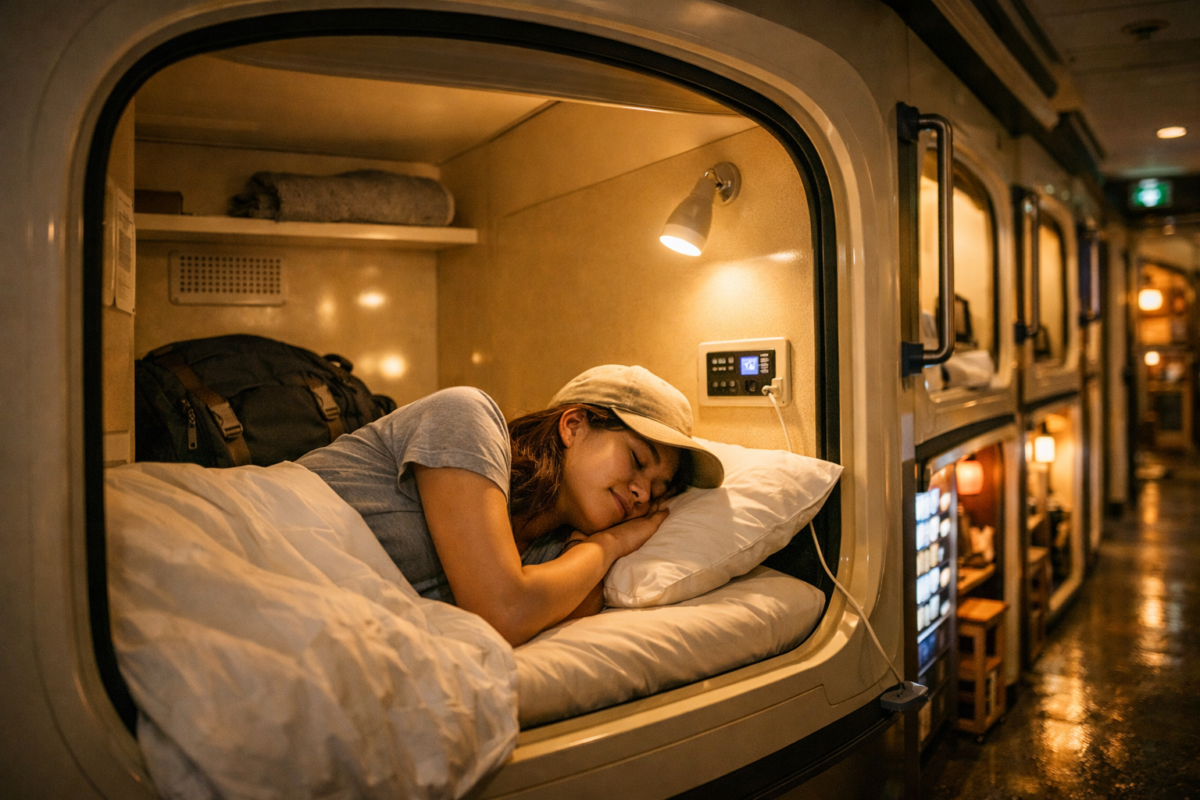
| Capsule Hotels: The Iconic Budget Sleep Capsule hotels are a Japanese invention and a genuine travel experience in their own right. A ‘capsule’ is a private sleeping pod – typically around 2m x 1m, with a mattress, lighting, USB ports, and a curtain or sliding door for privacy. Shared bathrooms and often excellent communal lounges.Modern capsule hotels are clean, secure, and surprisingly comfortable. Many now feature on-site saunas, restaurant areas, and stunning design. Prices: ¥2,000-5,000/night ($13-33). Premium capsule hotels: ¥6,000-8,000 ($40-53).Compare capsule hotels and traditional hostels in any Japanese city using Hotellook – it searches across all major booking platforms to show the absolute lowest available price. |
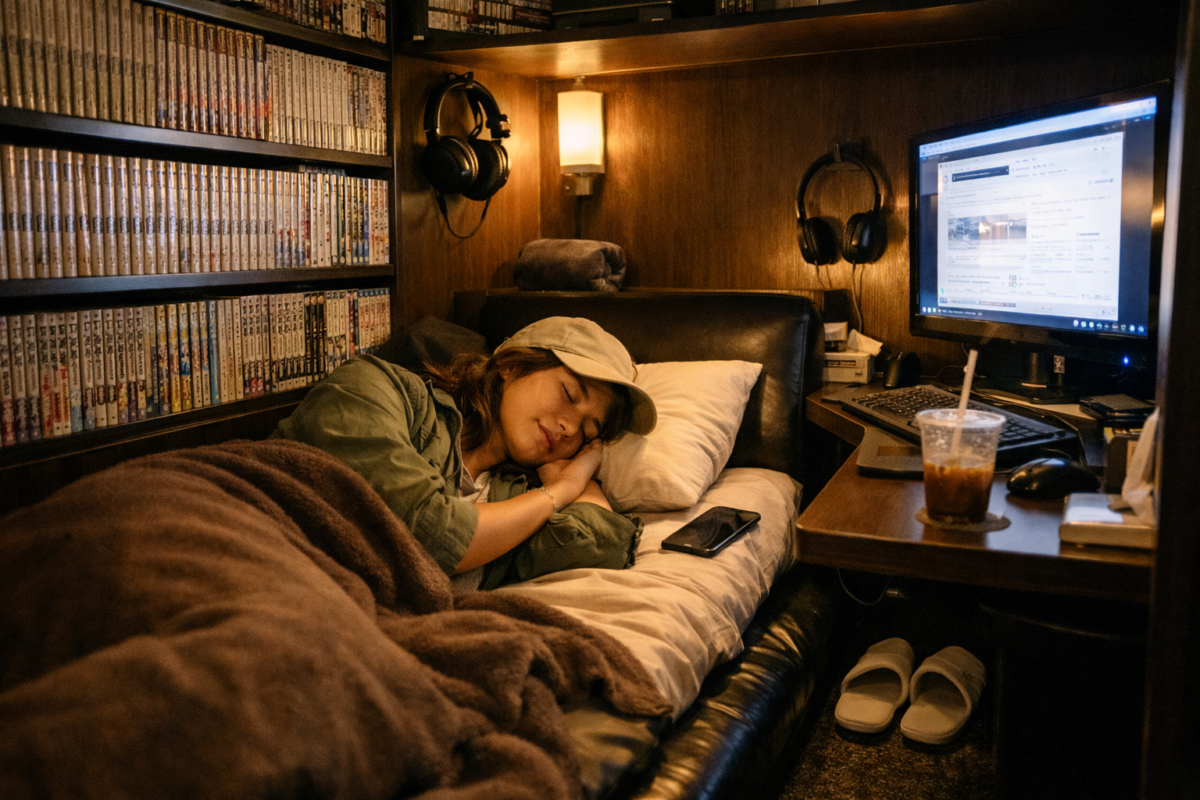
| Manga Cafes (Manga Kissa): Ultra-Budget Overnight Option For ultra-budget travelers or those needing a one-night emergency sleep, manga cafes charge by the hour and have private booths with recliners, free soft drinks, internet, and manga libraries. An 8-hour overnight pass runs ¥1,500-2,500 ($10-17). Not luxurious, but clean, safe, and a very Japanese experience. |
| Guesthouses and Hostels: The Social Option Japan’s guesthouse scene has exploded over the past decade. Modern hostels in Tokyo, Kyoto, and Osaka now offer well-designed dorms from ¥2,500-4,500 ($17-30) and private rooms from ¥6,000-12,000 ($40-80). Many are architecturally beautiful, serve excellent breakfasts, and have rooftop bars or communal kitchens.Always compare on Hotellook before booking to ensure you are getting the best available rate. |

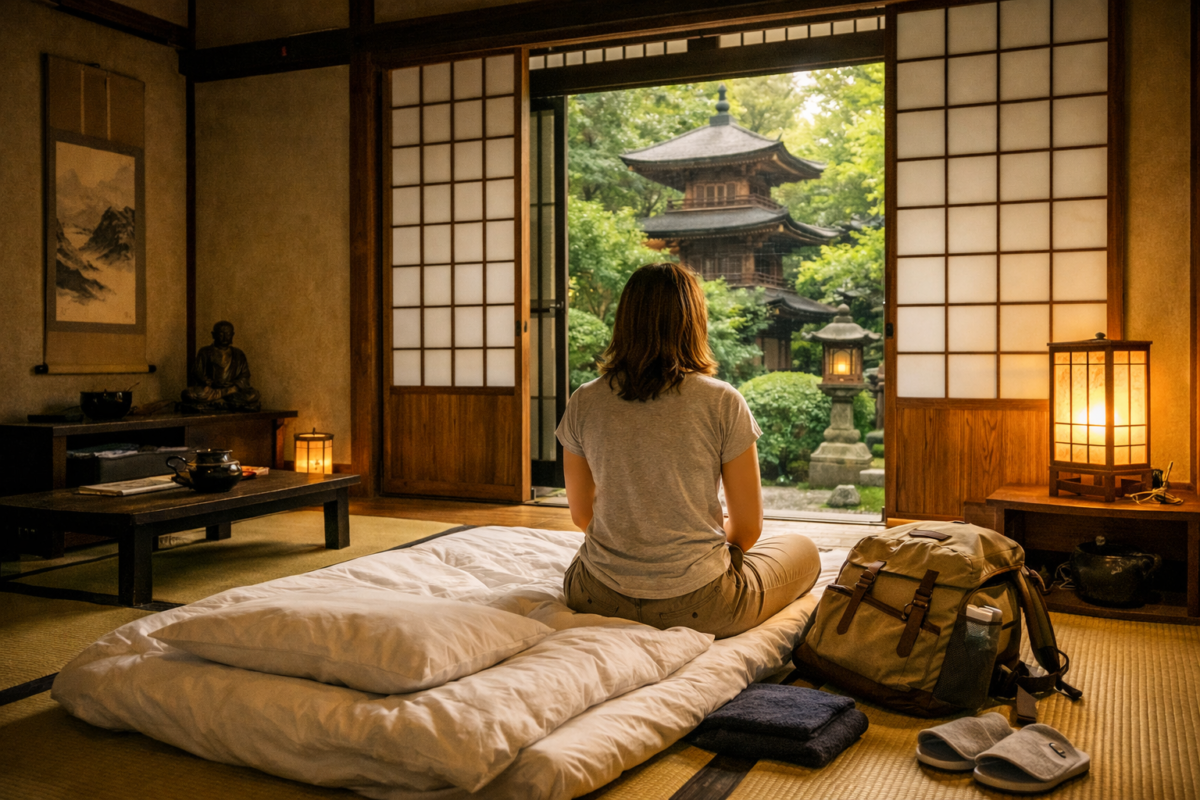
| Temple Lodging (Shukubo): Unique, Affordable, Unforgettable Some Buddhist temples across Japan – particularly in Koyasan, Kyoto, and Nara – offer overnight lodging to travelers. Called shukubo, these stays include a futon, traditional vegetarian meals, and sometimes the chance to attend morning prayers. Prices vary but many start around ¥8,000-12,000 ($53-80) including breakfast and dinner. An extraordinary cultural experience at a price that rivals mid-range hotels. |
Eating in Japan on a Budget: The Real Guide
Food in Japan is one of the great travel paradoxes: the world’s most refined culinary culture, and you can eat extraordinarily well for $5-12 a day if you know where to look.
The Convenience Store Revolution
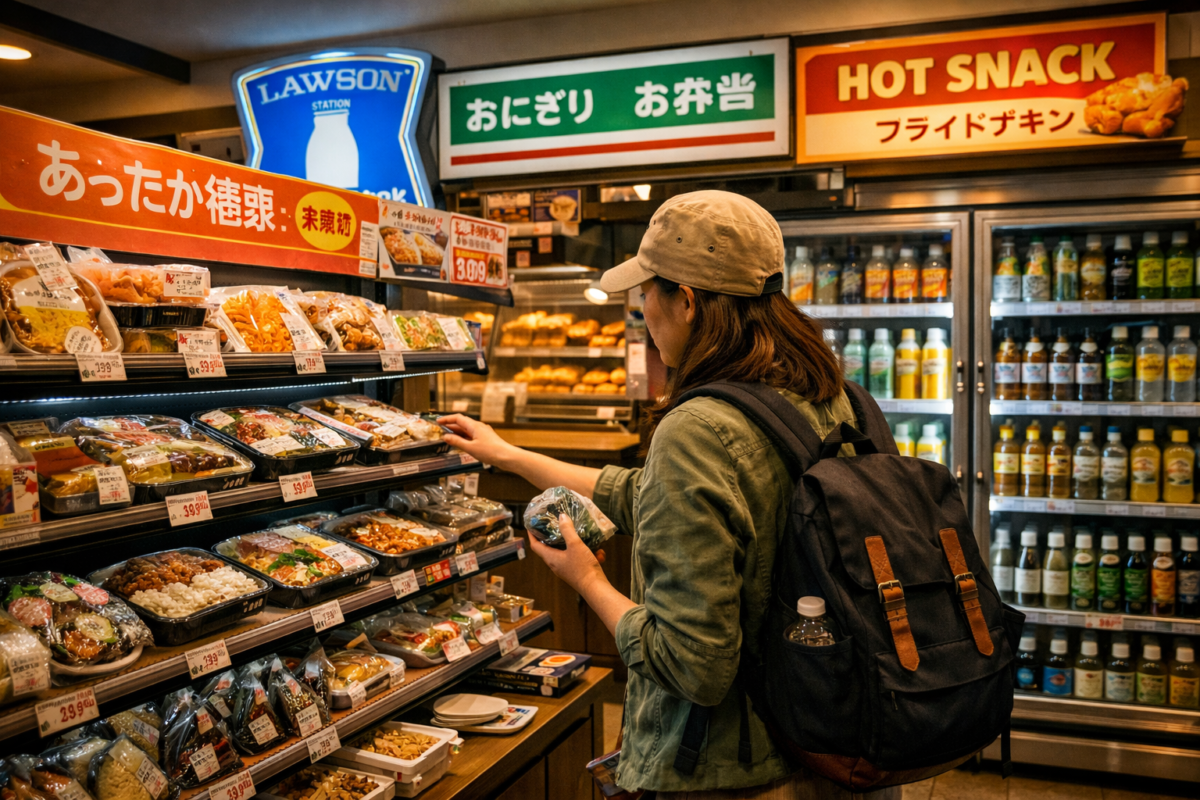
Japanese convenience stores – 7-Eleven, FamilyMart, Lawson – are unlike any convenience store you’ve encountered elsewhere. They sell freshly prepared onigiri (rice balls with fillings, ¥100-180), hot sandwiches, freshly made bento boxes, steaming nikuman (pork buns), instant ramen you can prepare right there, and a rotating selection of seasonal items developed by actual food teams.
A satisfying, genuinely good convenience store meal costs ¥500–800 ($3.30-5.30). This is not a compromise. Many experienced Japan travelers eat konbini (convenience store) breakfast and lunch as a matter of preference, not budget necessity.
Gyudon, Ramen, and Teishoku: The Under-$8 Meal Circuit
- Gyudon chains (Yoshinoya, Sukiya, Matsuya): beef rice bowls from ¥400–700 ($2.70-4.70). Open 24 hours. Everywhere.
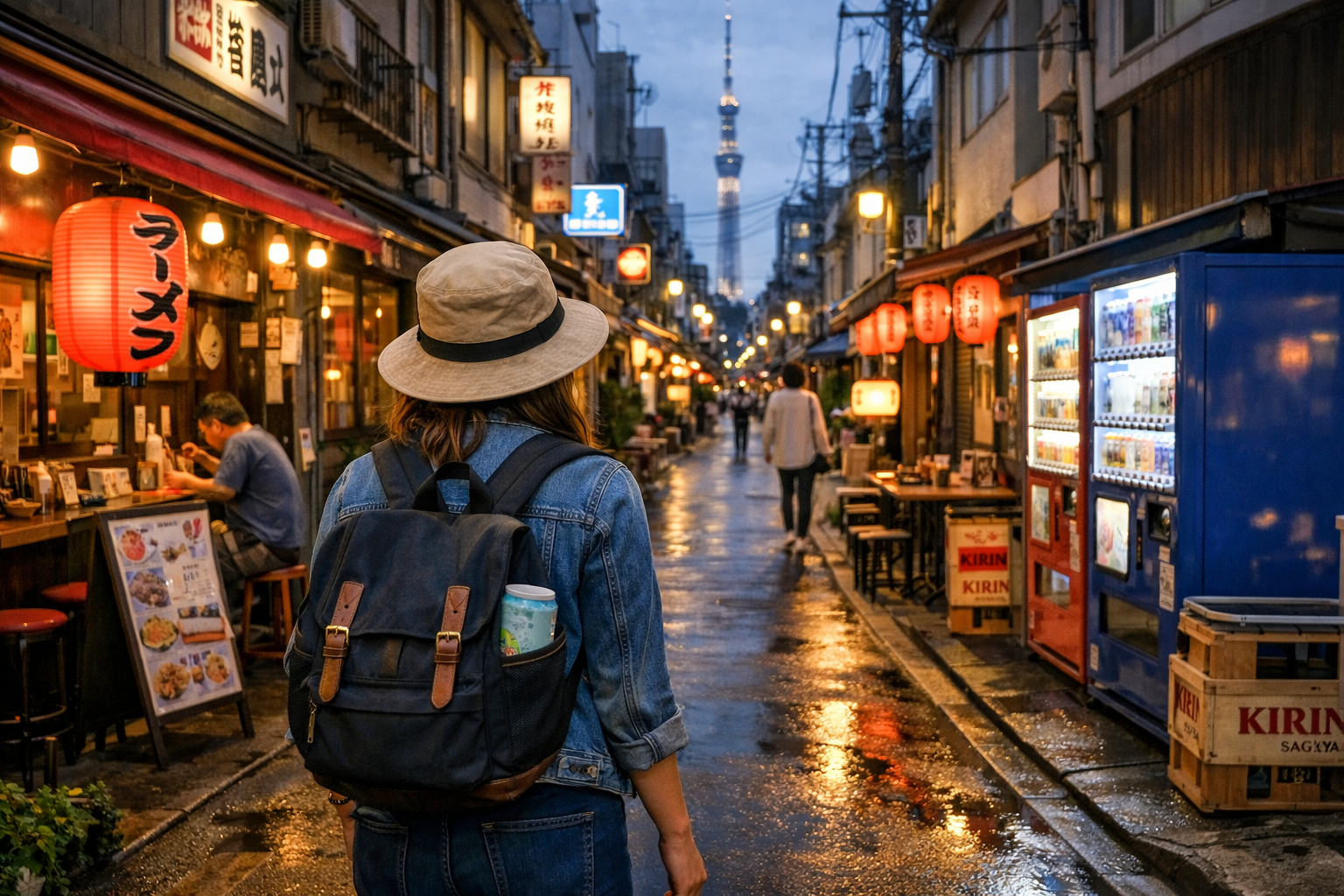
- Ramen shops: a full, deeply satisfying bowl of ramen costs ¥700-1,200 ($4.70-8). Regional varieties (Sapporo miso, Hakata tonkotsu, Tokyo shoyu) are among Japan’s great food experiences and accessible to any budget.
- Teishoku (set meal) lunch: many sit-down restaurants offer a fixed lunch menu – a main dish, rice, miso soup, and pickles – for ¥800-1,200 ($5.30-8). The same restaurant’s dinner menu costs 2-3x as much. Eat your main meal at lunch.
- Standing sushi bars (kaiten-zushi and tachigui-zushi): conveyor belt sushi plates start from ¥100-130 per plate ($0.67-0.87). A full satisfying meal: 8-12 plates, ¥800-1,500 ($5.30-10).
- Depachika basement food halls: major department store basements sell premium Japanese food at slightly-reduced end-of-day prices. Arrive 30 minutes before closing for significant discounts on bento boxes, sushi, and prepared dishes.
The Golden Rule: Eat Lunch at Restaurants, Buy Dinner at Konbini
The single most effective food budget strategy in Japan: exploit the lunch discount culture (restaurants compete aggressively on lunch pricing), then eat a konbini dinner that costs ¥600-900 while watching the sunset from a park or riverside. Total daily food cost: ¥1,500-2,500 ($10-17). Remarkable food. Minimal cost.
Getting Around Japan Without Breaking the Bank
Transport is Japan’s other great perceived expense – and the one most misunderstood by first-time visitors. The Shinkansen (bullet train) is expensive. But Japan has a deep network of affordable alternatives that smart travelers use consistently.
The IC Card: Your Most Important Japan Travel Tool
Before anything else, buy a Suica, ICOCA, or Pasmo IC card at any major train station. This rechargeable card works on virtually every train, subway, and bus in Japan, and at many convenience stores and vending machines. It automatically finds the cheapest fare between any two points and eliminates the complexity of buying individual tickets. Deposit: ¥500. Top up as needed.
Is the JR Pass Worth It for Budget Travelers?
The JR Pass – an unlimited Shinkansen and JR train pass for foreign visitors – has become more expensive in recent years. In 2025, the 7-day pass costs around ¥50,000 ($330). Whether it’s worth it depends entirely on your itinerary.
- If you’re doing a Tokyo-Kyoto–Osaka-Hiroshima loop in 7 days: the JR Pass pays for itself and more.
- If you’re spending most of your time in one or two cities: skip the JR Pass and buy individual tickets.
- Always calculate your planned journeys before buying. The official JR fare calculator makes this easy.
Budget Alternatives to the Shinkansen
- Highway buses: overnight highway buses from Tokyo to Osaka or Kyoto cost ¥3,000-6,000 ($20-40) versus ¥13,000+ for the Shinkansen. WIller Express, JR Bus, and Meitetsu Bus are popular carriers.
- Local JR trains: slower, but a fraction of Shinkansen cost. The scenic Kosei Line around Lake Biwa costs pennies. The Sanin Coast line is one of the world’s great train journeys at local train prices.
- Domestic budget airlines: Peach, Jetstar Japan, and Zipair connect major Japanese cities. A Sapporo-Tokyo flight can be cheaper than the Shinkansen when booked ahead on Aviasales.
Airport Transfers at Honest Prices
For a fixed-price, stress-free airport transfer on arrival, pre-book through GetTransfer – especially useful for late-night arrivals when navigating train options alone is daunting.
Free and Nearly-Free Japan: What No One Tells You
Here’s the Japan secret that changes every budget calculation: some of the country’s most extraordinary experiences cost absolutely nothing.
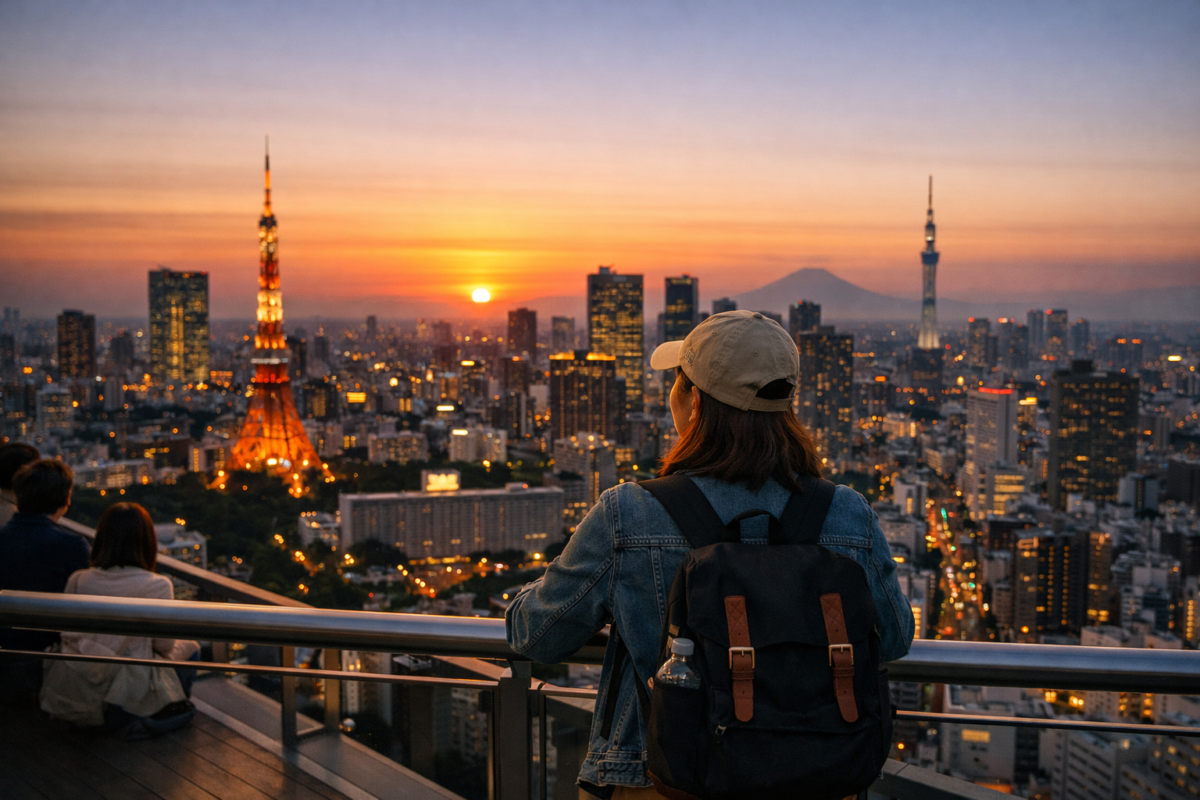
| Tokyo’s Free Skydeck Views The Tokyo Metropolitan Government Building in Shinjuku has two free observation decks on the 45th floor (202m) offering panoramic views over the entire city – including, on clear days, Mount Fuji. Open until 10:30pm. Completely free. Lines move quickly. This rivals – many say exceeds – the ¥2,000+ paid observation decks nearby. |
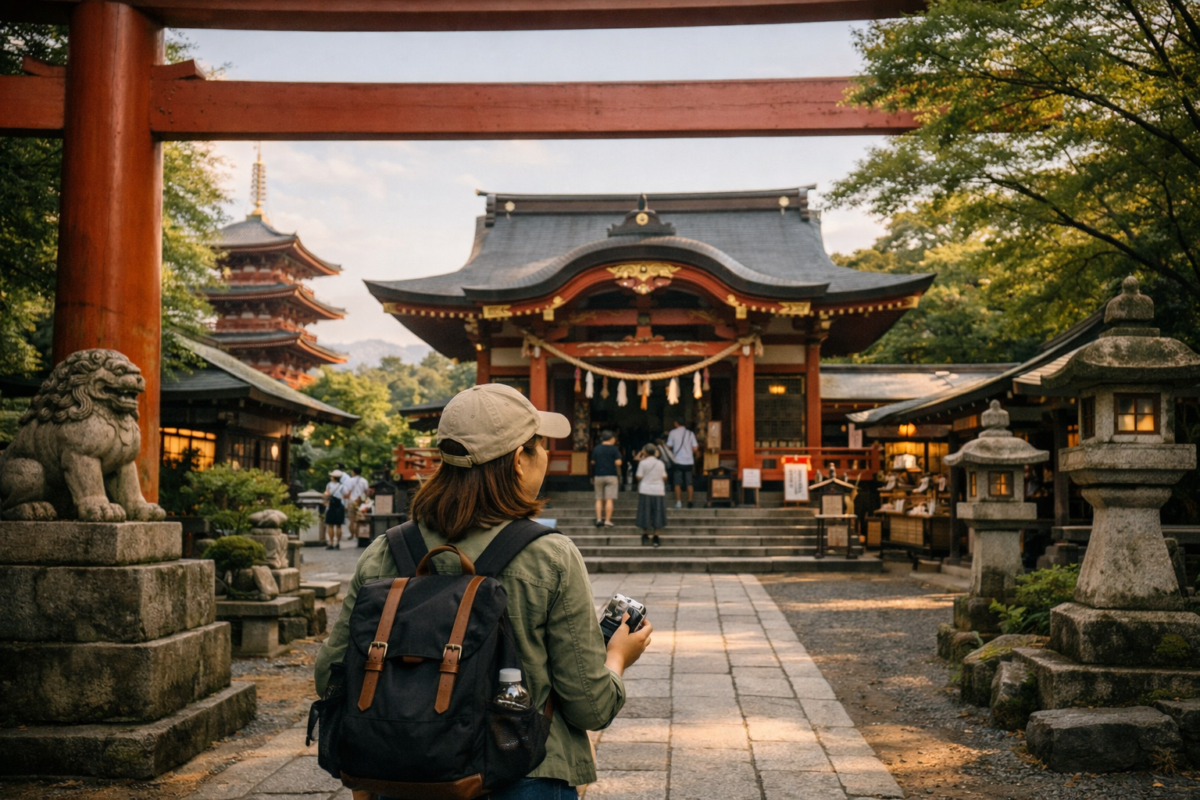
| Shrine and Temple Grounds: Almost Always Free The vast majority of Japan’s iconic shrines and many temples charge nothing for entry to their grounds. Meiji Shrine (Tokyo), Fushimi Inari (Kyoto – famous for thousands of torii gates), Senso-ji (Asakusa, Tokyo), Itsukushima Shrine (Miyajima, accessed by a cheap ferry) – all free or nearly free. Japan’s shrine and temple density means you can fill days of cultural exploration at almost zero cost. |
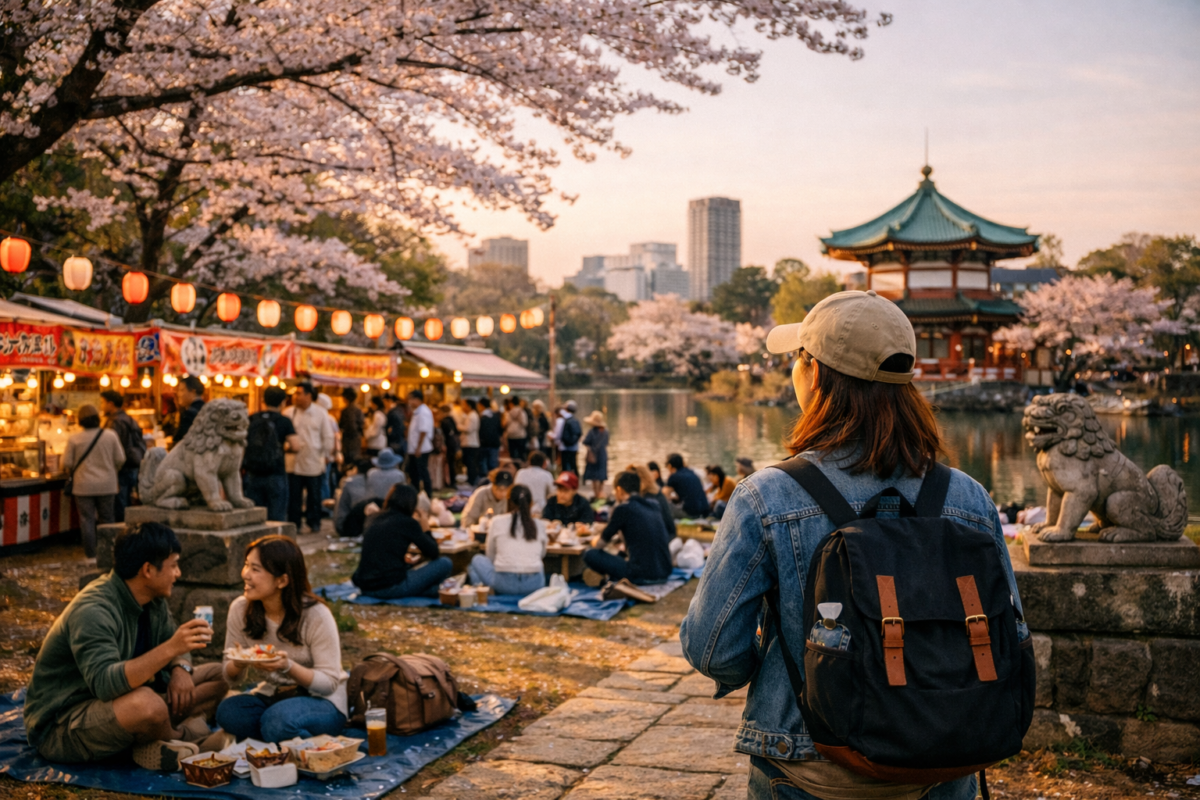
| Parks and Seasonal Events Japan’s seasonal natural events are some of its most celebrated experiences – cherry blossom season (late March-April), autumn foliage (November), hydrangea season (June). Viewing these costs nothing. Every major park, riverbank, and castle grounds puts on a free show. The famous Philosopher’s Path in Kyoto during cherry blossom season requires nothing but your presence. |
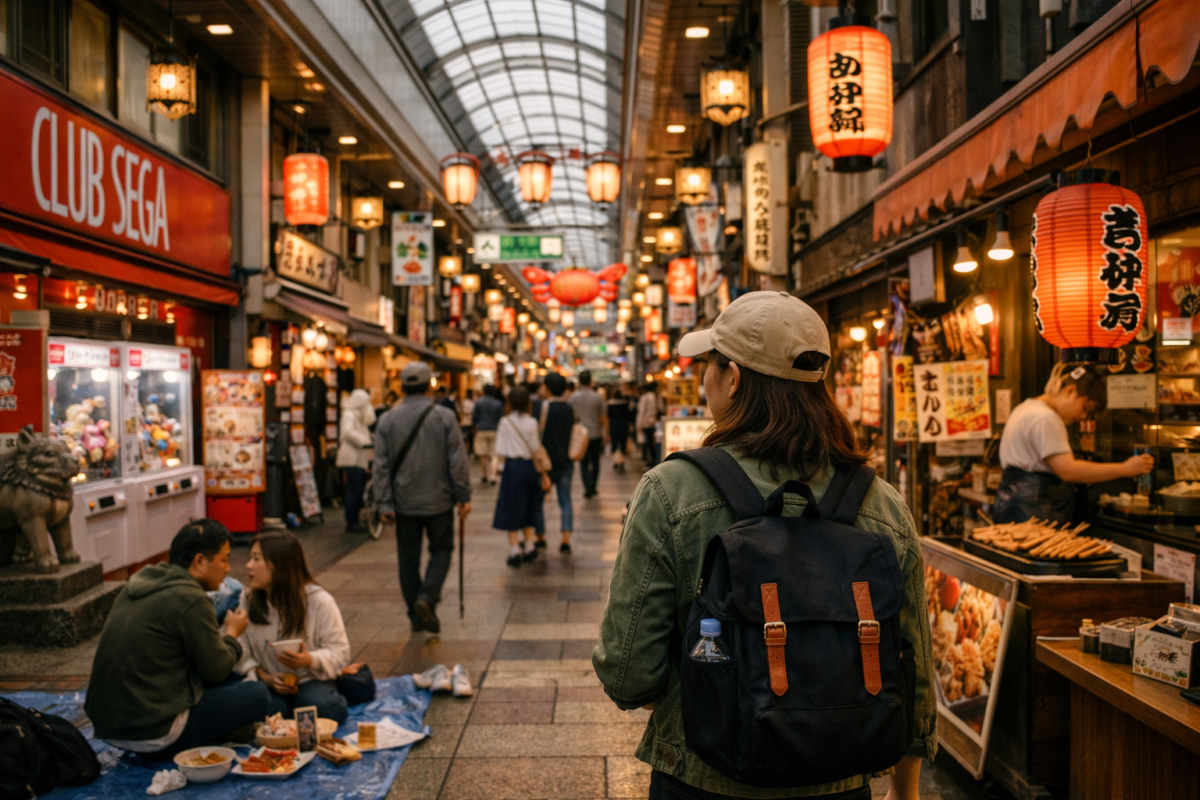
| Arcades, Covered Shopping Streets, and Neighbourhood Wandering Japanese arcades are free to enter and fascinating to explore even if you don’t play. The covered shopping streets (shotengai) of every Japanese city – Shin-Nakamise in Asakusa, Nishiki Market in Kyoto, Kuromon Market in Osaka – are free-to-wander cultural experiences. Getting deliberately lost in a Japanese neighbourhood is one of the great pleasures of travel and costs nothing. |
Sample 10-Day Japan Budget Itinerary
Here is a realistic 10-day itinerary for the classic Japan circuit, optimized for budget travelers.
| Days | Cities | Highlights | Est. Daily Budget |
| Days 1–3 | Tokyo | Shinjuku, Shibuya, Asakusa, teamLab digital art (free alternatives), Harajuku, Akihabara | $55–75 |
| Day 4 | Day trip: Nikko or Kamakura | Giant Buddha (Kamakura, free grounds), UNESCO shrines of Nikko | $35–45 (day trip only) |
| Days 5–6 | Kyoto | Fushimi Inari (free), Philosopher’s Path, Arashiyama Bamboo Grove (free), Nishiki Market | $55–70 |
| Day 7 | Nara | Free-roaming deer, Todai-ji temple, Kasuga Grand Shrine | $40–55 |
| Days 8–9 | Osaka | Dotonbori, Kuromon Market, Osaka Castle grounds (free), street food paradise | $50–65 |
| Day 10 | Hiroshima + Miyajima | Peace Memorial Park (free), Itsukushima Shrine, ferry day trip | $45–60 |
Estimated 10-day total (accommodation + food + transport + activities, excluding international flights): ¥75,000-¥110,000 ($500-$735). Well within a comfortable budget travel range for Japan.
Staying Connected in Japan
Get an eSIM Before You Land
Japanese airport SIM card desks are convenient but expensive. Instead, set up a Japan eSIM through Airalo before departure. Japan plans with 1-3GB of data start from around $5-8 and activate the moment you land. For longer stays or heavier data use, Yesim offers flexible plans with top-up options.
VPN: Essential for Japan
Some streaming content and certain websites are geo-restricted in Japan. A VPN like NordVPN solves this instantly – and protects your banking and personal data on hostel and café Wi-Fi networks. Connect once, stay protected for your entire trip.
Money Tips for Japan
- Japan is still largely cash-based – especially in smaller restaurants, temples, and rural areas. Always carry ¥5,000-10,000 in cash. ATMs at 7-Eleven and Japan Post accept most foreign cards.
- Avoid dynamic currency conversion – always pay in yen. Check the current rate on our Currency Converter before any significant spending.
- Tax-free shopping: foreign visitors can purchase tax-free at participating stores on purchases over ¥5,000. Bring your passport to department stores and electronics shops.
- 100-yen shops: Daiso, Seria, and Can Do sell an extraordinary range of items for ¥100-300. Perfect for toiletries, snacks, and souvenirs without the tourist markup.
Travel Insurance for Japan: Don’t Skip It
Japan has an excellent healthcare system – but it is not free for visitors. A single emergency room visit without insurance can cost ¥30,000-¥200,000+ ($200-1,300+). Comprehensive travel insurance through Ekta Traveling Insurance costs a fraction of that and covers medical emergencies, trip cancellations, lost luggage, and more. Buy it before every Japan trip without exception.
And if your flight is disrupted, remember: AirHelp handles compensation claims for delayed or cancelled flights on eligible routes – on a no-win, no-fee basis.
Plan Your Japan Trip With These Free Tools
Before booking anything, use our AI Travel Budget Estimator to build a personalized day-by-day budget for your Japan itinerary. Pack smart and carry-on-only using our Packing List Generator – avoiding checked baggage fees saves $80-160 on budget carriers. And time your visit for the best weather window with our Weather Checker.
Complete Japan Budget Summary
| Category | Budget Option | Daily / Trip Cost |
| Accommodation | Capsule hotel or hostel dorm | $17–33/night |
| Food | Konbini + gyudon + ramen | $10–17/day |
| City transport | IC card (subway/bus) | $5–10/day |
| Intercity transport | Highway bus (budget alternative) | $20–40 per leg |
| Activities | Shrines (free), 1–2 paid attractions | $5–15/day |
| eSIM data — Airalo | 10-day Japan plan | $8–15 total |
| Travel insurance — Ekta | 10-day comprehensive cover | $25–40 total |
| TOTAL (10 days, excl. flights) | All categories combined | $500–$740 |
Travel Guides & Budget Tips
- Ultimate Budget Travel Tips for Beginners — Learn smart strategies to travel more while spending less
- Cheapest Countries to Visit on a Budget — Explore top low-cost destinations around the world
Frequently Asked Questions (FAQ)
Q.1 How much money do I need per day Budget travel in Japan?
A realistic budget for Japan is ¥9,000-12,000 per day ($60-80), covering hostel/capsule hotel accommodation, convenience store and local restaurant meals, city transport, and one or two paid attractions. With careful planning – eating lunch at restaurants (discounted) and dinner at konbini, staying in dorms, using free shrines and parks -¥7,000-8,000/day ($47-53) is achievable.
Q.2 Is the JR Pass worth buying for a budget Japan trip?
It depends entirely on your itinerary. If you’re doing the classic Tokyo–Kyoto–Osaka route with day trips to Hiroshima and Nara within 7 days, the 7-day JR Pass pays for itself. If you’re spending most of your time in one or two cities and using highway buses for intercity travel, skip it and buy tickets individually.
Q.3 Is Japan safe for budget travelers staying in capsule hotels and hostels?
Japan is one of the world’s safest countries – and budget accommodation is no exception. Capsule hotels and hostels in Japan are clean, well-run, and secure. Lockers are standard. The bigger risk in Japan is petty theft from busy tourist areas, not accommodation. Secure your valuables and enjoy the culture of extraordinary public safety that makes Japan unique.
Q.4 What Is the best time of year to visit Japan on a budget?
January–February and mid-June to mid-July (rainy season) offer the lowest prices and smallest crowds. Cherry blossom season (late March–April) and autumn foliage (November) are peak seasons with higher prices. The shoulder periods around these – early March and December – offer a balance of good conditions and reasonable prices.
Q.5 Can I use credit and debit cards in Japan?
More widely than before, but Japan remains more cash-oriented than most developed countries. Major convenience stores, chain restaurants, train stations, and tourist-facing shops accept international cards. However, smaller local restaurants, temples, some markets, and rural businesses are cash-only. Always carry ¥5,000-10,000 in cash. 7-Eleven ATMs reliably accept foreign cards.
Q.6 Do I need a visa to visit Japan?
Citizens of the USA, UK, Canada, Australia, and most EU countries can visit Japan visa-free for up to 90 days. As of 2025, Japan has implemented a Visit Japan Web pre-registration system for arriving travelers – completing this before arrival speeds up immigration significantly. Always verify current entry requirements before traveling.
Q.7 How do I get affordable data in Japan?
Get a Japan eSIM through Airalo before departure. Plans start from $5-8 for 1-3GB and activate the moment you land. For longer stays or heavier data needs, Yesim offers flexible Japan plans with top-up options. Both are significantly cheaper than airport SIM counters and hotel pocket Wi-Fi rentals.
Japan Is Waiting – And It’s More Affordable Than You Have Been Told
Here’s the truth about budget travel in Japan: the country almost seems designed to reward patient, curious, and resourceful travelers.
The traveler who wanders into a standing ramen bar at 7am will eat one of the best meals of their life for $5. The traveler who walks the Philosopher’s Path in Kyoto at dawn, before the crowds arrive, will experience one of the world’s great moments of beauty for free. The traveler who books a capsule hotel in a converted Showa-era building will sleep in a piece of living history for less than $25.
Japan rewards engagement over expenditure. The more you lean into its culture – the convenience stores, the shrines, the local shotengai, the neighborhood ramen shop where the menu is written in kanji and the owner doesn’t speak English and doesn’t need to – the richer and cheaper your trip becomes.
Go. Eat everything. Bow to everyone. Get lost on purpose. Come home changed.
Start your Japan trip with our free AI Travel Budget Estimator. Browse more budget destination guides at Hidden Travels Destination Guides. And find more budget travel inspiration at the Hidden Travels Budget Hub.
© Hidden Travels — hiddentravels.site
Inspiring Travelers. Sharing Hidden Stories. One Adventure at a Time.